Scientists develop method to track immune system enzyme in live animals
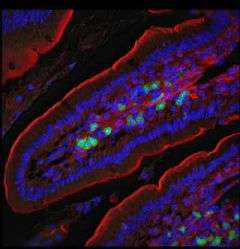
May 17, 2007 Mouse Plasma Cells are Tagged with Yellow Fluorescent Protein

In this picture of intestinal villi from one of the new mouse strains, plasma cells are tagged with yellow (green-appearing) fluorescent protein. Credit: National Institute of Arthritis and Musculoskeletal and Skin Diseases

Scientists supported by the National Institute of Arthritis and Musculoskeletal and Skin Diseases (NIAMS) at the National Institutes of Health have created two mouse strains that will permit researchers to trace, in a live animal, the activity of an enzyme believed to play a crucial role both in the normal immune response as well as autoimmunity and B cell tumor development. Their report appears in the Journal of Experimental Medicine.

The enzyme, known as activation-induced cytidine deaminase or AID (which has no relation to the AIDS virus), is expressed by B cells, which are produced in the bone marrow and are responsible for making antibodies that attack foreign invaders such as viruses and bacteria. The enzyme enables the cells to respond with precision to the almost limitless types of invaders the body may encounter. Unfortunately, it also has a down side.

B cells constantly scan the body for foreign invaders, explains Rafael Casellas, Ph.D., an investigator in NIAMS’ Molecular Immunology and Inflammation Branch and lead author of the paper. As B cells encounter foreign antigens from viruses, bacteria or allergens, they migrate to germinal centers — specialized microenvironments in tonsils, spleen and lymph nodes. Within germinal centers, B cells divide extensively and express the AID enzyme, which causes random mutations and recombination in the cells’ immunoglobulin (antibody) genes. For the most part, these genetic changes are beneficial because they enable B lymphocytes to attack and stop the invader. In some cases, however, AID-dependent alterations in the genetic material of B cells can also lead to unwanted results such as autoimmunity and development of B cell tumors, as in the case of Burkitt lymphoma.

"It becomes crucial that we comprehend how AID is regulated during the normal immune response as well as in tumorigenesis and autoimmunity," says Casellas. The problem with understanding how AID is regulated or deregulated is that there has not been an easy way to visualize the enzyme’s action in a living animal — until now.

To address this issue, Dr. Casellas and his colleagues created transgenic mice that had a green fluorescent protein derived from jellyfish fused to the AID enzyme. In these transgenic animals, B cells express the tagged enzyme during the immune response. In a second mouse strain, Casellas and coworkers expressed permanently a yellow fluorescent protein in the progeny of germinal center B cells. "Thanks to these new mouse models, we can track in live animals whenever the AID enzyme is active as well as the result of that activity," says Casellas. Scientists can also cross these new mouse strains with mice predisposed to B-cell tumors or autoimmunity to see differences in enzyme expression in health and disease.

Source: National Institute of Arthritis and Musculoskeletal and Skin Diseases


print this article email this article download pdf blog this article bookmark this article     Stumble it Digg this share on Facebook retweet share on Reddit add to delicious
Rate this story - 5 /5 (1 vote)


May 17, 2007 all stories

Comments: 0

5 /5 (1 vote)
  • Stumble this up

  • Digg this

  • share this

  • hide
  • Related Stories

  • Pathogen protection and virulence: Dark side of fungal membrane protein revealed
    created Nov 06, 2009 | popularity not rated yet | comments 0
  • Hitting cancer where it hurts
    created May 28, 2009 | popularity not rated yet | comments 0
  • New drug agent knocks out multiple enzymes in cancer pathway
    created Mar 25, 2009 | popularity not rated yet | comments 0
  • Groundbreaking study on complex movements of enzymes
    created Feb 11, 2009 | popularity not rated yet | comments 0
  • An enzyme that mutates antibodies also targets a cancer-causing oncogene
    created Dec 11, 2008 | popularity not rated yet | comments 0


  • hide
  • Relevant PhysicsForums posts

  • Improving the brain through chemistry
    created Nov 07, 2009
  • Sleep / REM Sleep and homeostasis
    created Nov 07, 2009
  • The Biceps Reflex
    created Nov 05, 2009
  • Consequenses of striking a Vein and an artery?
    created Nov 05, 2009
  • More from Physics Forums - Medical Sciences

Other News

Hundreds of genes distinguish patients likely to survive advanced melanoma

Medicine & Health / Cancer

created 50 minutes ago | popularity not rated yet | comments 0

Although the chances of surviving advanced melanoma aren't very good with current therapies, some patients can live for years with cancer that has spread beyond the skin to other organs. Now it may be possible to identify ...


Mood improves on low-fat, but not low-carb, diet plan

Medicine & Health / Health

created 40 minutes ago | popularity not rated yet | comments 0

After one year, a low-calorie, low-fat diet appears more beneficial to dieters' mood than a low-carbohydrate plan with the same number of calories, according to a report in the November 9 issue of Archives of Internal Me ...


Amyloid beta protein gets bum rap

Medicine & Health / Research

created 30 minutes ago | popularity not rated yet | comments 0

While too much amyloid beta protein in the brain is linked to the development of Alzheimer's disease, not enough of the protein in healthy brains can cause learning problems and forgetfulness, Saint Louis University scientists ...


Scanning invisible damage of PTSD, brain blasts

Medicine & Health / Research

created 1hour ago | popularity not rated yet | comments 0

(AP) -- Powerful scans are letting doctors watch just how the brain changes in veterans with post-traumatic stress disorder and concussion-like brain injuries - signature damage of the Iraq and Afghanistan wars.


Back pain permanently sidelines soldiers at war

Medicine & Health / Diseases

created 50 minutes ago | popularity not rated yet | comments 0

Military personnel evacuated out of Iraq and Afghanistan because of back pain are unlikely to return to the line of duty regardless of the treatment they receive, according to research led by a Johns Hopkins pain management ...