Anti-adhesive layers leave no hope for insects
January 13, 2006 The pitfall trap of the pitcher plant Nepenthes alata

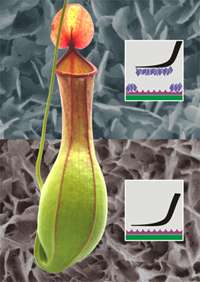
The pitfall trap of the pitcher plant Nepenthes alata. Background: the image from a scanning electron microscope of the upper and lower wax layers. The diagrams show how the two wax layers reduce the adhesive ability of insects. The upper layer contaminates the insects' adhesive pads, whereas the lower layer decreases the amount of contact between the adhesive hairs of the foot and the substrate. Image: Max Planck Institute for Metals Research

Plants are able, using organic substances, to achieve effects that we otherwise mostly know only from technical materials. One example of this is the carnivorous pitcher plant, as researchers from the Max Planck Institute for Metals Research and the University of Hohenheim have shown.

These plants catch insects and hold them using traps with a double layer of crystalline wax. The upper layer has crystalloids which contaminate the attachment organs that insects use to adhere themselves to surfaces. The lower layer additionally reduces the contact area between the insect feet and plant surface. The insects thus slip into the pitcher-shaped traps, where they are digested. These results provide ideas for further developments of technological anti-adhesive surfaces.

One highly specialised ecological group of plants is carnivores - meat-eaters. In order to obtain nutrients such as nitrogen and phosphorous, which may be lacking in the soil, carnivorous plants catch and digest small animals, primarily insects. These plants have evolved particular organs to catch their prey. Different types of carnivores bear traps with different morphologies and catch-mechanisms.

The pitfall trap of the tropical pitcher plant Nepenthes belongs to the group with passive traps. In this group, the plant does not move in order to catch animals. Although the origins of the pitchers lie in leaf organs, the structures that originate from the leaves are not leaf-like. Nepenthes pitchers are organised in a complex way, with a lid, a peristome (a ring around the pitcher's entrance), and slippery and digestive zones, the latter containing a supply of digestive fluid. These pitchers draw in insects, hold them, and finally digest them.

The slippery zone is very important to successful trappings. It is covered by a layer of crystalline wax on which insects lose their footing and slide down into the digestive fluid. Until now, studies have focused either on the wax structure or the behaviour of insects in the trap.

The Stuttgart researchers have investigated the micromorphology, chemical composition, and mechanical characteristics of the wax and combined them with experiments concerning insect behaviour. The wax cover is made of two layers that are different in structure, chemical composition, hardness, and elasticity. The wax layers reduce the adhesive ability of insects in two very different ways.

The top layer is made of single, irregular, 30-50 nanometre thick platelets standing more or less perpendicular to the surface of the pitcher's wall. They are of somewhat random orientation without a clear pattern. The platelets bear a small "stalk" connected to the lower layer of wax.

The lower layer is similar to foam. It is made of connected membrane-like platelets, which stick out from the surface at sharp angles and do not show any clear orientation. The hardness and elasticity of both layers are different by more than an order of magnitude; the upper wax layer is much softer and more elastic than the lower one.

Laboratory experiments with lady-bird beetles Adalia bipunctata showed that the wax layers - compared to glass or de-waxed pitcher walls - significantly reduce the adhesive ability of the insects. The upper layer contaminates the insects' feet and makes them less adhesive. The lower layer reduces the contact area between the feet and the trap.

Source: Max-Planck-Gesellschaft


print this article email this article download pdf blog this article bookmark this article     Stumble it Digg this share on Facebook retweet share on Reddit add to delicious
Rate this story - 4.7 /5 (15 votes)


January 13, 2006 all stories

Comments: 0

4.7 /5 (15 votes)
  • Stumble this up

  • Digg this

  • share this

  • hide
  • Related Stories

  • How the 100th protein structure solved at Diamond impacts our understanding of how insects smell
    created Sep 29, 2009 | popularity not rated yet | comments 0
  • Bees Throw Out Mites
    created Sep 11, 2009 | popularity not rated yet | comments 0
  • Environmental effects of cold-climate strawberry farming
    created Sep 05, 2009 | popularity not rated yet | comments 0
  • Why are autumn leaves red in America and yellow in Europe?
    created Aug 13, 2009 | popularity not rated yet | comments 0
  • Researchers to study rebirth of an island after volcanic eruption
    created Aug 06, 2009 | popularity not rated yet | comments 0


Other News

Climate change could boost incidence of civil war in Africa

Other Sciences / Social Sciences

created 16 hours ago | popularity 2.2 / 5 (13) | comments 5

Climate change could increase the likelihood of civil war in sub-Saharan Africa by over 50 percent within the next two decades, according to a new study led by a team of researchers at University of California, Berkeley, ...


As robots become more common, Stanford experts consider the legal challenges

Other Sciences / Social Sciences

created 14 hours ago | popularity 4.7 / 5 (3) | comments 0

(PhysOrg.com) -- They already detect and defuse bombs, control traffic patterns and do some basic household chores. And scientists predict that pretty soon, robots will be using artificial intelligence to play a larger role ...


Do kids benefit from homework?

Do kids benefit from homework?

Other Sciences / Social Sciences

created 11 hours ago | popularity not rated yet | comments 3

(PhysOrg.com) -- Homework is as old as school itself. Yet the practice is controversial as people debate the benefits or consider the shortcomings and hassles. Research into the topic is often contradictory ...


The cause behind the characteristic shape of a long leaf revealed

The cause behind the characteristic shape of a long leaf revealed

Other Sciences / Mathematics

created 16 hours ago | popularity 5 / 5 (2) | comments 0

Applied mathematicians dissected the morphology of the plantain lily (Hosta lancifolia), a characteristic long leaf with a saddle-like arc midsection and closely packed ripples along the edges. The simple ...


5-day delivery no sure cure for postal woes, economist says

Other Sciences / Economics

created 12 hours ago | popularity 2 / 5 (1) | comments 0

Scaling back mail delivery from six days a week to five may be the best bet to stem mounting U.S. Postal Service losses, but could still be a gamble, says a University of Illinois economist who has studied the agency's persistent ...