Researchers find new source of coherent light
January 13, 2006 Researchers find new source of coherent light

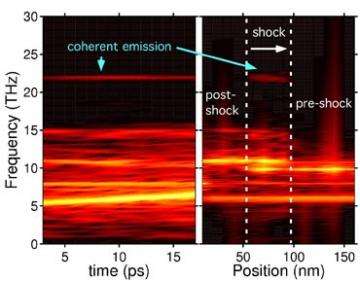
Livermore researchers find new source of coherent light. This figure shows the emission of coherent light at 22 THz from a molecular dynamics simulation of shocked NaCl (table salt). The left panel shows the emission of the light as a function of time while the shock is propagating. The right panel shows the generated radiation as a function of location within the shocked crystal indicating the 22 THz coherent signal is generated at the shock front (between the white dotted lines).

With the exception of lasers and free-electron lasers, there hasn't been another fundamental way to produce coherent light for close to 50 years. However, a group of researchers from Lawrence Livermore National Laboratory and the Massachusetts Institute of Technology have found a new source of coherent optical radiation that is distinct from lasers and free-electron lasers.

Applications from this research are numerous, but the most immediate result may be a new diagnostic tool to determine the properties of shock waves, said Evan Reed, an E.O. Lawrence postdoctoral fellow at Lawrence Livermore and lead author of a paper that appears in the Jan. 13 edition of Physical Review Letters.

Through a series of theoretical calculations and experimental simulations, scientists generated a mechanical shock wave inside a dielectric crystalline material, in this case kitchen salt (NaCl). One might expect to see only incoherent photons and sparks from the shocked crystal.

But what they found was so much more. Weak yet measurable coherent light was seen emerging from the crystal. The emission frequencies are determined by the shock speed and the lattice make-up of the crystal.

The team found that measurable coherent light can be observed emerging from the crystal in the range of 1 to 100 terahertz (THz).

"To our knowledge, coherent light never has been seen before from shock waves propagating through crystals because a shocked crystal is not an obvious source to look for coherent radiation," Reed said. "The light and radiation was in a portion of the electromagnetic spectrum that is not usually observed in these types of experiments."

Coherent light is very narrow bandwidth radiation; it is useful for interferometry (the measurement of two or more waves coming together at the same time and place, such as optical and shock waves) and is usually associated with lasers.

The invention of the laser in 1958 as a source of coherent light enabled a wide range of applications including medical technologies and energy production because of the coherence of the light they generate. However, producing coherent light from a source other than a laser can serve as a diagnostic for understanding shock waves, specifically providing information about shock speed and the degree of crystallinity, Reed said.

In the computational experiments, the researchers observed the light generated by a shocked polarized material by performing molecular dynamics simulations of shock waves propagating through crystalline NaCl. The simulations solved the classical equations of motion for atoms that are subject to interaction, thermal effects and deformation of the crystal lattice. The intensive computer simulations were made possible by utilizing LLNL's Thunder parallel computer.

Source: Lawrence Livermore National Laboratory


Rate this story - 4.4 /5 (51 votes)


January 13, 2006 all stories

Comments: 0

4.4 /5 (51 votes)

  • hide
  • Related Stories

  • Crashing the size barrier
    created Nov 18, 2009 | popularity not rated yet | comments 0
  • X-ray blaze on an invisible world
    created Apr 06, 2005 | popularity not rated yet | comments 0
  • Expert: Aging boomers may increase care burden on families
    created Jan 14, 2010 | popularity not rated yet | comments 0
  • New tidal streams found in Andromeda reveal history of galactic mergers
    created Jan 07, 2010 | popularity not rated yet | comments 0
  • Accelerators and Light Sources of Tomorrow (Part 1: From Linacs to Lasers)
    created Dec 22, 2009 | popularity not rated yet | comments 0


Other News

Extra large carbon

Extra large carbon

Physics / General Physics

created 15 hours ago | popularity 4.7 / 5 (12) | comments 7 | with audio podcast

An exotic form of carbon has been found to have an extra large nucleus, dwarfing even the nuclei of much heavier elements like copper and zinc, in experiments performed in a particle accelerator in Japan. ...


Scientist explore future of high-energy physics

Scientist explore future of high-energy physics

Physics / General Physics

created 21 hours ago | popularity 4.9 / 5 (12) | comments 8 | with audio podcast

In a 1954 speech to the American Physical Society, the University of Chicago's Enrico Fermi fancifully envisioned a particle accelerator that encircled the globe. Such would be the ultimate theoretical outcome, ...


Leaf veins inspire a new model for distribution networks (w/ Video)

Physics / General Physics

created 18 hours ago | popularity 5 / 5 (3) | comments 0 | with audio podcast

(PhysOrg.com) -- Following the straight and narrow may be good moral advice, but it’s not a great design principle for a distribution network. In new research, a team of biophysicists describe a complex netting of interconnected ...


New magnetic tuning method enhances data storage

New magnetic tuning method enhances data storage

Physics / General Physics

created 21 hours ago | popularity 4.2 / 5 (5) | comments 0 | with audio podcast

Researchers in Chicago and London have developed a method for controlling the properties of magnets that could be used to improve the storage capacity of next-generation computer hard drives.


High-performance microring resonator developed by INRS researchers

Physics / Optics & Photonics

created 13 hours ago | popularity 1.5 / 5 (2) | comments 0

A new, more efficient low-cost microring resonator for high speed telecommunications systems has been developed and tested by Professor Roberto Morandotti's INRS team in collaboration with Canadian, American, and Australian ...