Oceanic Storms Create Oases in the Watery Desert
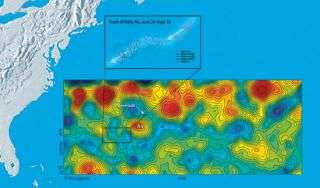
For two decades, scientists have puzzled over why vast blooms of microscopic plant life grow in the middle of otherwise barren mid-ocean regions. Now a research team led by the Woods Hole Oceanographic Institution (WHOI) has shown that episodic, swirling current systems known as eddies act to pump nutrients up from the deep ocean to fuel such blooms.
Dennis McGillicuddy, a WHOI oceanographer and leader of the Eddies Dynamics, Mixing, Export, and Species composition (EDDIES) project, found that ocean productivity was surprisingly high when stirred by certain types of mid-ocean eddies. These huge parcels of water were teeming with diatoms (a type of phytoplankton) in concentrations 10,000 to 100,000 times the norm—among the highest ever observed in the Sargasso Sea.
“Past research has shown that the open ocean is far more productive than we could explain based on what we knew about nutrients in surface water,” said McGillicuddy. “Scientists have been trying to figure out where the nutrients come from to make these oases in the oceanic desert, and some of us hypothesized that eddies were part of the answer. The EDDIES project has validated that suspicion.”
McGillicuddy and colleagues published their work in the May 18 issue of the journal Science. The work was primarily funded by the National Science Foundation, while leveraging a strategic partnership with NASA for satellite measurements to guide the shipboard sampling.
The Sargasso Sea, like other mid-ocean regions of the world, is warmer, saltier, bluer, and clearer than most other parts of the North Atlantic. The prevailing oceanographic wisdom has suggested that such open waters were mostly desert-like, unproductive regions populated by smaller plant species. Yet observations showed oxygen and other biologically important elements being consumed at a higher rate than the theories and models could account for. There had to be some natural nutrient source.
Now, McGillicuddy and colleagues have found that eddy-driven nutrient transport actually primes the ocean’s “biological pump,” fertilizing the waters with nutrients from the deep. Fed by this unusual upwelling, the phytoplankton population explodes and, in turn, attracts more zooplankton and other animals higher up the food chain. The fate of all of that biomass is also important, as plankton blooms can remove substantial amounts of carbon dioxide from surface waters and sink it to the deep ocean.
The research team included chemists, biologists, and physical oceanographers from WHOI, the Bermuda Institute of Ocean Sciences (BIOS), Rutgers University, the University of Southampton (UK), the University of California-Santa Barbara, the Virginia Institute of Marine Sciences, Humboldt State University, and the University of Miami. The report by McGillicuddy et al. was published along with another article by Benitez-Nelson et al. about the roles that eddies play in marine production.
“Eddies are the internal weather of the sea,” said McGillicuddy, “the oceanic equivalent of storms in the atmosphere.” The largest eddies can contain up to 1,200 cubic miles (5,000 cubic kilometers) of water and can last for months to a year. These distinct parcels of water are formed by differences in ocean temperature and salinity that give water different densities. On a rotating planet, these different water masses tend to dance around one another rather than mix.
The density inside an eddy can be higher or lower than the surrounding water, like high and low-pressure systems in the atmosphere. The balance between pressure differences and earth’s rotation (the Coriolis force) gives eddy currents their distinctive clockwise or counterclockwise spin. The direction of the spin depends on whether the eddy contains a cooler or a warmer core.
Working from a long-debated but mostly untested hypothesis, EDDIES investigators measured how these swirling currents can perturb the layers of the ocean and cause an upwelling of nutrient-rich water into the sunlit “euphotic” zone—the top 330 feet (100 meters) that light penetrates.
In nearly six months of ship-based work in the summers of 2004 and 2005, researchers employed a combination of remote sensing, video plankton recorders, ocean drifters, tracers, and traditional measurements of water properties and current speeds. They started with NASA satellite measurements of sea surface height to locate eddies in the Sargasso Sea, south and east of the Gulf Stream in the North Atlantic. The 18-member research team then sailed into those eddies with the research vessels Oceanus (operated by WHOI) and Weatherbird II (operated by BIOS).
In addition to proving the connection between eddies and mid-ocean plankton blooms, the researchers discovered that winds can act to dampen or amplify the effects. Biological activity was most prodigious in mode-water eddies, in which wind-driven currents interact with the clockwise spin of the eddy to enhance upwelling of nutrients. Cyclonic eddies also stir up plankton growth, but the process is tempered by the eddy-wind interaction that tends to cause downwelling in the centers of counter-clockwise spinning eddies.
The Woods Hole Oceanographic Institution is a private, independent organization in Falmouth, Mass., dedicated to marine research, engineering, and higher education. Established in 1930 on a recommendation from the National Academy of Sciences, its primary mission is to understand the oceans and their interaction with the Earth as a whole, and to communicate a basic understanding of the ocean's role in the changing global environment.
Source: Woods Hole Oceanographic Institution


