Handheld device 'sees' damage in concrete bridges, piers
May 21st, 2007 Handheld device 'sees' damage in concrete bridges, piers

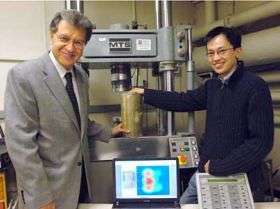
Professor Oral Buyukozturk of civil and environmental engineering, left, and student Tzu-Yang Yu in the lab with a concrete sample and an image (on the laptop screen) produced with the noninvasive damage-assessing technology they developed. Photo / Donna Coveney

Engineers at MIT have developed a new technique for detecting damage in concrete bridges and piers that could increase the safety of aging infrastructure by allowing easier, more frequent, onsite inspections that don't interfere with traffic or service.

The technique involves use of a hand-held radar device that can "see" through the fiberglass-polymer wrapping often used to strengthen aging concrete columns to detect damage behind the wrapping not visible to the naked eye. Such damage can occur on the concrete itself, or to areas where layers of the wrapping have come loose from one another or even debonded from the concrete.

The new noninvasive technique can be used onsite from a distance of more than 10 meters (30 feet) and requires no dismantling or obstruction of the infrastructure. It provides immediate, onsite feedback.

Called FAR-NDT (far-field airborne radar nondestructive testing), the technique could prove especially advantageous for bridges that span rivers or highways, which can prove inaccessible for other inspection techniques. The MIT researchers first reported the technique in the proceedings of the International Conference on Structural Faults and Repair held in Edinburgh, Scotland, last year.

"The use of radar for detecting hidden defects and deterioration behind covered surfaces offers great potential for wide-range use in assessing the safety of bridges and buildings that have been retrofitted with composite materials," said Professor Oral Buyukozturk of the Department of Civil and Environmental Engineering (CEE), who developed the technique with CEE graduate student Tzu-Yang Yu and Dennis Blejer of MIT Lincoln Laboratory, where prototype radar measurements were made.

Fiberglass-polymer jacketing--shiny, textured fabric in black or ivory often seen wrapped around concrete columns--is widely used to upgrade existing concrete structures so they can carry a greater load or sustain additional earthquake impact. The wrap is also commonly used to retrofit structures that are damaged or deteriorating from weather or other wear.

Techniques presently available for inspecting these fiberglass-polymer jacketing systems require the inspector to come in direct or close contact with the structure. Some actually require removal of a physical sample, which itself could create a safety issue. The advantage of the new technique is that it allows a rapid inspection from a distance and provides computerized visualization of the internal damages.

"This technique would allow the engineers to perform reliable, in-situ inspection for visualizing and characterizing hidden damages from distances without having to endanger the structure by taking specimens from it, and at the same time, without disturbing the traffic or service," said Yu, whose Ph.D. thesis will focus on this research. "The project is an excellent example of bridging fundamental science and engineering applications."

The researchers have demonstrated the validity and potential of the new technique through experiments and computer simulations by sending and receiving radar signals using a "horn" antenna to inspect bridge piers from distances of more than 10 meters. In their experiments, a horn antenna transmits a radar signal to a fiber-wrapped concrete specimen, which reflects the signal back to the antenna. The collected data are then converted by an imaging algorithm into a visualization of the interior of the specimen, including any damage.

The researchers say that the concept has been validated by their initial experimental results using an existing prototype radar system and by computer simulations. Future development of appropriate portable radar equipment for onsite use is necessary before the system can be placed in widespread use by industry.

Source: MIT


print this article email this article download pdf blog this article bookmark this article     Digg this Stumble it share on Facebook share on Reddit add to delicious save to Yahoo! bookmarks
5/5 after 6 votes


May 21st, 2007 all stories
Technology / Engineering

Comments: 0
Rank: 5/5 after 6 votes

  • Stumble this up

  • Digg this

  • Share it:
  • share on Facebook
  • share on MySpace
  • share on Slashdot
  • rss-newsfeed
  • share on Google
  • share on Reddit
  • add to delicious
  • save to Yahoo! bookmarks
  • share on Windows Live
  • Add to Mixx!
Rating: 5/5 after 6 votes

  • Related Stories

  • Radiation Review: Some People May be 'Allergic' to Cell Phones, Computers
    created May 15, 2009 | popularity not rated yet | comments 0
  • Large sponges may be reattached to coral reefs
    created Apr 27, 2009 | popularity not rated yet | comments 0
  • Satellites show how Earth moved during Italy quake
    created Apr 15, 2009 | popularity not rated yet | comments 0
  • NASA flies to Greenland to extend polar science
    created Mar 31, 2009 | popularity not rated yet | comments 0
  • Brain surgery on Monday, home on Tuesday
    created Mar 25, 2009 | popularity not rated yet | comments 0

Tags


  • Physicists Demonstrate Quantum Memory with Matter Qubits
    Physicists Demonstrate Quantum Memory with Matter Qubits
    Physics / General Physics
    created Jul 03, 2009 | popularity 4.4 / 5 (17) | comments 1
  • 'Holey' Nanosheets for Wastewater Dye Removal
    Nanotechnology / Nanomaterials
    created Jul 01, 2009 | popularity 5 / 5 (5) | comments 1
  • Jellyfish Robot Swims Like its Biological Counterpart
    Jellyfish Robot Swims Like its Biological Counterpart
    Electronics / Robotics
    created Jun 26, 2009 | popularity 4.4 / 5 (8) | comments 1
  • Could Maxwell's Demon Exist in Nanoscale Systems?
    Could Maxwell's Demon Exist in Nanoscale Systems?
    Physics / General Physics
    created Jun 24, 2009 | popularity 4.4 / 5 (18) | comments 29
  • Living Safely with Robots, Beyond Asimov's Laws
    Living Safely with Robots, Beyond Asimov's Laws
    Electronics / Robotics
    created Jun 22, 2009 | popularity 4.6 / 5 (52) | comments 40
  • Other News

    Japan demands 119 million dlrs in tax from Amazon: report

    Technology / Business

    created 14 hours ago | popularity 3.5 / 5 (4) | comments 0

    Japanese authorities told a sales affiliate of US retail giant Amazon.com to pay about 119 million dollars in tax for unreported income over a three-year period, a newspaper said Sunday.


    Iconic skyscrapers find new luster by going green (AP)

    Iconic skyscrapers find new luster by going green

    Technology / Energy

    created 15 hours ago | popularity 1 / 5 (1) | comments 0

    (AP) -- When owners of the Empire State Building decided to blanket its towering facade this year with thousands of insulating windows, they were only partly interested in saving energy. They also needed ...


    Geeks double as scourges and sages at media summit

    Technology / Business

    created 10 hours ago | popularity not rated yet | comments 0

    (AP) -- The media moguls attending an annual powwow staged by investment bank Allen & Co. used to be able to rest comfortably in the Idaho mountains as they mulled their next moves.


    Downturn dating: Hearts flutter as markets stutter (AP)

    Downturn dating: Hearts flutter as markets stutter

    Technology / Internet

    created 15 hours ago | popularity not rated yet | comments 0

    (AP) -- Credit the recession for "staycations" and bringing us more game-night parties at home. But also give it a shout for spurring more first dates.


    UK spy chief's family details posted on Facebook

    Technology / Internet

    created 15 hours ago | popularity not rated yet | comments 0

    (AP) -- He's the spy who came in from the beach.