Jet lag: It's all about chemical reactions in cells
May 21, 2007 Jet lag: It's all about chemical reactions in cells

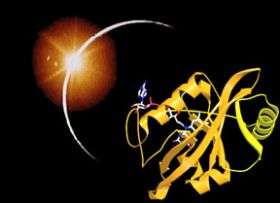
This graphic of the ribbon structure of the vivid protein with a rising sun signifies the circadian clock (24-hour cycle). Credit: Cornell University

Circadian clocks regulate the timing of biological functions in almost all higher organisms. Anyone who has flown through several time zones knows the jet lag that can result when this timing is disrupted.

Now, new research by Cornell and Dartmouth scientists explains the biological mechanism behind how circadian clocks sense light through a process that transfers energy from light to chemical reactions in cells. The research is published in the May 18 issue of the journal Science.

Circadian clocks in cells respond to differences in light between night and day and thereby allow organisms to anticipate changes in the environment by pacing their metabolism to this daily cycle. The clocks play a role in many processes: timing when blooming plants open their petals in the morning and close them at night; or setting when fungi release spores to maximize their reproductive success. In humans, the clocks are responsible for why we get sleepy at night and wake in the morning, and they control many major regulatory functions. Disruptions of circadian rhythms can cause jet lag, mental illness and even some forms of cancer.

"These clocks are highly conserved in all organisms, and in organisms separated by hundreds of millions of years of evolution," said Brian Crane, the paper's senior author and an associate professor in Cornell's Department of Chemistry and Chemical Biology.

The study revealed how a fungus (Neurospora crassa) uses circadian clock light sensors to control production of carotenoids, which protect against damage from the sun's ultraviolet radiation just after sunrise. The researchers studied a protein called vivid, which contains a chromophore -- a light-absorbing molecule. The chromophore captures a photon or particle of light, and the captured energy from the light triggers a series of interactions that ultimately lead to conformational changes on the surface of the vivid protein. These structural changes on the protein's surface kick off a cascade of events that affect the expression of genes, such as those that turn carotenoid production on and off.

By substituting a single atom (sulphur for oxygen) on the surface of the vivid protein, the researchers were able to shut down the chain of events and prevent the structural changes on the protein's surface, thereby disrupting the regulation of carotenoid production.

"We can now show that this conformational change in the protein is directly related to its function in the organism," said Brian Zoltowski, the paper's lead author and a graduate student at Cornell in chemical biology.

The circadian clock allows the fungus to regulate and produce carotenoids only when they are needed for protection against the sun's rays. A similar "switch" may be responsible for timing the sleep cycle in humans.

"We were interested in trying to understand behavior at the molecular level," said Crane. "This a great example of chemical biology, in that we can perturb the chemistry of a single molecule in a particular way and actually change the behavior of a complex organism."

Source: Cornell University


print this article email this article download pdf blog this article bookmark this article     Stumble it Digg this share on Facebook retweet share on Reddit add to delicious
Rate this story - 4 /5 (7 votes)


May 21, 2007 all stories

Comments: 0

4 /5 (7 votes)
  • Stumble this up

  • Digg this

  • share this

  • hide
  • Related Stories

  • Biological clocks of insects could lead to more effective pest control
    created Aug 12, 2009 | popularity not rated yet | comments 0
  • Research reveals how cells tell time
    created Jun 08, 2009 | popularity not rated yet | comments 0
  • PER:PER protein pair required for circadian clock function
    created Apr 29, 2009 | popularity not rated yet | comments 0
  • How your body clock avoids hitting the snooze button
    created Jan 29, 2009 | popularity not rated yet | comments 0
  • Researchers First to 'See' Reactive Oxygen Species in Vital Enzyme
    created Jan 10, 2009 | popularity not rated yet | comments 0


  • hide
  • Relevant PhysicsForums posts

  • Parkinsons like symptoms
    created 3 hours ago
  • Kidneys processing urine
    created 21 hours ago
  • Protein synthesis with learning
    created Dec 25, 2009
  • monovision and 3d movies
    created Dec 25, 2009
  • More from Physics Forums - Medical Sciences

Other News

Splitting fluorescent protein helps image clusters in live cells

Medicine & Health / Research

created 7 hours ago | popularity not rated yet | comments 0

Half a protein is better than none, and in this case, it's way better than a whole one. A Rice University lab has discovered that dividing a particular fluorescent protein and using it as a tag is handy for analyzing the ...


US Senate votes on landmark health bill

Medicine & Health / Health

created Dec 24, 2009 | popularity 2.6 / 5 (5) | comments 3

Senators gave Barack Obama a huge political boost on Thursday by passing a sweeping remake of the US health care system that aims to extend coverage to 31 million uninsured Americans.


'Self-seeding' of cancer cells may play a critical role in tumor progression

Medicine & Health / Cancer

created Dec 24, 2009 | popularity 5 / 5 (3) | comments 0

Cancer progression is commonly thought of as a process involving the growth of a primary tumor followed by metastasis, in which cancer cells leave the primary tumor and spread to distant organs. A new study by researchers ...


New tool in the fight against mosquito-borne disease: A microbial 'mosquito net'

Medicine & Health / Diseases

created Dec 24, 2009 | popularity 4.8 / 5 (4) | comments 0

Earlier this year, researchers showed that they could cut the lives of disease-carrying mosquitoes in half by infecting them with a bacterium they took from fruit flies. Now, a new report in the December 24th issue of Cell, ...


Molecular anchor links the 2 inheritable diseases Fanconi anemia and Bloom's syndrome

Medicine & Health / Genetics

created Dec 24, 2009 | popularity not rated yet | comments 0

A new study establishes a molecular link that bridges two rare inherited disorders and explains why these diseases result in genetic instability. The research, published by Cell Press in the December 24th issue of the journal ...