Wearing Your Wireless
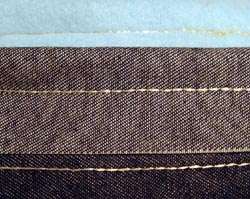
Movies and television have educated us more than we know. Thanks to detective thrillers, we understand about the drama of "wearing a wire." But a NASA-sponsored technology is paving the way for all of us to be "wearing a wireless."
Metal wiring weaves a less-than-perfect web. Copper is the most common electrical conductor, but as with most metals, it can be heavy, expensive, and breakable. In contrast, conductive fibers provide a lightweight, flexible alternative to copper wiring.
Think of conductive fibers as electric yarn where a polymer fiber is given a metallized coating. Multiple fibers are then wrapped together to form light, supple strands that conduct electricity.
While less conductive than copper, these fibers can carry virtually any necessary current. Coupled with lightness and flexibility, this is very useful in space applications where electronics battle small spaces and severe stress. These properties are also ideal for electromagnetic interference (EMI) shielding, aerospace wiring, and other applications that need strong, lightweight conductivity. Conductive fibers can also reduce the cost of metal wiring.
Despite its obvious benefits, this technology hasn't always been readily available because of production challenges. NASA partnerships within the high-tech textile industry have advanced development and manufacturing processes, increasing output while reducing cost.
While they have many uses in the space industry, conductive fibers can also reduce the maintenance cost of commercial planes, military aircraft, and missile guidance wires. On the ground, you might see them in power lines, lightweight deployable antennas, and airbag wiring in cars. Giant-areas of flexible circuits might be used for mass energy harvesting. You could also reach out and touch this technology in the form of a flexible keyboard.
If all of this gives you a chill of anticipation, you can warm up with heated clothing or thermal blankets interwoven with conductive fibers. The electronic textiles (electrotextiles) industry is still in its infancy, but future fabrics will offer protection from the environment while still being soft and comfortable. Intelligent, built-in features -- such as multifunctional sensors and computing devices -- will result in the ultimate smart accessories.
Conductive fibers are already being woven into experimental medical patient apparel such as jackets and vests that transmit vital signs to health care personnel. Military and law enforcement personnel can benefit from uniforms and body armor equipped with built-in sensors and computing devices. This would enhance battlefield monitoring by reporting vital signs and wound locations on soldiers.
Electrotextiles may one day provide a variety of functions ranging from listening to MP3s to controlling temperature. Sometime in the near future, you may see people wearing clothes wired for cell phones, PDAs, gaming devices, and music players. One of those people may be you.
AmberStrand™ is a trademark of Syscom Technology, Inc.
Source: NASA


