Cassini 'CAT Scan' maps clumps in Saturn's rings
May 22, 2007 Cassini 'CAT Scan' maps clumps in Saturn's rings

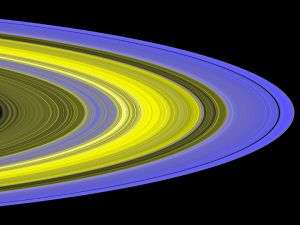
This false-color image of Saturn's main rings was made by combining data from multiple star occultations using the Cassini ultraviolet imaging spectrograph. Image credit: NASA/JPL/University of Colorado

Saturn's largest and most densely packed ring is composed of dense clumps of particles separated by nearly empty gaps, according to new findings from NASA's Cassini spacecraft.

These clumps in Saturn's B ring are neatly organized and constantly colliding, which surprised scientists.

Previous interpretations assumed the ring particles were distributed uniformly and so scientists underestimated the total mass of Saturn's rings. The mass may actually be two or more times previous estimates.

"These results will help us understand the overall question of the age and hence the origin of Saturn's rings," said Josh Colwell, assistant professor of physics at the University of Central Florida and a member of the Cassini ultraviolet imaging spectrograph team publishing its results in the journal Icarus this month.

Principal investigator Larry Esposito at the University of Colorado, Boulder is fascinated with the findings.

"The rings are different from the picture we had in our minds," Esposito said. "We originally thought we would see a uniform cloud of particles. Instead we find that the particles are clumped together with empty spaces in between. If you were flying under Saturn's rings in an airplane, you would see these flashes of sunlight come through the gaps, followed by dark and so forth. This is different from flying under a uniform cloud of particles."

The observations were made using the spectrograph aboard the Cassini spacecraft, which left earth in 1997 on a mission to collect detailed data about Saturn, its rings and moons. Cassini -- the largest interplanetary spacecraft launched from earth -- entered Saturn's orbit in July 2004, and scientists have been using sophisticated equipment on board to view and analyze images.

Boulder and UCF scientists observed the brightness of a star as the rings passed in front of the star on multiple occasions. This provides a measurement of the amount of ring material between the spacecraft and the star.

"Combining many of these occultations at different viewing geometries is like doing a CAT scan of the rings," said Colwell. "By studying the brightness of stars as the rings pass in front of them, we are able to map the ring structure in 3-D and learn more about the shape, spacing and orientation of clusters of particles."

The observations confirm that the gravitational attraction of ring particles to each other creates clumps, or "self-gravity wakes." If the clumps were farther from Saturn, they might continue to grow into a moon. But because these clumps are so close to Saturn, their different speeds around Saturn counteract this gravitational attraction so that the clumps get stretched like taffy and pulled apart. The clumps are constantly forming and coming apart once they get to be about 30 to 50 meters (about 100 to 150 feet) across.

"At any given time, most particles are going to be in one of the clumps, but the particles keep moving from clump to clump as clumps are destroyed and new ones are formed," added Colwell.

Colwell is a professor in UCF's growing program in planetary sciences. He joined the faculty because of the "opportunity to be involved in growing a new planetary sciences program."

Source: University of Central Florida


print this article email this article download pdf blog this article bookmark this article     Stumble it Digg this share on Facebook retweet share on Reddit add to delicious
Rate this story - 4.1 /5 (10 votes)


May 22, 2007 all stories

Comments: 0

4.1 /5 (10 votes)
  • Stumble this up

  • Digg this

  • share this

  • hide
  • Related Stories

  • Cassini Reveals New Ring Quirks, Shadows During Saturn Equinox
    created Sep 21, 2009 | popularity not rated yet | comments 0
  • Saturn's Rings May Be As Old As Solar System
    created Dec 13, 2007 | popularity not rated yet | comments 0
  • New Horizons Spacecraft Sees Changes in Jupiter System
    created Oct 09, 2007 | popularity not rated yet | comments 0
  • In nature, proteins sweep up nanoparticles
    created Jun 15, 2007 | popularity not rated yet | comments 0
  • Pluto-Bound New Horizons Provides New Look at Jupiter System
    created May 01, 2007 | popularity not rated yet | comments 0


  • hide
  • Relevant PhysicsForums posts

  • Question about 2-body gravity
    created Nov 24, 2009
  • life on Mars
    created Nov 24, 2009
  • Semi-major axis from cartesian co-ordinates
    created Nov 23, 2009
  • Primary Mirror grinding
    created Nov 23, 2009
  • More from Physics Forums - General Astronomy

Other News

Monster Waves on the Sun are Real

Monster Waves on the Sun are Real (w/ Video)

Space & Earth / Astronomy

created 10 hours ago | popularity 4.8 / 5 (11) | comments 1

Sometimes you really can believe your eyes. That's what NASA's STEREO (Solar Terrestrial Relations Observatory) spacecraft are telling researchers about a controversial phenomenon on the sun known as the "solar ...


Cosmic 'dig' reveals vestiges of the Milky Way's building blocks

Cosmic 'Dig' Reveals Vestiges of the Milky Way's Building Blocks

Space & Earth / Astronomy

created 15 hours ago | popularity 4.9 / 5 (15) | comments 1

(PhysOrg.com) -- Peering through the thick dust clouds of our galaxy's "bulge" (the myriads of stars surrounding its center), a team of astronomers has unveiled an unusual mix of stars in the stellar grouping ...


Climate experts debate strategies for reducing atmospheric carbon and future warming

Climate experts debate strategies for reducing atmospheric carbon and future warming

Space & Earth / Environment

created 11 hours ago | popularity 2.6 / 5 (7) | comments 10

(PhysOrg.com) -- Reducing carbon dioxide to safe levels may require extracting carbon from the air, says Cornell climate researcher.


No Wheel Stall in Diagnostic Drive

Spirit Mars Rover: No Wheel Stall in Diagnostic Drive

Space & Earth / Space Exploration

created 10 hours ago | popularity 4.5 / 5 (2) | comments 0

(PhysOrg.com) -- On Sol 2095 (Tuesday, Nov. 24), Spirit performed a set of diagnostic actions related to a stall of the right-rear wheel on the previous drive, three days earlier.


Cutting greenhouse pollutants could directly save millions of lives worldwide

Space & Earth / Environment

created 17 hours ago | popularity 2.2 / 5 (10) | comments 6

Tackling climate change by reducing carbon dioxide and other greenhouse emissions will have major direct health benefits in addition to reducing the risk of climate change, especially in low-income countries, according to ...