Follow the 'Green' Brick Road?
May 22nd, 2007 Follow the 'Green' Brick Road?

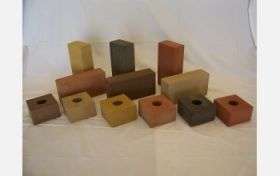
Researchers have developed bricks that look and perform like normal bricks yet are crafted from fly ash, a waste produced by coal-fired power plants. Credit: Henry Liu, FPC

Researchers have found that bricks made from fly ash--fine ash particles captured as waste by coal-fired power plants--may be even safer than predicted. Instead of leaching minute amounts of mercury as some researchers had predicted, the bricks apparently do the reverse, pulling minute amounts of the toxic metal out of ambient air.

Each year, roughly 25 million tons of fly ash from coal-fired power plants are recycled, generally as additives in building materials such as concrete, but 45 million tons go to waste. Fly ash bricks both find a use for some of that waste and counter the environmental impact from the manufacture of standard bricks.

"Manufacturing clay brick requires kilns fired to high temperatures," said Henry Liu, a longtime National Science Foundation (NSF) awardee and the president of Freight Pipeline Company (FPC), which developed the bricks. "That wastes energy, pollutes air and generates greenhouse gases that contribute to global warming. In contrast, fly ash bricks are manufactured at room temperature. They conserve energy, cost less to manufacture, and don't contribute to air pollution or global warming."

Once colored and shaped, the FPC bricks are similar to their clay counterparts, both in appearance and in meeting or exceeding construction-material standards.

Supported by NSF's Small Business Innovation Research (SBIR) program, Liu has been working since 2004 to develop the bricks. The first phase of support enabled him to make fly ash bricks more durable by engineering them to resist freezing and thawing due to weather. Liu is now working from a second-phase SBIR award to test the brick material's safety and prepare it for market.

"Green manufacturing is a focus for the nation," said Tom Allnutt of NSF's SBIR program, who oversaw Liu's award. "Liu's innovative use of fly ash to manufacture high quality building materials will potentially decrease some of the negative environmental impact of coal-fired power generation while meeting increasing demands for greener building materials."

While researchers need to study the bricks further to determine how the mercury adsorption occurs and how tightly the metal is trapped, the new findings suggest the bricks will not have a negative impact on indoor air quality.

On average, air contains low amounts of mercury that can range from less than 1 nanogram per cubic meter (ng/m3) to tens of ng/m3--a small fraction of the Environmental Protection Agency limit for continuous exposure.

Inside a confined experimental chamber, the bricks did not raise the mercury levels in the surrounding air (originally more than one nanogram), and instead appeared to lower the concentration down to roughly half a nanogram.

Engineers from FPC of Columbia, Mo., developed the bricks with NSF support and reported their findings on mercury leaching at the May 7-10, 2007, World of Coal Ash Conference in Cincinnati, Ohio.

Henry Liu has received a number of NSF awards since 1980 and founded FPC after retiring as professor of civil engineering and director of Capsule Pipeline Research Center, a state/industry university cooperative research center established by NSF at University of Missouri-Columbia in 1991 to research and develop capsule pipeline technology.

Source: NSF


print this article email this article download pdf blog this article bookmark this article     Digg this Stumble it share on Facebook share on Reddit add to delicious save to Yahoo! bookmarks
4.7/5 after 18 votes


May 22nd, 2007 all stories
Other Sciences / Other

Comments: 0
Rank: 4.7/5 after 18 votes

  • Stumble this up

  • Digg this

  • Share it:
  • share on Facebook
  • share on MySpace
  • share on Slashdot
  • rss-newsfeed
  • share on Google
  • share on Reddit
  • add to delicious
  • save to Yahoo! bookmarks
  • share on Windows Live
  • Add to Mixx!
Rating: 4.7/5 after 18 votes

  • Related Stories

  • Laying the foundations for a green industry
    created Jul 31, 2006 | popularity not rated yet | comments 0
  • Smart phones transform the way we shop
    created Apr 29, 2009 | popularity not rated yet | comments 0
  • Lunar rock-like material may someday house moon colonies
    created Jan 05, 2009 | popularity not rated yet | comments 0
  • External Tank, Solid Rocket Boosters, Readied for Next Shuttle Launch
    created Aug 06, 2008 | popularity not rated yet | comments 0
  • Ghost Protein Leaves Fresh Tracks in the Cell
    created Oct 30, 2006 | popularity not rated yet | comments 0

Tags


  • Physicists Demonstrate Quantum Memory with Matter Qubits
    Physicists Demonstrate Quantum Memory with Matter Qubits
    Physics / General Physics
    created Jul 03, 2009 | popularity 4.4 / 5 (17) | comments 1
  • 'Holey' Nanosheets for Wastewater Dye Removal
    Nanotechnology / Nanomaterials
    created Jul 01, 2009 | popularity 5 / 5 (5) | comments 1
  • Jellyfish Robot Swims Like its Biological Counterpart
    Jellyfish Robot Swims Like its Biological Counterpart
    Electronics / Robotics
    created Jun 26, 2009 | popularity 4.4 / 5 (8) | comments 1
  • Could Maxwell's Demon Exist in Nanoscale Systems?
    Could Maxwell's Demon Exist in Nanoscale Systems?
    Physics / General Physics
    created Jun 24, 2009 | popularity 4.4 / 5 (18) | comments 29
  • Living Safely with Robots, Beyond Asimov's Laws
    Living Safely with Robots, Beyond Asimov's Laws
    Electronics / Robotics
    created Jun 22, 2009 | popularity 4.6 / 5 (52) | comments 40
  • Other News

    Creation Museum president Ken A. Ham

    Paleontologists brought to tears, laughter by Creation Museum

    Other Sciences / Other

    created Jun 30, 2009 | popularity 4.2 / 5 (43) | comments 123

    For a group of paleontologists, a tour of the Creation Museum seemed like a great tongue-in-cheek way to cap off a serious conference.


    Mummified dinosaur skin yields up new secrets

    Mummified dinosaur skin yields up new secrets

    Other Sciences / Archaeology & Fossils

    created Jul 01, 2009 | popularity 4.7 / 5 (15) | comments 10

    (PhysOrg.com) -- Scientists from The University of Manchester have identified preserved organic molecules in the skin of a dinosaur that died around 66-million years ago.


    Liberal? Conservative? Stanford study says mental nudge can make voters flip-flop

    Liberal? Conservative? Stanford study says mental nudge can make voters flip-flop

    Other Sciences / Social Sciences

    created Jul 02, 2009 | popularity 3.8 / 5 (5) | comments 4

    (PhysOrg.com) -- No doubt you’ve worked hard for your success. But chances are you’ve also had some help and lucky breaks along the way.


    Probing Question: How do Ponzi Schemes work?

    Other Sciences / Economics

    created Jul 02, 2009 | popularity 5 / 5 (2) | comments 2

    Imagine the shock, the horror, and the sheer panic that would come with learning that the financial plan you’d sunk your life savings into was a sham, the financial experts you trusted were crooks, and all your money was ...


    Tourists enjoy a "Pineapple Tour" in Costa Rica

    Costa Rica tops happiness, 'green living' poll

    Other Sciences / Social Sciences

    created Jul 04, 2009 | popularity 3 / 5 (3) | comments 0

    Costa Rica is the happiest place on earth, and one of the most environmentally friendly, according to a new survey by a British non-governmental group.