Survey gauges teens' view of tech future
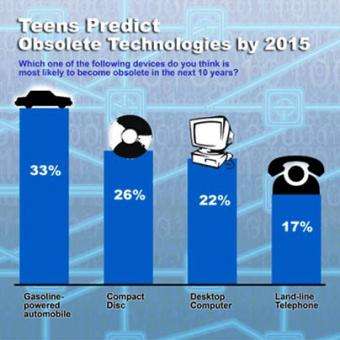
Gasoline-powered automobiles, compact discs and desktop computers are headed toward the technology scrap heap, according to a recent survey of American teenagers.
The 2006 Lemelson-MIT Invention Index, which gauges Americans' attitudes toward invention and innovation, found that a third of teens (33 percent) predict the demise of gasoline-powered cars by the year 2015. One in four teens (26 percent) expects compact discs to be obsolete within the next decade, and roughly another one in five (22 percent) predicts desktop computers will be a thing of the past.
Teens are also optimistic that new inventions and innovations will be able to solve important global issues, such as clean water (91 percent), world hunger (89 percent), disease eradication (88 percent), pollution reduction (84 percent) and energy conservation (82 percent).
"Perhaps more than any preceding generation, today's young people are completely comfortable with rapid technological change," Lemelson-MIT Program Director Merton Flemings said. "The rate of innovation, as reflected in U.S. patent applications, has more than doubled during their lifetime."
Flemings added, "Teens' belief that science and technology may hold the answers to our biggest societal challenges is encouraging, but it also begs the question: Is this generation properly equipped and motivated to invent solutions to these mind-boggling challenges?"
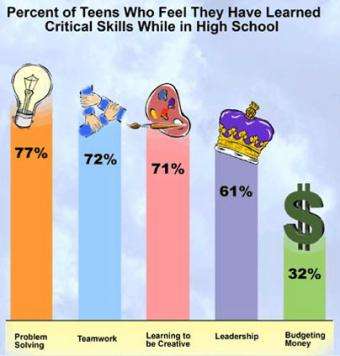
The Lemelson-MIT Invention Index found that teens believe they have developed some of the critical skills that will be needed to address these problems. More than three out of four teens surveyed (77 percent) believe they have learned problem-solving skills well while in school. They also feel prepared to work in teams (72 percent), think creatively (71 percent) and lead others (61 percent). However, they fall short when it comes to budgeting money. Only 32 percent of teens said they feel they learned that skill well while in school.
Other studies suggest, however, that teens in high school may have a limited frame of reference to assess how well they are truly prepared. For example, a February 2005 report by Achieve Inc. found that 55 percent of college instructors were dissatisfied with their students' abilities to apply what they learn to problem-solving.
And while teens are optimistic that societal problems can be solved through invention and innovation, the Lemelson-MIT Invention Index raises questions about whether teens are interested in personally solving these problems.
When asked to select the career field in which they are most interested, arts and medicine were teens' top choices (17 percent each). Teen girls were significantly more likely to be interested in medicine or health-care careers than teen boys (25 percent vs. 9 percent). Engineering was the third most-attractive career choice (14 percent of all respondents), but it was significantly more popular with teen boys than girls (24 percent vs. 4 percent). Only 9 percent of respondents chose science and only 8 percent chose business as their top career choices.
"The relative lack of interest in science and technology-oriented fields is alarming," Flemings said. "This year's Invention Index found that nearly half of teens view invention as a way to contribute to society and be creative. Yet we continue to fall short, particularly with respect to teenage girls, when it comes to presenting these fields as viable and attainable career options. We need to do more to make science and technology more attractive to today's youth."
The Lemelson-MIT Program aims to enable and inspire young people to pursue creative lives and careers. It particularly encourages young people to engage in invention and to pursue sustainable new solutions to real-world problems. It accomplishes this mission through outreach activities and annual awards, including the $500,000 Lemelson-MIT Prize, the largest single award in the United States for invention.
Source: MIT


