A nurse makes the decision on who will live
May 23, 2007 Thymic Nurse Cell

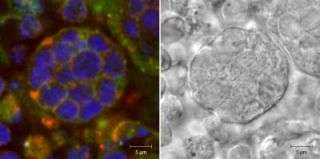
Thymocytes inside of a thymic nurse cell. Credit: Society for Experimental Biology and Medicine

Thymic nurse cells are specialized cells of the thymus capable of taking up as many as 50 developing T cells into their cytoplasm. In the June issue of Experimental Biology and Medicine, Dr. Guyden and his colleagues show that thymic nurse cells play a role in deciding which thymocytes that have been taken up will die, because they will become potentially harmful if they mature, and which will be released to continue the developmental process.

Thymic nurse cells were given their name because of their intimate relationship with developing T cells (thymocytes) in the thymus. Thymic nurse cells have been reported to take as many as 50 thymocytes into their cell body (see thymocytes inside of a thymic nurse cell in photos, the blue dye stains the nuclei of thymocytes inside of a nurse cell). Whether or not thymic nurse cells have the capacity to "internalize" another cell into itself, and the function of this unique biological phenomenon during T cell development is the focus of studies performed by Dr. Guyden at The City College of New York and his colleagues at Tuskegee University.

Thymic nurse cells were discovered in 1980. Their existence was heavily debated because many scientists found it difficult to believe that a cell could internalize another cell. In early studies, it was suggested that thymic nurse cells function exclusively in the up-take and removal of non-functional thymocytes from the developmental process.

In a study featured in the June issue of Experimental Biology and Medicine, Dr. Guyden and his colleagues show that thymic nurse cell function is not limited to the removal of non-functional thymocytes, but plays a role in deciding which thymocytes will die, because they will be potentially harmful if they mature, and which will continue to develop into normal T cells. These results were obtained using a genetically altered mouse system created to study this selection process, which is called MHC restriction.

During MHC restriction, all potentially harmful thymocytes must be weeded out (a process called negative selection). The remaining normal subset of thymocytes is induced to mature (a process called positive selection). The genetic alteration in the animals studied results in female mice whose thymocytes undergo positive selection, exclusively, while all thymocytes in male mice are negatively selected. If thymic nurse cells only internalize thymocytes that will be killed and removed, one would expect them to be absent in the female animal (exclusive to positively selected thymocytes that continue development). However, their results show a significantly larger number of thymic nurse cells containing thymocytes (selected to live) in female mice than in male mice.

These data show that thymic nurse cells are not only capable of internalizing thymocytes that have been selected to die, but also possess the capacity to take up thymocytes that have been selected to live via positive selection.

Source: Society for Experimental Biology and Medicine


print this article email this article download pdf blog this article bookmark this article     Stumble it Digg this share on Facebook retweet share on Reddit add to delicious
Rate this story - 3.8 /5 (4 votes)


May 23, 2007 all stories

Comments: 0

3.8 /5 (4 votes)
  • Stumble this up

  • Digg this

  • share this

  • hide
  • Related Stories

  • 'Nurse cells' make life and death decisions for infection-fighting cells
    created May 29, 2007 | popularity not rated yet | comments 0
  • A protein that triggers aggressive breast cancer
    created Mar 12, 2008 | popularity not rated yet | comments 0
  • New tool reveals secrets of migrating cells
    created May 04, 2005 | popularity not rated yet | comments 0


  • hide
  • Relevant PhysicsForums posts

  • How to prevent another stroke?
    created Nov 11, 2009
  • Swine flu vaccination
    created Nov 10, 2009
  • Improving the brain through chemistry
    created Nov 07, 2009
  • Sleep / REM Sleep and homeostasis
    created Nov 07, 2009
  • More from Physics Forums - Medical Sciences

Other News

Researchers find potential treatment for Huntington's disease (w/ Video)

Medicine & Health / Research

created 37 minutes ago | popularity not rated yet | comments 0

Investigators at Burnham Institute for Medical Research, the University of British Columbia's Centre for Molecular Medicine and Therapeutics and the University of California, San Diego have found that normal synaptic activity ...


Largest gene study of childhood IBD identifies 5 new genes

Medicine & Health / Genetics

created 26 minutes ago | popularity not rated yet | comments 0

In the largest, most comprehensive genetic analysis of childhood-onset inflammatory bowel disease (IBD), an international research team has identified five new gene regions, including one involved in a biological pathway ...


Young athletes need dual screening tests for heart defects, study suggests

Medicine & Health / Health

created 29 minutes ago | popularity not rated yet | comments 0

To best detect early signs of life-threatening heart defects in young athletes, screening programs should include both popular diagnostic tests, not just one of them, according to new research from heart experts at Johns ...


Heart and bone damage from low vitamin D tied to declines in sex hormones

Medicine & Health / Research

created 15 minutes ago | popularity not rated yet | comments 0

Researchers at Johns Hopkins are reporting what is believed to be the first conclusive evidence in men that the long-term ill effects of vitamin D deficiency are amplified by lower levels of the key sex hormone estrogen, ...


Postmortem genetic tests after sudden death may provide less expensive way to identify risk

Medicine & Health / Research

created 28 minutes ago | popularity not rated yet | comments 0

Targeted postmortem testing to identify genetic mutations associated with sudden unexplained death (SUD) is an effective and less expensive way to determine risk to relatives than comprehensive cardiac testing of first degree ...