DNA clues to inform conservation in Africa
May 23, 2007 The African bushbuck

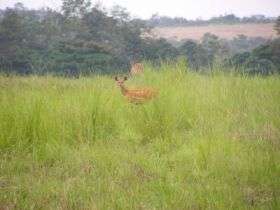
The African bushbuck, a common species which lives in most sub-Saharan habitat types. Credit: Cardiff University

Tracing the evolutionary history of wildlife could improve global habitat conservation, a major Cardiff University study has found.

Researchers in the School of Biosciences analysed the African bushbuck, a common species which lives in most sub-Saharan habitat types to test whether DNA similarity between populations living in different habitats can reveal the similarity of those ecoregions now and in the past.

The study, one of the first of its kind, identified 28 key regions for bushbucks. By understanding the genetic similarity of populations inhabiting different habitats researchers found they can potentially trace which ecoregions are most similar and establish which are the most unique in evolutionary history.

Professor Mike Bruford, School of Biosciences, co-author of the study, said: "The conservation of habitat or ecoregion biodiversity is one of our greatest challenges. This new approach will allow conservationists in Africa to focus their efforts on the most biodiverse and more unique habitats which harbour the most genetically distinct populations."

The researchers suggest the study provides a framework for the incorporation of genetic and biogeographic information into a more widely applicable model for pan-African conservation and, potentially, for the conservation of other global regions.

Source: Cardiff University


print this article email this article download pdf blog this article bookmark this article     Stumble it Digg this share on Facebook retweet share on Reddit add to delicious
Rate this story - not rated yet


May 23, 2007 all stories

Comments: 0

not rated yet
  • Stumble this up

  • Digg this

  • share this

  • hide
  • Related Stories


Other News

Fish food fight: Fish don't eat trees after all, says new study

Fish food fight: Fish don't eat trees after all, says new study

Biology / Ecology

created 1hour ago | popularity not rated yet | comments 0

(PhysOrg.com) -- What constitutes fish food is a matter of debate. A high-profile study a few years ago suggested that fish get almost 50 percent of their carbon from trees and leaves, evidence for a very ...


Computational microscope peers into the working ribosome

Computational microscope peers into the working ribosome (w/ Video)

Biology / Cell & Microbiology

created 21 hours ago | popularity 4.9 / 5 (8) | comments 0

Two new studies reveal in unprecedented detail how the ribosome interacts with other molecules to assemble new proteins and guide them toward their destination in biological cells. The studies used molecular ...


New chameleon species discovered in East Africa

New chameleon species discovered in East Africa (w/ Podcast)

Biology / Plants & Animals

created 23 hours ago | popularity 5 / 5 (1) | comments 0

A new species of chameleon has been discovered in Tanzania by a team of scientists.


Spider secrets decoded in world-first database

Biology / Plants & Animals

created 15 hours ago | popularity not rated yet | comments 0

(PhysOrg.com) -- Queensland scientists have developed a world-first database that catalogues the venom components from hundreds of spiders.


A year after discovery, Congo's 'mother lode' of gorillas remains vulnerable

A year after discovery, Congo's 'mother lode' of gorillas remains vulnerable

Biology / Plants & Animals

created 18 hours ago | popularity 5 / 5 (1) | comments 0

A new study by the Wildlife Conservation Society says that western lowland gorillas living in a large swamp in the Republic of Congo—part of the "mother lode" of more than 125,000 gorillas discovered last ...