A brown dwarf joins the jet-set
May 23rd, 2007 A brown dwarf joins the jet-set

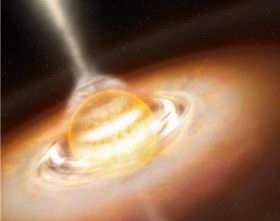
Using ESO´s VLT, astronomers found jets coming out from a 24 Jupiter-mass brown dwarf, showing that outflows are rather ubiquituous in the Universe and leading to the prospect that that young giant planets could also be associated with outflows. (c) ESO

Jets of matter have been discovered around a very low mass 'failed star', mimicking a process seen in young stars. This suggests that these 'brown dwarfs' form in a similar manner to normal stars but also that outflows are driven out by objects as massive as hundreds of millions of solar masses down to Jupiter-sized objects.

Brown dwarfs are objects whose masses are below those of normal stars - the borderline is believed to be about 8% of the mass of our Sun - but larger than those of planets. Unlike normal stars, brown dwarfs are unable to sustain stable nuclear fusion of hydrogen.

The brown dwarf with the name 2MASS1207-3932 is full of surprises. Its companion, a 5 Jupiter-mass giant, was the first confirmed exoplanet for which astronomers could obtain an image, thereby opening a new field of research - the direct detection of alien worlds. It was then later found that the brown dwarf has a disc surrounding it, not unlike very young stars.

Now, astronomers using ESO's Very Large Telescope (VLT) have found that the young brown dwarf is also spewing jets, a behaviour again quite similar to young stars.

The mass of the brown dwarf is only 24 Jupiter-masses. Hence, it is by far the smallest object known to drive an outflow. "This leads us to the tantalizing prospect that young giant planets could also be associated with outflows," says Emma Whelan, the lead-author of the paper reporting the results.

The outflows were discovered using an amazing technique known as spectro-astrometry, based on high resolution spectra taken with UVES on the VLT. Such a technique was required due to the difficulty of the task. While in normal young stars - known as T-Tauri stars for the prototype of their class - the jets are large and bright enough to be seen directly, this is not the case around brown dwarfs: the length scale of the jets, recovered with spectro-astrometry is only about 0.1 arcsecond long, that is, the size of a two Euro coin seen from 40 km away.

The jets stretch about 1 billion kilometres and the material is rushing away from the brown dwarf with a speed of a few kilometres per second.

The astronomers had to rely on the power of the VLT because the observed emission is extremely faint and only UVES on the VLT could provide both the sensitivity and the spectral resolution they required.

"Discoveries like these are purely reliant on excellent telescopes and instruments, such as the VLT," says Whelan. "Our result also highlights the incredible level of quality which is available today to astronomers: the first telescopes built by Galileo were used to observe the moons of Jupiter. Today, the largest ground-based telescopes can be used to observe a Jupiter size object at a distance of 200 light-years and find it has outflows!"

Using the same technique and the same telescope, the team had previously discovered outflows in another young brown dwarf. The new discovery sets a record for the lowest mass object in which jets are seen.

Outflows are ubiquitous in the Universe, as they are observed rushing away from the active nuclei of galaxies - AGNs - but also emerging from young stars. The present observations show they even arise in still lower mass objects. The outflow mechanism is thus very robust over an enormous range of masses, from several tens of millions of solar mass (for AGNs) down to a few tens of Jupiter masses (for brown dwarfs).

Source: European Southern Observatory


print this article email this article download pdf blog this article bookmark this article     Digg this Stumble it share on Facebook share on Reddit add to delicious save to Yahoo! bookmarks
4.4/5 after 16 votes


May 23rd, 2007 all stories
Space & Earth / Astronomy

Comments: 0
Rank: 4.4/5 after 16 votes

  • Stumble this up

  • Digg this

  • Share it:
  • share on Facebook
  • share on MySpace
  • share on Slashdot
  • rss-newsfeed
  • share on Google
  • share on Reddit
  • add to delicious
  • save to Yahoo! bookmarks
  • share on Windows Live
  • Add to Mixx!
Rating: 4.4/5 after 16 votes

  • Related Stories

  • Ultracool stars take 'wild rides' around, outside the Milky Way
    created Jun 09, 2009 | popularity not rated yet | comments 0
  • Wide-field Infrared Survey Explorer Coming Together
    created May 20, 2009 | popularity not rated yet | comments 0
  • Cool Stars Have Different Mix of Life-Forming Chemicals
    created Apr 07, 2009 | popularity not rated yet | comments 0
  • Adventures in the 'Goldilocks zone'
    created Mar 12, 2009 | popularity not rated yet | comments 0
  • With March 6 Kepler launch, work begins for Berkeley astronomers
    created Mar 04, 2009 | popularity not rated yet | comments 0

Tags


  • Physicists Demonstrate Quantum Memory with Matter Qubits
    Physicists Demonstrate Quantum Memory with Matter Qubits
    Physics / General Physics
    created Jul 03, 2009 | popularity 4.4 / 5 (13) | comments 1
  • 'Holey' Nanosheets for Wastewater Dye Removal
    Nanotechnology / Nanomaterials
    created Jul 01, 2009 | popularity 5 / 5 (5) | comments 1
  • Jellyfish Robot Swims Like its Biological Counterpart
    Jellyfish Robot Swims Like its Biological Counterpart
    Electronics / Robotics
    created Jun 26, 2009 | popularity 4.4 / 5 (7) | comments 1
  • Could Maxwell's Demon Exist in Nanoscale Systems?
    Could Maxwell's Demon Exist in Nanoscale Systems?
    Physics / General Physics
    created Jun 24, 2009 | popularity 4.4 / 5 (18) | comments 29
  • Living Safely with Robots, Beyond Asimov's Laws
    Living Safely with Robots, Beyond Asimov's Laws
    Electronics / Robotics
    created Jun 22, 2009 | popularity 4.6 / 5 (51) | comments 39
  • Other News

    Global warming tactic cools climate but won’t help corals, say researchers

    Space & Earth / Earth Sciences

    created 22 hours ago | popularity 2.3 / 5 (3) | comments 6

    (PhysOrg.com) -- “Geoengineering” experiments proposed to reduce global warming by blocking sunlight with atmosphere-injected particles may cool the world but still leave carbon dioxide levels dangerously high, Stanford scientists ...


    The least sea ice in 800 years

    The least sea ice in 800 years

    Space & Earth / Earth Sciences

    created Jul 01, 2009 | popularity 4.3 / 5 (57) | comments 44

    New research, which reconstructs the extent of ice in the sea between Greenland and Svalbard from the 13th century to the present indicates that there has never been so little sea ice as there is now. The ...


    Gas around young galaxy

    Intense heat killed the Universe's would-be galaxies, researchers say

    Space & Earth / Astronomy

    created Jul 01, 2009 | popularity 3.1 / 5 (18) | comments 23

    (PhysOrg.com) -- Our Milky Way galaxy only survived because it was already immersed in a large clump of dark matter which trapped gases inside it, scientists led by Durham University's Institute for Computational ...


    New class of black holes discovered

    New class of black holes discovered

    Space & Earth / Astronomy

    created Jul 01, 2009 | popularity 4.9 / 5 (18) | comments 15

    A new class of black hole, more than 500 times the mass of the Sun, has been discovered by an international team of astronomers.


    Scientists' Drill Hits Magma: Only Third Time on Record

    Scientists' Drill Hits Magma: Only Third Time on Record

    Space & Earth / Earth Sciences

    created Jun 29, 2009 | popularity 4.7 / 5 (19) | comments 17

    (PhysOrg.com) -- Scientists drilling a borehole deep into Iceland’s rocky crust to explore new methods of using geothermal energy hit a major roadblock on Thursday: Their drill ran into molten rock at a depth ...