System to pinpoint airline passengers who contaminate cabins
Researchers developing a system that uses mathematical models and sensors to locate passengers releasing hazardous materials or pathogens inside airline cabins have shown that the technique can track a substance to an area the size of a single seat.
The technique might enable officials to identify passengers responsible for the unintentional release of germs, such as contagious viruses, or the intentional release of pathogens or chemical agents in a terrorist attack, said Qingyan (pronounced Chin-Yan) Chen, a professor of mechanical engineering at Purdue University.
"The goal is to be able to track the source if a person released a biological agent, such as anthrax, or inadvertently released a pathogen such as pandemic flu by sneezing, for example," he said.
The research is supported by the Air Transportation Center of Excellence for Airline Cabin Environment Research, established by the Federal Aviation Administration. The work aims to improve air quality and safety inside airline cabins.
The inadvertent release of infectious pathogens inside an aircraft is especially dangerous during lengthy international flights, said Chen, who is a principal director of the center. The effort involves an interdisciplinary team of Purdue researchers from chemical and mechanical engineering, physics and chemistry.
The center's Purdue-related research focuses on developing mathematical models for software that will be needed to operate such a tracking system and learning how to precisely place several sensors to accurately trace hazardous airborne materials back to the source.
Research findings are detailed in a paper being published in June in Indoor Air - International Journal of Indoor Environment and Health. The paper was written by Chen and mechanical engineering doctoral student Tengfei Zhang.
The technique, called "inverse simulation," analyzes how a material disperses throughout the cabin and then runs the dispersion in reverse to find its origin. Sensors track the airflow pattern and collect data related to factors such as temperature, velocity and concentration of gases and particles in the air.
"This is difficult to do, in part because an airline cabin is a pretty large area," Chen said. "The procedure now requires several days of computing time to complete the track, meaning the method could be used only after a contamination occurs."
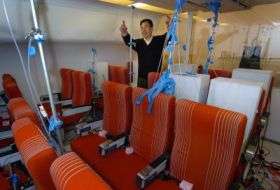
Chen has recreated a commercial airliner's passenger compartment, complete with rows of seating, at Purdue's Ray W. Herrick Laboratories. Data from experiments in the lab are used to validate results from the computational models. The lab is equipped with three sensors and recreates the exhalation and body heat of passengers and an airliner's "linear diffuser" environmental control system, which supplies fresh and recirculated air for passengers. Boxy devices located on several seats reproduce body heat, and each has a tube that expels a gas to simulate passengers exhaling. Recreating body heat is important because it affects airflow inside airliners, Chen said.
Future work will concentrate on speeding the computation time, with a goal of one day creating a system that alerts pilots in real time and pinpoints a contaminant's source.
"We need to find a way to enhance the computing speed, and we have a strategy to do that," Chen said.
The method is most accurate when three sensors are used to track a material. Using three sensors, the Purdue researchers showed that the method could track a substance to within about two feet of its origin in an airline cabin.
"We would be able to tell you the general area of the origin, and from that you could figure out which passenger seats were in this area," said Chen, whose research is based at Herrick Laboratories.
The same principle could be applied to systems designed for other environments, such as office buildings, he said.
The Air Transportation Center of Excellence for Airline Cabin Environment Research includes Auburn University, Harvard University, Boise State University, Kansas State University, the University of California at Berkeley, and the University of Medicine and Dentistry of New Jersey. Auburn is the center's lead administrative university, while Purdue and Harvard are co-technical leaders.
Research through the center aims to:
-- Understand and mitigate environmental health issues on airplanes, including contamination of cabin air with engine oil or hydraulic fluid.
-- Study how cabin pressure affects passengers, especially those with cardiopulmonary conditions, as well as flight attendants and pilots who work in the environment daily.
-- See how elevated ozone levels at higher altitudes affect the cabin environment.
-- Look at the basic science of how contaminants travel through the cabin.
-- Learn which sensors best detect certain materials in cabin air.
-- Discover the best strategies to decontaminate an airplane.
Purdue's team is concentrating on tracking and decontaminating airborne agents.
Source: Purdue University


