May 23, 2007 feature
Flat, Flexible, Wireless Power Source Can Go Anywhere
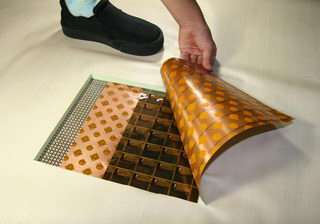
A team of Japanese researchers has created a novel wireless power-transmission device that is thin, flat, and flexible. Based on a sheet of plastic, the device can be put on desks, floors, walls, and almost any other location, delivering power to electronics placed on or near it without the use of cables or connectors.
The power sheet is described in the April 29, 2007, online edition of Nature Materials.

The electrical components are deposited onto the plastic via state-of-the-art inkjet printing technology using “electronic ink.” The finished product is about one millimeter thick and 21 centimeters square, although power sheets large enough to cover entire walls or floors could potentially be created.
The sheet can deliver up to about 40 watts, enough to power light bulbs and small electronics (cell phones, clocks, etc.) equipped to accept wireless power. The sheet has an impressive 81 percent efficiency, meaning 81 percent of the emitted power is received by devices.
The sheet is a significant step forward for the field of electronics. Corresponding researcher Takao Someya, a scientist at the University of Tokyo, told PhysOrg.com, “Our power-transmission sheet addresses two of the issues facing the electronics field: creating ecologically friendly power systems and developing power-transmission technologies that further the imminent trend of 'ambient electronics' – electronic networks, such as sensors, built into our homes and offices to increase our day-to-day security and convenience.”
The sheet is an example of “organic electronics,” a fast-growing field in which circuits are based on conducting plastics rather than conventional silicon. Organic electronics have several advantages, including being cheaper to manufacture, more environmentally safe to produce, physically light, and, as in this case, are often thin and bendable.

However, many organic electronic devices can only be integrated into low-power applications because organic transistors have high electrical resistances and cannot handle large amounts of electricity. By combining organic transistors with a technology traditionally used to fabricate silicon circuits, Someya and his colleagues have boosted the amount of power their organic power-transmission sheet can handle.
The finished product consists of several layers. These include a layer printed with an array of thin, flat copper coils, which sense the position of nearby electronic devices, and a layer of sender coils that deliver the wireless power. This process occurs via electromagnetic induction, a physics phenomenon in which a magnetic field can induce a current in a nearby conductor. Here, a voltage applied across the sender coils produces a magnetic field, which induces current flow in nearby devices that need power, as long as those devices are equipped with receiver coils.
Someya and his colleagues say that any potential safety concerns regarding wireless power, such as electric shock and leakages, have been addressed by coating the power sheet's sender coils and other electrical components with an insulating material. They demonstrated the system's safety by using the sheet to power a light bulb submerged in water.
“This could lead to a whole new class of water-safe electronics,” said Someya.
Citation: Tsuyoshi Sekitani, Makoto Takamiya, Yoshiaki Noguchi, Shintaro Nakano, Yusaku Kato, Takayasu Sakurai and Takao Someya, “A large-area wireless power-transmission sheet using printed organic transistors and plastic MEMS switches” Nature advance online publication DOI: 10.1038/nmat1903
Copyright 2007 PhysOrg.com.
All rights reserved. This material may not be published, broadcast, rewritten or redistributed in whole or part without the express written permission of PhysOrg.com.


