Scientists observe brain cell development in 'real time'
May 24, 2007 Neuron Division

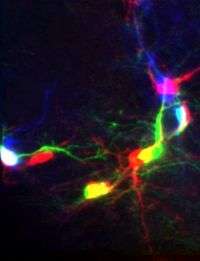
Magnified photo shows division of neuron in vivo. Credit: Hebrew University of Jerusalem photo

For the first time anywhere, a researcher at the Hebrew University of Jerusalem has succeeded in observing in vivo the generation of neurons in the brain of a mammal.

Dr. Adi Mizrahi of the Department of Neurobiology at the Alexander Silberman Institute of Life Sciences at the Hebrew University, used mouse models to study how neurons, or nerve cells, develop from an undifferentiated cellular sphere into a rich and complex cell. This has great significance for the future of brain research, said Dr. Mizrahi, since "the structural and functional complexity of nerve cells remains one of the biggest mysteries of neuroscience, and we now have a model to study this complexity directly."

The results of Dr. Mizrahi’s groundbreaking work appeared in the online edition of Nature Neuroscience.

Using special microscopic imaging techniques, combined with virus gene technology, Dr. Mizrahi was able to develop an experimental model to study development of neural dendrites in vivo. The dendrites are the string-like extensions of the neuron that spread out to reach other neurons and serve as the points of communication between the neurons.

The model employed by Dr. Mizrahi in his research was the newborn neuron population which develops into the olfactory bulb of adult mice, providing them with a sense of smell. The development and maintenance of newborn neurons in this area was assessed by time-lapse imaging over several days at different stages of development. Mizrahi revealed that dendritic formation is highly dynamic. Moreover, once incorporated into the network, adult-born neurons in the study also remained dynamic and capable of continuous change.

This method provides a mechanism for observing, for the first time in a mammal, how a neuron develops into a rich and complex cell and how, once developed, neurons are maintained in the highly active and changing environment of the brain.

As for further research that some day could lead to significant breakthroughs in treatment of neural disorders, Dr. Mizrahi noted that "there are only a few small areas in the brain which are capable of neurogenesis, and they hide secrets we want to reveal."

Source: The Hebrew University of Jerusalem


print this article email this article download pdf blog this article bookmark this article     Stumble it Digg this share on Facebook retweet share on Reddit add to delicious
Rate this story - 4.6 /5 (30 votes)


May 24, 2007 all stories

Comments: 0

4.6 /5 (30 votes)
  • Stumble this up

  • Digg this

  • share this

  • hide
  • Related Stories

  • Upending textbook science on Alzheimer's disease
    created 12 hours ago | popularity not rated yet | comments 0
  • Study uses brain scans to discover how children 'read' faces
    created Nov 20, 2009 | popularity not rated yet | comments 0
  • Scientists find new link between insulin and core body temperature
    created Nov 19, 2009 | popularity not rated yet | comments 0
  • New Down syndrome treatment suggested by study in mice
    created Nov 18, 2009 | popularity not rated yet | comments 0
  • Researchers find explanation for rapid maturation of neurons at birth
    created Nov 17, 2009 | popularity not rated yet | comments 0


  • hide
  • Relevant PhysicsForums posts

  • nesfatin
    created Nov 22, 2009
  • Obsessive Compulsive Disorder
    created Nov 20, 2009
  • West's zone 2 starling resistor respiratory physiology
    created Nov 18, 2009
  • 50-0-50 rule
    created Nov 18, 2009
  • More from Physics Forums - Medical Sciences

Other News

Multitasking may be Achilles heel for hepatitis C

Medicine & Health / Research

created 5 hours ago | popularity 5 / 5 (1) | comments 0

(PhysOrg.com) -- Hepatitis C, a formidable virus that affects 130 million people worldwide, is nursing some pretty impressive bruises. By knocking out sections and subsections of one of its proteins, scientists reveal weak ...


Gene therapy improves vision

Gene therapy improves vision

Medicine & Health / Research

created 6 hours ago | popularity 5 / 5 (2) | comments 0

German scientist Paul Ehrlich found what he coined the "magic bullet" in the early 20th century upon developing the world’s first effective treatment of syphilis.


Tissue tension regulates tumor progression

Medicine & Health / Cancer

created 6 hours ago | popularity not rated yet | comments 0

(PhysOrg.com) -- UCSF scientists have shown for the first time that the rigidity of a tissue can induce cancer. The research team identified an enzyme that is crucial for regulating tissue stiffness and demonstrated that ...


Measured -- The time it takes us to find the words we need

Medicine & Health / Psychology & Psychiatry

created 8 hours ago | popularity 3.3 / 5 (3) | comments 0

(PhysOrg.com) -- The time it takes for our brains to search for and retrieve the word we want to say has been measured for the first time. The discovery is reported in a paper published in the Proceedings of the National Ac ...


Multiple health concerns surface as winter, vitamin D deficiences arrive

Medicine & Health / Health

created 11 hours ago | popularity 3.7 / 5 (3) | comments 3

A string of recent discoveries about the multiple health benefits of vitamin D has renewed interest in this multi-purpose nutrient, increased awareness of the huge numbers of people who are deficient in it, spurred research ...