Researchers probe bones' tiny building blocks
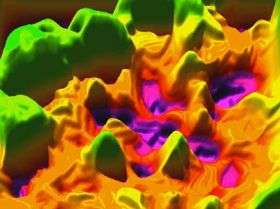
In work that could lead to more effective diagnoses and treatments of bone diseases using only a pinhead-sized sample of a patient's bone, MIT researchers report a first-of-its-kind analysis of bone's mechanical properties.
The work, reported in the May 21 advance online edition of Nature Materials, sheds new light on how bone absorbs energy.
The researchers' up-close-and-personal look at bone probes its fundamental building block--a corkscrew-shaped protein called collagen embedded with tiny nanoparticles of mineral--at the level of tens of nanometers, or billionths of a meter. A human hair, by comparison, is 80,000 nanometers in diameter.
"If you want to investigate the origins of the strength and toughness of a material, you probe it at smaller and smaller length scales," said co-author Subra Suresh, Ford Professor of Engineering, with appointments in materials science and engineering, biological engineering, mechanical engineering and the Harvard-MIT Division of Health Sciences and Technology. "The methodologies used in this research can be employed to assess the quality of bone with extremely high precision by providing new and detailed structural and mechanical information on the nature of its fundamental constituents."
The insights gained from the work could also lead to the creation of new, tougher materials, he said.
The study was led by Christine Ortiz, associate professor of materials science and engineering. "The structure, quality and integrity of bone change dramatically with age and disease, hence understanding the origins of the mechanical properties of this major load-bearing, structural tissue in our body is extremely important from a medical standpoint," Ortiz said.
Using a table-top instrument called a molecular force probe, which uses an extremely small probe tip to poke out a tiny fragment of bone, Ortiz and colleagues mapped the stiffness of bovine shin bone into complex, colorful, two-dimensional contour maps similar to those used by geographers.
The team found that the mechanical properties of bone vary greatly within a single region only two micrometers (thousandths of a meter) wide. Because a variety of disorders tied to disease or aging lead to changes in bone structure, the researchers' discovery of the non-uniformity of bone's mechanical properties at very small length scales could lead to improved diagnoses of diseases. For example, if specific nanoscale patterns of stiffness within bone structure are tied to disease or aging, these could potentially be identified earlier or provide more conclusive evidence of a disorder.
The researchers also formulated a computer model to study the effects of their experimental results on larger-scale biomechanical properties. For example, using the model they found that the non-uniform stiffness patterns were advantageous to bone's ability to absorb energy.
"We tend to think that if a material is non-uniform, it is not as tough," Suresh said. "This work shows otherwise. Our thesis is that nature, by making bones non-uniform at extremely small length scales over the course of millions of years of evolution, has designed bone to be able to absorb much more energy than a uniform material with the same properties."
"I was surprised that we observed such beautiful and complex patterns," Ortiz said. "Cells sense and respond to stresses in their environment. Since different local mechanical properties in bone change the magnitude of stresses around the cell, the cells' behavior can be altered in response, thereby affecting the health of the tissue."
In addition, the team's results could lead to new ways of producing improved structural composites that mimic nature's clever design that allows bones to resist sudden fractures; to "fail gracefully," as Suresh put it. For example, certain kinds of a new class of materials called nanocomposites are composed of a polymer or metallic matrix filled with nanoscale particles randomly distributed or periodically spaced. "There may be ways to disperse particles non-uniformly that may lead to improved material toughness," Suresh said.
Ortiz' and Suresh's colleagues on the work are Kuangshin Tai, a recent MIT Ph.D. graduate; research scientist Ming Dao of the Department of Materials Science and Engineering; and Ahmet Palazoglu of the University of California at Davis.
Ortiz is currently looking at stem-cell-based, tissue-engineered bone in collaboration with Dan Gazit at the Hebrew University of Jerusalem to see how similar it is to native bone. She is also applying the new analysis and related imaging and simulation techniques to different types of mineralized biological materials such as armored scales from ancient fish and seashells.
Source: MIT


