Reviews Document NASA's Progress on Next Human Spacecraft
May 24, 2007 Orion

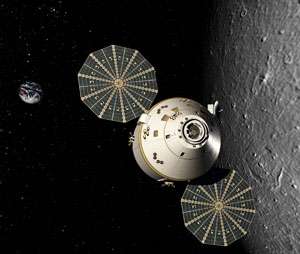
Orion in lunar orbit. Image credit: Lockheed Martin Corp.

NASA this week wrapped up six months of system requirements reviews for the Orion spacecraft, the Ares launch vehicles and other support systems, bringing together the Constellation Program's list of basic capability needs.

The Constellation Program is developing a new space transportation system that will take astronauts to Earth orbit, the moon, and eventually to Mars.

The basic program architecture for design, development, construction and operation of the rockets and spacecraft remains unchanged as a result of the reviews, but it now has a firmer foundation built through extensive requirements allocation, reconciliation, analyses and validation testing.

A "baseline synchronization" on May 23 followed individual systems requirements reviews, or SRRs, by the Constellation Program and the Orion, Ares, Ground Operations, Mission Operations and Extravehicular Activity (spacewalk) projects. The synchronization effort was designed to identify any conflicts or gaps between and among the projects and the program and to establish a plan for resolving those issues.

"This has been an eventful spring, known as the 'season of SRRs,'" said Jeff Hanley, Constellation Program manager at NASA's Johnson Space Center, Houston. "This summer will bring a new season of rolling system definition reviews that will finish our requirements for initial mission capability and set us up for our first preliminary design reviews."

The Constellation requirements work was completed at the same time the program was dealing with other significant challenges, including development of an integrated test schedule, a mission manifest and a budget profile that will support its next 20 years of work.

The program also closely followed the work of NASA's Lunar Architecture Team, which is formulating the requirements for a lunar surface outpost development and scientific research activities. A lunar architecture system requirements review is expected in spring of 2009. "This is an impressive accomplishment in a short period of time, and I'm pleased with the dedication and cooperation across projects and attention to detail that has gotten us this far," said Chris Hardcastle, Constellation Program systems engineering and integration manager at Johnson.

The next series of reviews will begin with the Orion system definition review in August and continue through another Constellation Program baseline synchronization in March 2008. System definition reviews focus on emerging designs for all transportation elements and compare the predicted performance of each element against the currently baselined requirements.

The next significant milestones for the Constellation Program are a preliminary design review series in summer 2008 and a critical design review series in early 2010.

Source: NASA


print this article email this article download pdf blog this article bookmark this article     Stumble it Digg this share on Facebook retweet share on Reddit add to delicious
Rate this story - 3.8 /5 (10 votes)


May 24, 2007 all stories

Comments: 0

3.8 /5 (10 votes)
  • Stumble this up

  • Digg this

  • share this

  • hide
  • Related Stories

  • NASA denies new space program is too risky, pricey
    created Jul 30, 2009 | popularity not rated yet | comments 0
  • Panel to evaluate NASA's manned spaceflight program
    created Jun 17, 2009 | popularity not rated yet | comments 0
  • NASA Launch Tests Alternate Concept for Astronaut Escape System
    created Jun 04, 2009 | popularity not rated yet | comments 0
  • NASA's Ares I Rocket Passes Review, Takes Giant Leap Toward Reality
    created Sep 11, 2008 | popularity not rated yet | comments 0
  • NASA Prepares for First Unmanned Test of Orion
    created Mar 12, 2008 | popularity not rated yet | comments 0


  • hide
  • Relevant PhysicsForums posts

  • Are there green, purple and pink stars?
    created 5 hours ago
  • Sideral question
    created Nov 21, 2009
  • Doppler shifted blackbody spectrum
    created Nov 21, 2009
  • Earth v. Moon
    created Nov 21, 2009
  • More from Physics Forums - General Astronomy

Other News

The shore of Deception Island in Antarctica, in 2008

Antarctic ice loss vaster, faster than thought: study

Space & Earth / Earth Sciences

created 9 hours ago | popularity 2.6 / 5 (12) | comments 9

The East Antarctic icesheet, once seen as largely unaffected by global warming, has lost billions of tonnes of ice since 2006 and could boost sea levels in the future, according to a new study.


Denmark: 65 world leaders for UN climate summit (AP)

Denmark: 65 world leaders for UN climate summit

Space & Earth / Environment

created 9 hours ago | popularity 1 / 5 (2) | comments 2

(AP) -- Sixty-five world leaders have said they will attend the Copenhagen climate summit in December, and several more have responded positively to invitations, Danish officials said Sunday.


Astronaut's baby daughter born as he circles Earth (AP)

Astronaut's baby daughter born as he circles Earth

Space & Earth / Space Exploration

created 9 hours ago | popularity 5 / 5 (1) | comments 0

(AP) -- Astronaut Randolph Bresnik jubilantly welcomed his new daughter into the world Sunday as he floated 220 miles above it.


Commuters wait on the platform shrouded by fog in London

Climate change not man-made, say majority of Britons: poll

Space & Earth / Environment

created Nov 15, 2009 | popularity 3.4 / 5 (16) | comments 46

Less than half of Britons believes that human activity is to blame for global warming, according to a poll carried out for The Times newspaper and published on Saturday.


Mysteriously warm times in Antarctica

Mysteriously warm times in Antarctica

Space & Earth / Earth Sciences

created Nov 18, 2009 | popularity 4.2 / 5 (21) | comments 31

(PhysOrg.com) -- A new study of Antarctica's past climate reveals that temperatures during the warm periods between ice ages (interglacials) may have been higher than previously thought. The latest analysis ...