Flexible genes allow ants to change destiny
May 24, 2007
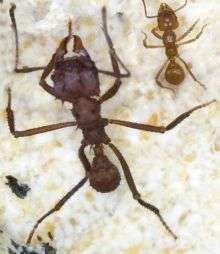
Acromyrmex leaf-cutting ants -- large and small workers. Credit: W.O.H Hughes
The discovery of a flexible genetic coding in leaf-cutting ants sheds new light on how one of nature's ultimate self-organising species breeds optimum numbers of each worker type to ensure the smooth running of the colony.
Research at the University of Leeds shows that despite an inherited genetic pre-disposition to grow into a particular worker caste, ant larvae can be triggered by environmental stimuli to switch development depending on colony's workforce needs.
"Our previous research suggested that genetics did indeed play a part in caste determination - but not how much of a part," says evolutionary biologist Dr William Hughes of the Faculty of Biological Sciences. "This left us with a conundrum: ant colonies are a model of social efficiency, yet if genetics ruled caste development, then this would be a very rigid - and therefore very inefficient - method of ensuring an optimum workforce balance."
"It seems that ants have evolved their own solution to this problem. Given that it takes an ant eight weeks to develop from an egg into an adult, ant colonies have to predict the need for different types of worker well in advance, and a flexible combination of nature and nurture will help them do this."
Dr Hughes' research used colonies of Acromyrmex leaf-cutting ants, which have two distinct worker castes: large workers, which forage and build the nest and small workers, which care for the ant larvae and the fungus they eat. Worker ants are always female and the large workers are up to three times the size of the smaller ones. "Males don't do much other than eat, fly off, mate and die," says Dr Hughes.
As leaf-cutting queens mate with multiple males, they make good candidates for examining role of genetics in caste determination. With the same mother and rearing conditions, the only differences between workers within a colony will be the genes inherited from their different fathers.
To see if genetic pre-disposition was fixed, all the large workers were removed from a colony to stimulate the need for more larvae to develop into this caste. The results showed that genetic types that didn't normally develop into large workers did so when the need for this caste was increased, proving that the genetic influence is adaptable.
Leaf-cutting ants have an enormous ecological impact because of the amount of leaves they harvest and are a significant pest for several crops. They particularly like citrus and Eucalyptus trees and a colony of the Atta species can defoliate a tree in a single night. They have been estimated to remove 17 per cent of leaf production in some tropical forests. Understanding how colonies function may well offer new opportunities to control their impact.
"We don't yet know what environmental cues influence the caste destiny of the larvae – it could be the food they're fed, the temperature, or even pheromones," says Dr Hughes.
Dr Hughes' research has been published online in Proceedings of the Royal Society B: Biological Sciences.
Source: University of Leeds
-
Supersoldier ants created in the lab by reactivating ancestral genes
Jan 06, 2012 |
4.1 / 5 (23) |
21
-
Organism diversity: Fast-evolving genes control developmental differences in social insects
Sep 19, 2011 |
4.5 / 5 (2) |
0
-
Genetic study offers insight into the social lives of bees
Apr 11, 2011 |
5 / 5 (1) |
0
-
Leafcutter ant genome reveals secrets of fungus farming ways
Feb 10, 2011 |
5 / 5 (2) |
8
-
Argentine ant genome sheds light on a successful pest
Jan 31, 2011 |
4.8 / 5 (6) |
0
-
Engineers build first sub-10-nm carbon nanotube transistor
Feb 01, 2012 |
4.9 / 5 (31) |
30
-
Something old, something new: Evolution and the structural divergence of duplicate genes
Jan 31, 2012 |
4.6 / 5 (7) |
1
-
The hidden nanoworld of ice crystals: Revealing the dynamic behavior of quasi-liquid layers
Jan 30, 2012 |
5 / 5 (3) |
1
-
Stock market network reveals investor clustering
Jan 27, 2012 |
3.9 / 5 (23) |
8
-
Of microchemistry and molecules: Electronic microfluidic device synthesizes biocompatible probes
Jan 26, 2012 |
5 / 5 (1) |
0
More news stories
Entire genome of extinct human decoded from fossil
(PhysOrg.com) -- In 2010, Svante Pääbo and his colleagues presented a draft version of the genome from a small fragment of a human finger bone discovered in Denisova Cave in southern Siberia. The ...
Feb 07, 2012 |
4.7 / 5 (58) |
44
|
Why are there so few fish in the Earth's oceans?
(PhysOrg.com) -- A Stony Brook University researcher has found that, contrary to popular belief, there are not plenty of fish in the sea.
Feb 08, 2012 |
4.3 / 5 (17) |
25
|
The power of estrogen -- male snakes attract other males
A new study has shown that boosting the estrogen levels of male garter snakes causes them to secrete the same pheromones that females use to attract suitors, and turned the males into just about the sexiest ...
Feb 10, 2012 |
4.8 / 5 (6) |
2
|
Miami battling invasion of giant African snails
No one knows how they got there. But an invasion of African giant snails has southern Florida in a panic over potential crop damage, disease and general yuckiness surrounding the slimy gastropods.
Feb 10, 2012 |
4.5 / 5 (2) |
5
Deciding to go left or right: Researchers use device to determine that lower animals can navigate too
For decades, scientists have associated binary decision making opting to go left or right with higher-ranking animals, including humans. A team of Harvard researchers, however, is rewriting that ...
Feb 09, 2012 |
4 / 5 (1) |
4
|
Walney offshore wind farm is world's biggest (for now)
(PhysOrg.com) -- The Walney wind farm on the Irish Sea--characterized by high tides, waves and windy weather--officially opened this week. The farm is treated in the press as a very big deal as the Walney ...
GPS court ruling leaves US phone tracking unclear
A US Supreme Court decision requiring a warrant to place a GPS device on the car of a criminal suspect leaves unresolved the bigger issue of police tracking using mobile phones, legal experts say.
Europeans protest controversial Internet pact
Tens of thousands of people marched in protests in more than a dozen European cities Saturday against a controversial anti-online piracy pact that critics say could curtail Internet freedom.
Europe stakes billion-dollar bet on new rocket
A pencil-slim rocket is scheduled to lift into space from South America on Monday, carrying a billion-dollar bet that Europe can grab a juicy slice of the market to place satellites in low orbit.
Study finds that anti-diabetic medication can prevent the long-term effects of maternal obesity
In a study to be presented today at the Society for Maternal-Fetal Medicine's annual meeting, The Pregnancy Meeting, in Dallas, Texas, researchers will report findings that show that short therapy with the anti-diabetic medication ...
Netflix settlement trims 14 pct off 4Q earnings
(AP) -- Netflix pressed the rewind button on its fourth-quarter earnings after settling allegations that the video subscription service violated a consumer-privacy law.