Tidal Tales of Minor Mergers: Young Stars Where They Shouldn't Be
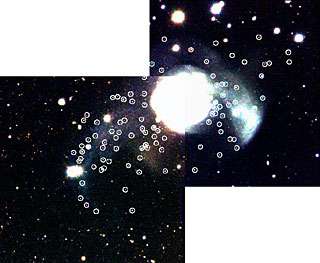
Arizona astronomers have discovered a population of what appear to be young star clusters where they aren't supposed to be. The newborn stars appear to have formed in the debris of the NGC 2782 galaxy collision -- debris that lacks what astronomers believe are some important ingredients needed to form stars.
A large, Milky Way-type galaxy collided with a much smaller galaxy in the NGC 2782 collision. It's an example of the most common type of galaxy collision in the universe. Scientists believe that such collisions played an important role in the buildup of large galaxies in the early universe.
If confirmed, these newly discovered young star clusters and their environment could help shed light on the process of star formation, especially in the early universe in regions far from the crowded, active centers of galaxies.
Karen Knierman, a graduate student and Arizona/NASA Space Grant Fellow at The University of Arizona, and Patricia Knezek of the WIYN Consortium in Tucson, Ariz., have reported the research at the American Astronomical Society meeting in Washington, D.C.
The astronomers found the star clusters by taking deep images of the galaxy collision with the 4 Megapixel CCD camera of the 1.8 meter (71-inch) Vatican Advanced Technology Telescope (VATT) at Mount Graham International Observatory in Arizona.
NGC 2782 lies about 111 million light years away toward the Lynx constellation. When the two galaxies of unequal mass collided about 200 million years ago, their gravitational pull ripped out two tails of debris with very different properties.
Beverly Smith of Eastern Tennessee University and collaborators studied the optical and gas properties of these two tails and published their results in 1994 and 1999. Studying the gas properties tells astronomers about neutral hydrogen gas and molecular gas -- both important ingredients in star formation. Smith and collaborators found that the optically bright eastern tail has some neutral hydrogen gas and molecular gas at the base of the tail, and an optically bright, but gas-poor concentration at the end of the tail. The optically faint western tail is rich in neutral hydrogen gas, but has no molecular gas.
Knierman and Knezek found blue star clusters younger than 100 million years along both tails, indicating that those stars formed within the tails after the galaxy collision began.
"That's surprising because the western tail lacks molecular gas, one of the key ingredients for star formation," Knierman said.
Star clusters are thought to form from the collapse of giant molecular gas clouds. If this is the case, astronomers would expect to see remnants of the molecular gas which helped give birth to the stars.
Given Smith's earlier observations of gas in the debris tails, Knierman and Knezek expected they might see star formation in the eastern tail, where molecular gas is clearly present. But they didn't expect to see star formation in the western tail, where no molecular gas was detected. Finding young star clusters in the western tail should prompt astronomers to question their current models of star formation, the Arizona team said.
"Do we still need a model of giant molecular gas clouds?" Knierman asked. "Or do we need a different model - perhaps one with smaller clumps of molecular gas that might have been destroyed or blown away when these energetic young stars formed?"
Finding unexpected young star clusters in the western tail could help explain why stars form in other places where there may be little molecular gas, like the outer edges of the Milky Way galaxy or in the debris of other galaxy collisions, Knierman and Knezek noted.
"This has important implications in how star formation proceeded when our universe was young and galaxy collisions were much more common than they are today," Knierman said.
"Only recently have we become aware of the importance of the merging of small galaxies with larger systems in creating galaxies like our own Milky Way," Knezek added.
Source: University of Arizona


