New Fabrication Technique Yields Nanoscale UV LEDs
May 25, 2007 New Fabrication Technique Yields Nanoscale UV LEDs

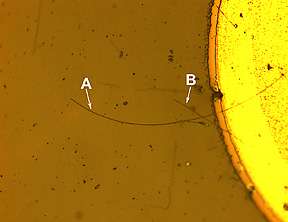
Micrograph of a complete nanowire LED with the end contact. The long nanowire (A) is about 110 micrometers long, a shorter nanowire (B) crosses it. The bright circular section is the metal post from which the nanowires are aligned.

Researchers at the National Institute of Standards and Technology (NIST), in collaboration with scientists from the University of Maryland and Howard University, have developed a technique to create tiny, highly efficient light-emitting diodes (LEDs) from nanowires.

As described in a recent paper, the fabricated LEDs emit ultraviolet light—a key wavelength range required for many light-based nanotechnologies, including data storage—and the assembly technique is well-suited for scaling to commercial production.
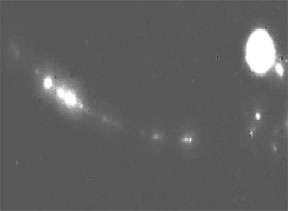
Optical image of the same nanowire in action

. Most of the light emitted from the device is in the ultraviolet portion of the spectrum, but enough visible light is generated to see it glowing.

Light-based nanoscale devices, such as LEDs, could be important building blocks for a new generation of ultracompact, inexpensive technologies, including sensors and optical communications devices. Ultraviolet LEDs are particularly important for data-storage and biological sensing devices, such as detectors for airborne pathogens. Nanowires made of a particular class of semiconductors that includes aluminum nitride, gallium nitride and indium nitride are the most promising candidates for nanoscale LEDs. But, says NIST researcher Abhishek Motayed, “The current nanowire LEDs are created using tedious nanowire manipulation methods and one-by-one fabrication techniques, which makes them unsuitable for commercial realization.”

The NIST team used batch fabrication techniques, such as photolithography (printing a pattern into a material using light, similar to photography), wet etching and metal deposition. They aligned the nanowires using an electric field, eliminating the delicate and time-consuming task of placing each nanowire separately.

A key feature of the new nanowire LEDs is that they are made from a single compound, gallium nitride (GaN). Each LED consists of an “n-type” GaN nanowire placed on the surface of a “p-type” GaN thin film. “N-type” and “p-type” refer to semiconductors with, respectively, an abundance of electrons and an abundance of positively charged electron vacancies called holes. P-n junctions made from the same basic compound yield more efficient LEDs than those made with different compounds, and so can operate at lower power.

When the proper voltage is applied to the junction, it emits light with a peak wavelength of 365 nanometers, which falls squarely in the ultraviolet range. The group produced and tested more than 40 of these LEDs; all showed very similar emission properties. They also displayed excellent thermal stability—withstanding temperatures up to 750 degrees Celsius—and operational stability, showing no signs of deterioration even after two continuous hours of operation at room temperature. These properties indicate that this LED production method yields reliable, stable devices. The researchers say their method could be used to fabricate other nanowire structures as well as applications requiring a large area of nanoscale light sources.

Source: National Institute of Standards and Technology (NIST)


print this article email this article download pdf blog this article bookmark this article     Stumble it Digg this share on Facebook retweet share on Reddit add to delicious
Rate this story - 4.4 /5 (22 votes)


May 25, 2007 all stories

Comments: 0

4.4 /5 (22 votes)
  • Stumble this up

  • Digg this

  • share this

  • hide
  • Related Stories

  • Transforming nanowires into nano-tools using cation exchange reactions
    created Oct 23, 2009 | popularity not rated yet | comments 0
  • New material could efficiently power tiny generators
    created Oct 22, 2009 | popularity not rated yet | comments 0
  • New fabrication technique yields nanoscale UV LEDs
    created Jun 13, 2007 | popularity not rated yet | comments 0
  • Nanosys Announces Issued Patent Covering Fundamental Nanowire Heterostructures
    created May 06, 2005 | popularity not rated yet | comments 0
  • Solar Cells with LEDs Provide Inexpensive Lighting
    created Nov 09, 2009 | popularity not rated yet | comments 0


  • hide
  • Relevant PhysicsForums posts

Other News

Peptides control crystal growth with 'switches, throttles and brakes'

Peptides control crystal growth with 'switches, throttles and brakes'

Nanotechnology / Bio & Medicine

created 14 hours ago | popularity 5 / 5 (3) | comments 0

(PhysOrg.com) -- By producing some of the highest resolution images of peptides attaching to mineral surfaces, scientists have a deeper understanding how biomolecules manipulate the growth crystals. This research ...


Water droplets direct self-assembly process in thin-film materials

Nanotechnology / Nanomaterials

created 13 hours ago | popularity 5 / 5 (4) | comments 2

You can think of it as origami - very high-tech origami. Researchers at the University of Illinois have developed a technique for fabricating three-dimensional, single-crystalline silicon structures from thin films by coupling ...


Nanoparticles used in common household items caused genetic damage in mice

Nanotechnology / Bio & Medicine

created Nov 16, 2009 | popularity 4.8 / 5 (24) | comments 11

Titanium dioxide (TiO2) nanoparticles, found in everything from cosmetics to sunscreen to paint to vitamins, caused systemic genetic damage in mice, according to a comprehensive study conducted by researchers at UCLA's Jonsson ...


Nanotube defects equal better energy and storage systems

Nanotube defects equal better energy and storage systems

Nanotechnology / Nanomaterials

created Nov 19, 2009 | popularity 4.4 / 5 (10) | comments 2

(PhysOrg.com) -- Most people would like to be able to charge their cell phones and other personal electronics quickly and not too often. A recent discovery made by UC San Diego engineers could lead to carbon ...


Using superconducting probes to get a picture of what it's like inside CNTs

Nanotechnology / Nanophysics

created Nov 20, 2009 | popularity 4.4 / 5 (9) | comments 0

(PhysOrg.com) -- "Carbon nanotubes are exciting for fundamental physics, and for potential technological applications," Nadya Mason tells PhysOrg.com. "However, we are generally limited in the way that we can study them. ...