Skimmed milk -- Straight from the cow
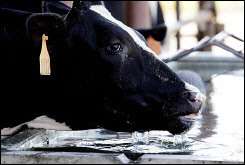
May 28, 2007 A dairy cow drinks water from a trough

Herds of cows producing skimmed milk could soon be roaming our pastures, reports Cath O’Driscoll in Chemistry & Industry, the magazine of the SCI. Scientists in New Zealand have discovered that some cows have genes that give them a natural ability to produce skimmed milk and plan to use this information to breed herds of milkers producing only skimmed milk.

The researchers also plan to breed commercial herds producing milk with the unique characteristics required to make a butter that is spreadable straight from the fridge. They have already identified a cow, Marge, with the genes required to do this and say a commercial herd is likely by 2011. The milk is very low in saturated fats and so should be high in polyunsaturates and monounsaturated fats.

Experts say that the discovery of these rogue milkers could completely revolutionise the dairy industry. Ed Komorowski, technical director at Dairy UK says that the New Zealand approach could be used to breed cows that still produce full-fat milk but with only the good fats, which could swing things back in favour of full-fat milk. In the UK, for example, only 25% of milk sold is full fat. ‘In future if whole milk can be made to contain unsaturated fats – which are good for you – then it might mean that people change back to whole milk products. The big thing about dairy products is taste, so this would be a way of giving the benefits of taste without the disadvantage of saturated fats,’ according to Komorowski.

This may also overcome the problem of waste. ‘If you can genetically produce milk without fat then that may turn out to be a very good solution to what might later be a big disposal issue,’ says Komorowski. Producing skimmed and semi-skimmed milk means there is a lot of fat left over.

Komorowski noted, however, that although the lower-fat milk may be healthier, it will be interesting to see how much milk the cows actually produce.

The rogue cows were discovered when biotech company ViaLactia screened the range of milk compositions across the entire herd of 4m New Zealand cattle. New Zealand dairy firm Fonterra has already made milk products from Marge’s milk and they maintain the positive taste.


Source: Society of Chemical Industry


print this article email this article download pdf blog this article bookmark this article     Stumble it Digg this share on Facebook retweet share on Reddit add to delicious
Rate this story - 3.8 /5 (9 votes)


May 28, 2007 all stories

Comments: 0

3.8 /5 (9 votes)
  • Stumble this up

  • Digg this

  • share this

  • hide
  • Related Stories

  • Give thanks to the bee
    created Nov 24, 2009 | popularity not rated yet | comments 0
  • Colorado county copes with methane mystery
    created Nov 02, 2009 | popularity not rated yet | comments 0
  • Study of baby teeth yields new findings on nuclear fallout
    created Oct 21, 2009 | popularity not rated yet | comments 0
  • The 2009 Ig Nobel prizewinners
    created Oct 05, 2009 | popularity not rated yet | comments 0
  • New labels might decrease overall demand for milk
    created Oct 02, 2009 | popularity not rated yet | comments 0


Other News

The six elephants in Sierra Leone were shot and "crudely butchered"

S.Leone elephants 'wiped out' by poachers: official

Biology / Ecology

created 5 hours ago | popularity 5 / 5 (3) | comments 3

Poachers "wiped out" the entire elephant herd in Sierra Leone's only wildlife park, wildlife managers said Thursday after police said they had arrested a gang of 10 poachers.


Knockouts in human cells point to pathogenic targets

Knockouts in human cells point to pathogenic targets

Biology / Cell & Microbiology

created 7 hours ago | popularity not rated yet | comments 0

(PhysOrg.com) -- Whitehead researchers have developed a new approach for genetics in human cells and used this technique to identify specific genes and proteins required for pathogens.


Whiteflies sabotage alarm system of plant in distress

Whiteflies sabotage alarm system of plant in distress

Biology / Plants & Animals

created 8 hours ago | popularity 5 / 5 (1) | comments 0

(PhysOrg.com) -- When spider mites attack a bean plant, the plant responds by producing odours which attract predatory mites. These predatory mites then exterminate the spider mite population, thus acting ...


First-ever blueprint of a minimal cell is more complex than expected

First-ever blueprint of a minimal cell is more complex than expected

Biology / Cell & Microbiology

created 3 hours ago | popularity 5 / 5 (6) | comments 0

What are the bare essentials of life, the indispensable ingredients required to produce a cell that can survive on its own? Can we describe the molecular anatomy of a cell, and understand how an entire organism ...


Ecological speciation by sexual selection on good genes: Is speciation adaptive?

Biology / Ecology

created 3 hours ago | popularity not rated yet | comments 0

Darwin suggested that the action of natural selection can produce new species, but 150 years after the publication of his famous book, 'On the Origin of Species', debate still continues on the mechanisms of speciation. New ...