How nerve cells stay in shape
Nerve cells store and transmit information via special contact sites called synapses. Synapses also play a role in determining what we remember and what we forget. When we learn, both the structure and the functional characteristics of these contact sites change. Scientists are only now beginning to understand the molecular processes which cause that change.
Researchers led by Michael Kiebler at the Max Planck Institute for Developmental Biology in Tabingen (now at the Center for Brain Research, University of Vienna) have identified a protein that is essential for the maintenance of synapses: if the protein Staufen2 is removed in a nerve cell, the cell loses a large portion of its synapses. Moreover, signalling at the remaining contact sites is significantly impaired. Staufen proteins are involved in the transport of molecular blueprints (mRNAs) to specific locations in a cell. The disturbance in the structure and function of synapses without Staufen2 protein suggests that mRNA transport to synapses is crucial to their maintenance and the storage of memory (Journal of Cell Biology, January 17, 2006).
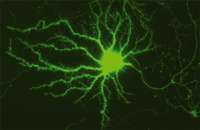
Nerve cells receive signals from other nerve cells via dendrites, which branch out like the branches of a tree. The cell-body receives incoming information, and transmits it further through the axon, a long projection from the cell. Nerve cells make contact with each other at highly-specialised locations known as synapses. There, information is not only passively transmitted. Synapses can, depending on input, change and in this way store new memory.
A synapse has two parts: one originates from the axon of the sending cell, the other, from a dendrite of the receiving cell (see image). Both parts comprise a special set of molecules, which clearly distinguishes them from the rest of the cell. Furthermore, these contact sites can change structure and characteristics with incoming signals. In dendrites, these changes can only happen when certain proteins are produced at the synapse. A prerequisite for protein synthesis, however, is that the mRNAs carrying the "blueprint" of the protein actually arrive at the synapse. The mRNAs have to be recognized by special RNA-binding proteins and transported to the synapses, which in some cases are a considerable distance from the cell body. Staufen2 protein is involved in this transport process.
Bernhard Goetze and Paolo Macchi have, for the first time, shown that the protein Staufen2 is required to maintain synapses. The researchers knocked-down different proteins in the nerve cells. If the brain-specific Staufen2 protein was missing, the architecture of the synapses was severely disturbed. Instead of a number of mushroom-shaped dendritic spines, the cell only produced long, thin protuberances, similar in shape to immature synapses. A more detailed analysis of the actin cytoskeleton offered the first evidence for a possible explanation for the observed synapse changes. Actin is a central protein in the cell's skeleton, which keeps synapses in shape. Formless synapses in Staufen2-deficient nerve cells have significantly fewer actin fibres than normal synapses. The mRNA for actin is normally transported into dendrites and locally translated into protein there. If there is no Staufen2 to function as a transport protein in the nerve cells, a lesser amount of mRNA makes it to the synapse - this could explain its altered shape.
"We wanted to know if Staufen2-deficient nerve cells can still transmit signals," explains Michael Kiebler. In order to determine this, researchers collaborated with Stefan Boehm's group at the Medical University of Vienna's Institute of Pharmacology. Measurements of electrical activity at individual synapses showed impaired signal transmission in cells lacking Staufen2 protein. "This was important evidence that Staufen2 is necessary for the formation of functional synapses in nerve cells," Kiebler says. His group thus creates the first conceptual link between molecular processes in the receiving part of the nerve cell and changes in the structure and function of its synapses. This could lead to a better understanding of molecular mechanisms, which lie at the heart of the brain's ability to learn and to remember.
Source: Max-Planck-Gesellschaft


