Hubble photographs grand spiral galaxy Messier 81
May 29, 2007 Hubble photographs grand spiral galaxy Messier 81

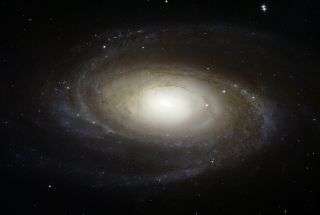
The sharpest image ever taken of the large "grand design" spiral galaxy M81 is being released today at the American Astronomical Society Meeting in Honolulu, Hawaii. A spiral-shaped system of stars, dust, and gas clouds, the galaxy's arms wind all the way down into the nucleus. Though the galaxy is located 11.6 million light-years away, the Hubble Space Telescope's view is so sharp that it can resolve individual stars, along with open star clusters, globular star clusters, and even glowing regions of fluorescent gas. The Hubble data was taken with the Advanced Camera for Surveys in 2004 through 2006. This colour composite was assembled from images taken in blue, visible, and infrared light.

The beautiful galaxy Messier 81 is tilted at an oblique angle on to our line of sight, giving a "birds-eye view" of the spiral structure. The galaxy is similar to our Milky Way, but our favourable view provides a better picture of the typical architecture of spiral galaxies. Though the galaxy is 11.6 million light-years away, the vision of the NASA/ESA Hubble Space Telescope is so sharp that it can resolve individual stars, along with open star clusters, globular star clusters, and even glowing regions of fluorescent gas.

The spiral arms, which wind all the way down into the nucleus, are made up of young, bluish, hot stars formed in the past few million years. They also host a population of stars formed in an episode of star formation that started about 600 million years ago. The greenish regions are dense areas of bright star formation. The ultraviolet light from hot young stars are fluorescing the surrounding clouds of hydrogen gas. A number of sinuous dust lanes also wind all the way into the nucleus of Messier 81.

The galaxy’s central bulge contains much older, redder stars. It is significantly larger than the Milky Way's bulge. The central black hole is 70 million solar masses, or 15 times the mass of the Milky Way's black hole. Previous Hubble research shows that the size of the central black hole in a galaxy is proportional to the mass of a galaxy’s bulge.

Messier 81 may be undergoing a surge of star formation along the spiral arms due to a close encounter it may have had with its nearby spiral galaxy NGC 3077 and a nearby starburst galaxy (Messier 82) about 300 million years ago. Astronomers plan to use the Hubble image to study the star formation history of the galaxy and how this history relates to the neutron stars and black holes seen in X-ray observations of Messier 81 with NASA’s Chandra X-ray Observatory.

Messier 81 is one of the brightest galaxies that can be seen from the Earth. It is high in the northern sky in the constellation Ursa Major, the Great Bear. At an apparent magnitude of 6.8 it is just at the limit of naked-eye visibility. The galaxy's angular size is about the same as that of the Full Moon.

The Hubble data was taken with the Advanced Camera for Surveys in 2004 through 2006. The colour composite measures 22,620 x 15,200 pixels and was assembled from images taken in blue, visible, and infrared light. It was released today at the American Astronomical Society Meeting in Honolulu, Hawaii, USA.

Souce: ESA


print this article email this article download pdf blog this article bookmark this article     Stumble it Digg this share on Facebook retweet share on Reddit add to delicious
Rate this story - 4.1 /5 (20 votes)


May 29, 2007 all stories

Comments: 0

4.1 /5 (20 votes)
  • Stumble this up

  • Digg this

  • share this

  • hide
  • Related Stories

  • Hubble Image Showcases Star Birth in M83, the Southern Pinwheel
    created Nov 05, 2009 | popularity not rated yet | comments 0
  • University of Utah celebrates telescope's 'first light'
    created Nov 04, 2009 | popularity not rated yet | comments 0
  • The Ring Nebula
    created Nov 02, 2009 | popularity not rated yet | comments 0
  • The Milky Way's tiny but tough galactic neighbor
    created Oct 14, 2009 | popularity not rated yet | comments 0
  • Heart of a galaxy emits gamma rays
    created Oct 02, 2009 | popularity not rated yet | comments 0


  • hide
  • Relevant PhysicsForums posts

Other News

2 Earth-sized bodies with oxygen rich atmospheres found -- but they're stars not planets

Two Earth-sized bodies with oxygen rich atmospheres found -- but they're stars not planets

Space & Earth / Astronomy

created 9 hours ago | popularity 4.6 / 5 (11) | comments 1

(PhysOrg.com) -- Astrophysicists at the University of Warwick and Kiel University have discovered two earth sized bodies with oxygen rich atmospheres - however there is a bit of a disappointing snag for anyone ...


Greenland ice cap melting faster than ever

Greenland ice cap melting faster than ever

Space & Earth / Earth Sciences

created 9 hours ago | popularity 3.6 / 5 (16) | comments 10

Satellite observations and a state-of-the art regional atmospheric model have independently confirmed that the Greenland ice sheet is loosing mass at an accelerating rate, reports a new study in Science.


A faraway planet intrigues: Exoplanet with extremely tilted orbit raises new interest in stellar astronomy

A faraway planet intrigues: Exoplanet with extremely tilted orbit raises new interest in stellar astronomy

Space & Earth / Astronomy

created 16 hours ago | popularity 4.8 / 5 (9) | comments 5

(PhysOrg.com) -- Two teams of astronomers have found a planet outside the solar system that might be orbiting backwards compared to its star's rotation, a discovery that could shed light on how unique the ...


Research gives new insights into 4 billion year-old meteorites

Research gives new insights into 4 billion year-old meteorites

Space & Earth / Astronomy

created 7 hours ago | popularity not rated yet | comments 0

(PhysOrg.com) -- Scientists have gained new insight into the makeup of ancient meteorites called Carbonaceous Chondrites, in research published in the October edition of the journal Earth Science and Planetary Le ...


NASA to Begin Attempts to Free Sand-Trapped Mars Rover

NASA to Begin Attempts to Free Sand-Trapped Mars Rover

Space & Earth / Space Exploration

created 8 hours ago | popularity not rated yet | comments 0

(PhysOrg.com) -- NASA will begin transmitting commands to its Mars exploration rover Spirit on Monday as part of an escape plan to free the venerable robot from its Martian sand trap.