Study Finds Evolution Doesn't Always Favor Bigger Animals
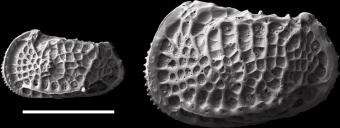
Biologists have long believed that bigger is better when it comes to body size, since many lineages of animals, from horses to dinosaurs, have evolved into larger species over time. But a study published this week by two biologists at the University of California, San Diego in an early online edition of the Proceedings of the National Academy of Sciences suggests that maxim, known as “Cope’s Rule,” may be only partly true.
The scientists found that populations of tiny crustaceans retrieved from deep-sea sediments over the past 40 million years grew bigger and evolved into larger species, as might be predicted from Cope’s Rule. However, the changes in the sizes of these clam-like crustaceans commonly known as ostracodes —from the genus Poseidonamicus — increased only when the global ocean temperature cooled. When temperatures remained stable, not much happened to body size.
“These data show a very nice correlation between temperature and body size,” said Kaustuv Roy, a professor of biology at UCSD and a coauthor of the paper.
“Although not the most glamorous of fossils, deep-sea ostracodes are very useful for this question because they have a rich fossil record, which allows us to reconstruct the evolution of body size in great detail,” said Gene Hunt, who designed and conducted the study while postdoctoral fellow at UCSD.
“Scientists have been interested in how body size evolves for a long time, but there is a lot of uncertainty about what factors are most important in determining whether animals get bigger or smaller over time,” added Hunt, now a curator at the National Museum of Natural History in Washington, DC.
The two scientists said their data suggest that Cope’s Rule—named for Edward Cope, a 19 th century American paleontologist who claimed the fossil record showed that lineages became larger over time—may simply be an evolutionary manifestation of Bergmann’s Rule, which holds that animals increase in mass in colder environments.
Biologists had long assumed that Bergmann’s Rule—named after the 19 th century German biologist Christian Bergmann—reflected the adaptation of warm-blooded animals to become larger when they move in colder environments. The reason: Bigger animals have smaller surface to volume ratios and can more effectively conserve heat in cold environments. Similarly, smaller animals with larger surface to volume ratios are better adapted to warmer environments where they can more effectively dissipate heat.
However, this simple relationship doesn’t explain why ostracodes and other cold-blooded creatures that do not regulate their internal body temperatures, such as mollusks to turtles, also follow this rule.
“It is a bit of a puzzle why Bergmann's Rule holds in cold-blooded animals like ostracodes,” said Hunt.
Hunt and Roy found that as ocean temperatures declined by some 10 degrees centigrade, from 40 million years ago to the present day, the overall size of the deep-sea ostracode Poseidonamicus dramatically increased.
“It’s not just that the small species got replaced by a larger species,” said Roy. “The same species, the same lineage got bigger over time.”
In addition, the biologists discovered that the body size increases in nine species of ostracodes that evolved over that 40 million year span were commensurate with the change expected given how much the ocean temperatures decreased over this time and how body sizes of living ostracodes vary with temperature. On average, for every degree centigrade of climatic cooling, each of the species of Poseidonamicus increased in length by about 29 micrometers.
Hunt and Roy said biologists are uncertain what may be triggering this biological response to larger size from cool environments. Nevertheless, the UCSD study is important because it establishes a firm link between climatic change and the body size of organisms, paving the way for a better understanding of the evolution of body size in fossil organisms as well as in environments that are now being impacted by global warming.
“There’s still a huge debate over what drives Cope’s Rule, but our study shows that climate change can undoubtedly play an important role” said Roy.
For much of the past 40 million years, global climate has been exhibiting a steady cooling trend. But within the last century, as greenhouse emissions have accumulated in our atmosphere, temperatures have rapidly warmed.
“If you look at most of life today, they’ve all been adapted to a world getting gradually cooler,” said Roy. “But our future is destined to be significantly warmer. What are animals going to look like when everything must adapt to a warmer world? Size correlates with many aspects of the biology of an animal so changes in size are likely to translate into substantial ecological changes. A better prediction of the biological effects of future global change requires that, among other things, we understand how climate change shapes body size evolution.”
Source: University of California, San Diego


