New research shows sharks use their noses and bodies to locate smells
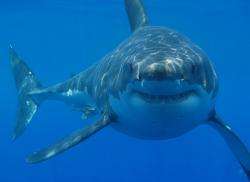
Sharks are known to have a keen sense of smell, which in many species is critical for finding food. However, according to new research from Boston University marine biologists, sharks can not use just their noses to locate prey; they also need their skin – specifically a location called the lateral line. The lateral line is an organ used by all fish to detect, with exquisite sensitivity, movement and vibration in the surrounding water. According to the research team, this is similar to how humans can sense air flow with the small hairs on the face. Until now, it had not been demonstrated that the lateral line also aids in the tracking of odor plumes.
"Odor plumes are complex, dynamic, three-dimensional structures used by many animal species to locate food, mates, and home sites. However, odor itself has no directional properties, so animals must use a variety of senses to get the directional information for a smell," said Jelle Atema, professor of biology at Boston University and study co-author.
The new study examined the contribution of the olfactory system, the lateral line, and vision in odor source detection and localization in the smooth dogfish shark. The results, which appear in the June 1 issue of the Journal of Experimental Biology, show that this shark is severely handicapped in its ability to locate the source of an odor when deprived of information from its lateral line, particularly in the dark.
According to Atema, since most odor plumes disperse in patches, fish locate odor sources through a process referred to as "eddy chemotaxis," or the tracking of odor and turbulence simultaneously.
"We might see odor and turbulent eddies in the oily wake behind a boat. A moving animal, similarly, leaves behind a trail of turbulent eddies flavored by its body odor," explained Atema.
In an eight meter flume in the lab, Atema and Jayne Gardiner, a recently graduated Boston University Marine Program (BUMP) Masters student and study co-author, created two parallel, turbulent odor plumes – one using squid scent and the other a plain seawater control. Minimally turbulent ‘oozing’ sources of squid odor and seawater control were physically separated from sources of major turbulence by placing a brick downstream from each oozing source to create two turbulent wakes with one or the other flavored with food odor. This produced four separate smell targets for the sharks to locate.
"In addition, we also tested the sharks under two light conditions – fluorescent and infrared – and in two sensory conditions – with their lateral lines intact or lesioned by streptomycin," explained Gardiner.
According to the researchers, streptomycin, an antibiotic, interferes with the normal function of motion sensitive "hair cells," the receptor cells of the lateral line. At high doses it has been known to cause hearing and equilibrium problems in humans, senses that are also based on hair cells.
Sharks with their lateral lines intact demonstrated a preference for the odor plume over the seawater plume and, more specifically, for the odor source with the higher turbulence (the brick on the odor side) over the source of the odor alone (the odor-oozing nozzle). Plume and target preference and search time were not significantly affected by light condition.
In the light, lesioning the lateral line increased search time, but did not affect success rate or plume preference. However, lesioned animals no longer discriminated between sources of turbulent and oozing odor. In the dark, search time of lesioned animals further increased, and the few animals that located any of the targets did not discriminate between odor and seawater plumes, let alone targets.
"These results demonstrate for the first time that sharks require both olfactory and lateral line input for efficient and precise tracking of odor-flavored wakes and that visual input can improve food-finding when lateral line information is not available," said Atema. "Since dogfish feed primarily in the dark hunting for crabs, lobsters, shrimp and small fish, their reliance on information from their lateral line is essential. The results are interesting for our understanding of animal navigation under water and for the development of guidance of autonomous underwater vehicles (AUVs)"
Source: Boston University


