Natural compound and exercise boost memory in mice
May 30, 2007
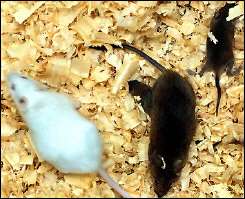
Lab mice

[B]May help protect against cognitive decline in aging[/B]
A natural compound found in blueberries, tea, grapes, and cocoa enhances memory in mice, according to newly published research. This effect increased further when mice also exercised regularly.

"This finding is an important advance because it identifies a single natural chemical with memory-enhancing effects, suggesting that it may be possible to optimize brain function by combining exercise and dietary supplementation," says Mark Mattson, PhD, at the National Institute on Aging.

The compound, epicatechin, is one of a group of chemicals known as flavonols and has been shown previously to improve cardiovascular function in people and increase blood flow in the brain. Flavonols are found in some chocolate. Henriette van Praag, PhD, of the Salk Institute, and colleagues there and at Mars, Inc., showed that the combination of exercise and a diet with epicatechin also promoted structural and functional changes in the dentate gyrus, a part of the brain involved in the formation of learning and memory. The findings, published in the May 30 issue of The Journal of Neuroscience, suggest that a diet rich in flavonols may help reduce the incidence or severity of neurodegenerative disease or cognitive disorders related to aging.

Van Praag and her team compared mice fed a typical diet with those fed a diet supplemented with epicatechin. Half the mice in each group were allowed to run on a wheel for two hours each day. After a month, the mice were trained to find a platform hidden in a pool of water. Those that both exercised and ate the epicatechin diet remembered the location of the platform longer than the other mice.

When studying their brains, van Praag and her colleagues found that these mice had greater blood vessel growth in the dentate gyrus and had developed more mature nerve cells, suggesting an enhanced ability of the cells to communicate. Further analysis showed that the epicatechin and exercise combination had a beneficial effect on the expression of genes important for learning and memory, and decreased the activity of genes playing a role in inflammation and neurodegeneration.

The researchers found that sedentary mice fed epicatechin showed enhanced memory, blood vessel growth, and gene activity, but these benefits were even more evident in mice that also exercised.

Source: Society for Neuroscience

4.5 /5 (34 votes)  

Rank 4.5 /5 (34 votes)
Tags

Relevant PhysicsForums posts

More news stories

The power of estrogen -- male snakes attract other males

A new study has shown that boosting the estrogen levels of male garter snakes causes them to secrete the same pheromones that females use to attract suitors, and turned the males into just about the sexiest ...

Biology / Plants & Animals

created 6 hours ago | popularity 5 / 5 (1) | comments 0 | with audio podcast

Experts reveal how plants don't get sunburn

(PhysOrg.com) -- Experts at the University of Glasgow have discovered how plants survive the harmful rays of the sun.

Biology / Cell & Microbiology

created 6 hours ago | popularity 5 / 5 (2) | comments 0 | with audio podcast

Grass to gas: Researchers' genome map speeds biofuel development

Researchers at the University of Georgia have taken a major step in the ongoing effort to find sources of cleaner, renewable energy by mapping the genomes of two originator cells of Miscanthus x giganteus, a large perenn ...

Biology / Biotechnology

created 3 hours ago | popularity 3.7 / 5 (3) | comments 0 | with audio podcast

Protein libraries in a snap

(PhysOrg.com) -- A Rice University undergraduate will depart with not only a degree but also a possible patent for his invention of an efficient way to create protein libraries, an important component of biomolecular ...

Biology / Cell & Microbiology

created 9 hours ago | popularity 5 / 5 (2) | comments 0 | with audio podcast

Miami battling invasion of giant African snails

No one knows how they got there. But an invasion of African giant snails has southern Florida in a panic over potential crop damage, disease and general yuckiness surrounding the slimy gastropods.

Biology / Ecology

created 10 hours ago | popularity not rated yet | comments 2


Complex wiring of the nervous system may rely on a just a handful of genes and proteins

Researchers at the Salk Institute have discovered a startling feature of early brain development that helps to explain how complex neuron wiring patterns are programmed using just a handful of critical genes. ...

CIA website offline, Anonymous takes credit

The website of the Central Intelligence Agency was unresponsive on Friday after the hacker group Anonymous claimed to have knocked it offline.

Q&A: Obama and the birth control controversy

(AP) -- What birth control debate? A half-century after the introduction of the pill, acceptance of birth control by American women is virtually universal.

Human cognitive performance suffers following natural disasters, researchers find

Not surprisingly, victims of a natural disaster can experience stress and anxiety, but a new study indicates that it might also cause them to make more errors - some serious - in their daily lives. In their upcoming Human Fa ...

New error-correcting codes guarantee the fastest possible rate of data transmission

Error-correcting codes are one of the triumphs of the digital age. They’re a way of encoding information so that it can be transmitted across a communication channel — such as an optical fiber o ...

Both maternal and paternal age linked to autism

Older maternal and paternal age are jointly associated with having a child with autism, according to a recently published study led by researchers at The University of Texas Health Science Center at Houston (UTHealth).