Huge wind machine to simulate category three hurricanes
May 30, 2007
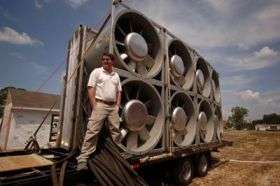
University of Florida wind engineering researcher Forrest Masters stands on a newly completed, fully portable hurricane wind simulator on May 29, 2007.
It will huff, and puff, and blow the house in — but only for research purposes. Two days before the June 1 start of the 2007 hurricane season, University of Florida wind engineers unveiled the world’s largest portable hurricane wind and rain simulator. Mounted on a trailer, the industrial-sized behemoth is composed of eight 5-foot-tall industrial fans powered by four marine diesel engines that together produce 2,800 horsepower. To cool the engines, the system taps water from a 5,000-gallon tank aboard a truck that doubles as the simulator’s tow vehicle.
UF civil and coastal engineers plan to use the simulator to blast vacant homes with winds of up to 130 mph — Category 3 on the Saffir-Simpson Hurricane Scale — and high-pressure water jets that mimic wind-driven torrential rain.
The goal: to learn more about exactly how hurricanes damage homes, and how to modify them to best prevent that damage.
“We want to conduct experiments to evaluate real homes in communities that are impacted by hurricanes,” said Forrest Masters, an assistant professor of civil and coastal engineering and the leader of the project. “This simulator also gives us the ability to test home retrofits and new building products aimed at preventing hurricane damage.”
The simulator, which cost about $500,000 in parts and labor, was designed and constructed entirely by Masters, lab manager Jimmy Jesteadt and a team of undergraduate students.
It is one of a kind.
Unlike previous, smaller simulators, the new simulator uses an innovative hydraulic system, rather than chains or mechanical drive trains, to transfer power from the engines to the fans. Designed by Linde Hydraulics Corporation and Cunningham Fluid Power Inc., the engines spin pumps, which then drive fluid through motors housed in the fans. The result is lighter, less bulky and safer than traditional drive systems, Masters said.
At full power, the fans turn at about 1,800 revolutions per minute, producing wind speeds of about 100 mph. A custom-built duct reduces the space available for the air to flow through, ratcheting up the wind speeds to a potential 130 mph. Steering vanes allow the engineers to direct the air wherever they want it to blow.
Implanted in the vanes, the water jets can simulate the most extreme rainfall of up to 35 inches per hour, although 8 inches per hour is more typical, Masters said.
The simulator is the latest addition to a growing arsenal of hurricane research equipment designed and assembled by UF wind engineering researchers trying to learn more about ground-level hurricane winds and how they affect structures. In a related project, the researchers built several portable hurricane wind monitoring towers that were deployed in the path of land-falling hurricanes in recent years.
“When this program first started, we brought the lab to the hurricane,” Masters said. “Now, we’re bringing the hurricane back to the lab.”
Rick Dixon, executive director of the Florida Building Commission, said state officials began to tap UF research for help in strengthening the state’s hurricane-related building codes shortly after Hurricane Andrew in 1992.
The 2004 storms showed that while improved codes were effective in preventing catastrophic building failures, challenges remained in blocking wind and water intrusion, he said. It will take more research to learn how to protect windows, doors, soffits, roof coverings and other so-called “components and claddings” – research for which the new wind simulator will be pivotal, he said.
“The test facility that Forrest has built allows us to evaluate those components and claddings and determine where they are failing,” he said. “So if the building code establishes minimum performances, than that can give us new standards for upgrading the building code.”
Source: University of Florida
-
CIMAS, NOAA research conduct innovative investigations to study Hurricane Earl
Sep 07, 2010 |
not rated yet |
0
-
Report on Texas fire urges firefighters to consider wind effects
Feb 08, 2012 |
not rated yet |
0
-
Sandia tool determines value of solar photovoltaic power systems
Jan 31, 2012 |
4 / 5 (2) |
0
-
Scientists make progress in assessing tornado seasons
Jan 19, 2012 |
4.5 / 5 (2) |
2
-
NASA satellite sees birth of Tropical Storm Ethel, now threatening Rodrigues
Jan 19, 2012 |
5 / 5 (2) |
0
-
Engineers build first sub-10-nm carbon nanotube transistor
Feb 01, 2012 |
4.9 / 5 (31) |
30
-
Something old, something new: Evolution and the structural divergence of duplicate genes
Jan 31, 2012 |
4.6 / 5 (7) |
1
-
The hidden nanoworld of ice crystals: Revealing the dynamic behavior of quasi-liquid layers
Jan 30, 2012 |
5 / 5 (3) |
1
-
Stock market network reveals investor clustering
Jan 27, 2012 |
3.9 / 5 (23) |
8
-
Of microchemistry and molecules: Electronic microfluidic device synthesizes biocompatible probes
Jan 26, 2012 |
5 / 5 (1) |
0
-
Need help reading 3-D
9 hours ago
-
A way to send and receive wireless data
15 hours ago
-
Tabletop Cold Fusion Reactor
16 hours ago
-
Calling function with no input argument
Feb 10, 2012
-
Force free body diagram problem on gym equipment
Feb 10, 2012
-
Empirical data regarding shower heads and water
Feb 10, 2012
- More from Physics Forums - General Engineering
More news stories
Walney offshore wind farm is world's biggest (for now)
(PhysOrg.com) -- The Walney wind farm on the Irish Sea--characterized by high tides, waves and windy weather--officially opened this week. The farm is treated in the press as a very big deal as the Walney ...
GPS court ruling leaves US phone tracking unclear
A US Supreme Court decision requiring a warrant to place a GPS device on the car of a criminal suspect leaves unresolved the bigger issue of police tracking using mobile phones, legal experts say.
18 hours ago |
4 / 5 (2) |
0
Europeans protest controversial Internet pact
Tens of thousands of people marched in protests in more than a dozen European cities Saturday against a controversial anti-online piracy pact that critics say could curtail Internet freedom.
14 hours ago |
4.5 / 5 (8) |
0
Netflix settlement trims 14 pct off 4Q earnings
(AP) -- Netflix pressed the rewind button on its fourth-quarter earnings after settling allegations that the video subscription service violated a consumer-privacy law.
18 hours ago |
not rated yet |
0
Navy to begin tests on electromagnetic railgun prototype launcher
The Office of Naval Research (ONR)'s Electromagnetic (EM) Railgun program will take an important step forward in the coming weeks when the first industry railgun prototype launcher is tested at a facility ...
Feb 06, 2012 |
4.7 / 5 (15) |
92
|
Europe stakes billion-dollar bet on new rocket
A pencil-slim rocket is scheduled to lift into space from South America on Monday, carrying a billion-dollar bet that Europe can grab a juicy slice of the market to place satellites in low orbit.
Study finds that anti-diabetic medication can prevent the long-term effects of maternal obesity
In a study to be presented today at the Society for Maternal-Fetal Medicine's annual meeting, The Pregnancy Meeting, in Dallas, Texas, researchers will report findings that show that short therapy with the anti-diabetic medication ...
Explained: Sigma
It's a question that arises with virtually every major new finding in science or medicine: What makes a result reliable enough to be taken seriously? The answer has to do with statistical significance -- but ...
Political leaders play key role in how worried Americans are by climate change: study
More than extreme weather events and the work of scientists, it is national political leaders who influence how much Americans worry about the threat of climate change, new research finds.
New power source discovered
(PhysOrg.com) -- Researchers at the Massachusetts Institute of Technology (MIT) and RMIT University have made a breakthrough in energy storage and power generation.
NASA budget will axe Mars deal with Europe: scientists
US President Barack Obama's budget proposal to be submitted next week for 2013 will cut NASA's budget by 20 percent and eliminate a major partnership with Europe on Mars exploration, scientists said Thursday.