Northeastern University researchers solve Rubik's Cube in 26 moves
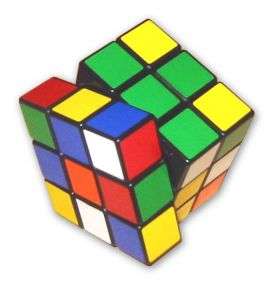
May 31, 2007 Rubik's cube

It’s a toy that most kids have played with at one time or another, but the findings of Northeastern University Computer Science professor Gene Cooperman and graduate student Dan Kunkle are not child’s play. The two have proven that 26 moves suffice to solve any configuration of a Rubik's cube – a new record. Historically the best that had been proved was 27 moves.

Why the fascination with the popular puzzle? “The Rubik's cube is a testing ground for problems of search and enumeration,” says Cooperman. “Search and enumeration is a large research area encompassing many researchers working in different disciplines – from artificial intelligence to operations. The Rubik's cube allows researchers from different disciplines to compare their methods on a single, well-known problem.”

Cooperman and Kunkle were able to accomplish this new record through two primary techniques: They used 7 terabytes of distributed disk as an extension to RAM, in order to hold some large tables and developed a new, “faster faster” way of computing moves, and even whole groups of moves, by using mathematical group theory.

Cooperman and Kunkle put all of the configurations of a Rubik's cube in a family of sets of configurations (called a family of cosets in mathematical group theory). They then looked at the result of applying a single move to all of the configurations of a coset at once. They simulated this on a computer at a rate of 100,000,000 times per second, using a new technique in mathematical group theory.

In May 1997, U.C.L.A. computer science Professor Richard Korf announced that he had found the first optimal solutions to Rubik's Cube. His research showed that the median optimal solution was 18 moves, and he believed any cube could be solved in no more than 20 moves. However, he was unable to prove this, and no one has ever been able to prove that it could be solved in less than 27 moves.

“Korf had written a program that spends a long time to find optimal solutions for single states of the Rubik's cube,” says Kunkle. “Our program first does a large pre-computation and then it very quickly - in about a second - finds a solution in 26 moves or less for any state of Rubik's cube.

Cooperman and Kunkle used computers at Teragrid (teragrid.org) and at Northeastern, part of the first node from a $200,000 grant Cooperman and colleagues received from the National Science Foundation in 2006 to obtain 20 terabytes of storage.

Rubik's Cube, invented in the late 1970s by Erno Rubik of Hungary, is perhaps the most famous combinatorial puzzle of its time. Its packaging boasts billions of combinations, which is actually an understatement. In fact, there are more than 43 quintillion (4.3252 x 10**19) different states that can be reached from any given configuration.


Source: Northeastern University


Rate this story - 4.1 /5 (74 votes)


May 31, 2007 all stories

Comments: 0

4.1 /5 (74 votes)

  • hide
  • Related Stories

  • Review: Rubik's TouchCube a little too touchy
    created Sep 23, 2009 | popularity not rated yet | comments 0
  • 15 Great iPhone Games
    created Apr 02, 2009 | popularity not rated yet | comments 0
  • Single rocket to carry 6 'private' satellites
    created Jan 19, 2009 | popularity not rated yet | comments 0
  • From cartilage to fruit-fly wings, physicist studies 'squishiness' in everyday things
    created Apr 16, 2008 | popularity not rated yet | comments 0
  • Finding ingenious design in nature
    created Feb 22, 2008 | popularity not rated yet | comments 0


  • hide
  • Relevant PhysicsForums posts

  • Regressions without calculator
    created 13 hours ago
  • please help
    created 23 hours ago
  • Angles of a quadrilateral
    created Feb 08, 2010
  • How can we know how many solutions an equation has?
    created Feb 08, 2010
  • More from Physics Forums - General Math

Other News

Study challenges bird-from-dinosaur theory of evolution - was it the other way around?

Study challenges bird-from-dinosaur theory of evolution - was it the other way around?

Other Sciences / Archaeology & Fossils

created 11 hours ago | popularity 4 / 5 (10) | comments 4 | with audio podcast

(PhysOrg.com) -- A new study just published in the Proceedings of the National Academy of Sciences provides yet more evidence that birds did not descend from ground-dwelling theropod dinosaurs, experts say, a ...


'Counterfactual' thinkers are more motivated and analytical, study suggests

Other Sciences / Social Sciences

created 15 hours ago | popularity 4.4 / 5 (5) | comments 6 | with audio podcast

(PhysOrg.com) -- "If only I had..." Almost everyone has said those four words at some time. Rather than intensifying regret, '"what if" reflection about pivotal moments in the past helps people to weave a coherent life story, ...


The Glass Cliff: Female representation in politics and business

Other Sciences / Social Sciences

created 6 hours ago | popularity not rated yet | comments 0

Leadership positions in business have proven to be precarious for women. Female business leaders are more likely to be appointed to powerful leadership positions when an organization is in crisis or high-risk circumstances. ...


Office romance? Not a problem most of time: study

Office romance? Not a problem most of time: study

Other Sciences / Social Sciences

created 13 hours ago | popularity not rated yet | comments 1

(PhysOrg.com) -- Pam and Jim on The Office. Meredith and McDreamy on Grey's Anatomy. Television shows depict many workplace romances, but in the real world how do co-workers view love on the job? According ...


Women on board: Does forced diversity hurt firm performance?

Other Sciences / Social Sciences

created 12 hours ago | popularity 1 / 5 (1) | comments 1

(PhysOrg.com) -- New SEC rules will require public firms to disclose what role, if any, diversity plays in appointing members to their corporate boards, but University of Michigan researchers say any forced restructuring ...