Lessons from the orangutans: Upright walking may have begun in the trees
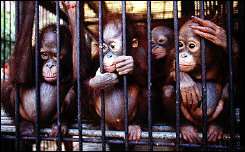
By observing wild orangutans, a research team has found that walking on two legs may have arisen in relatively ancient, tree-dwelling apes, rather than in more recent human ancestors that had already descended to the savannah, as current theory suggests.
These findings appear in the 1 June 2007 issue of the journal Science, published by AAAS, the nonprofit science society.
Upright walking, or bipedalism, has long been considered a defining feature of humans and our closest ancestors. One of the most popular explanations, known as the savannah hypothesis, suggests that the ancestors to chimps, gorillas and humans descended from the trees and began walking on the ground on all fours.
Over time, this four-legged gait would have evolved into the "knuckle-walking" that chimps and gorillas still use today and then into upright, two-legged walking in humans.
Paleontologists have conventionally used signs of bipedalism as key criteria for distinguishing early human, or "hominin," fossils from those of other apes. But, this distinction is complicated by recent fossil evidence that some early hominins, including Lucy (Australopithecus afarensis), lived in woodland environments, while even earlier forms such as Millennium Man (Orrorin) appear to have lived in the forest canopy and moved on two legs.
"Our findings blur the picture even further," said Robin Crompton of the University of Liverpool in Liverpool, Great Britain, who is one of the study's authors. "If we're right, it means you can't rely on bipedalism to tell whether you're looking at a human or other ape ancestor. It's been getting more and more difficult for us to say what's a human and what's an ape, and our work makes that much more the case."
Crompton and his colleagues, Susannah Thorpe and Roger Holder of the University of Birmingham in Birmingham, Great Britain, came to their conclusions by observing wild orangutans in Sumatra, Indonesia. Orangutans spend almost their whole lives in trees, making them useful models for how our ancestors moved around several million years ago.
To collect the data, Thorpe spent a year living in the Sumatran rainforest and recording virtually every move the orangutans made. Then, she and her colleagues used these observations to test the hypothesis that bipedalism would have benefited tree-dwelling ape ancestors.
Because these ancestors were probably fruit-eaters, as orangutans are, they would have needed a way to navigate the thin, flexible branches at the tree's periphery, where the fruit typically is. Moving on two legs and using their arms primarily for balance, or "hand-assisted bipedalism," may have helped them travel on these branches.
The researchers analyzed nearly 3,000 examples of observed orangutan movement, and found that the orangutans were more likely to use hand-assisted bipedalism when they were on the thinnest branches. When bipedal, the animals also tended to grip multiple branches with their long toes.
On medium-sized branches, the orangutans used their arms more to support their weight, changing their moving style to incorporate hanging. They only tended to walk on all fours when navigating the largest branches, the researchers found.
Hand-assisted bipedalism may have offered several advantages that allowed our arboreal ancestors to venture onto thin branches. They could have gripped multiple branches with their toes and distributed their center of gravity more effectively, while keeping one or both of their long arms free to reach for fruits and other supports.
Orangutans also keep their legs straight while standing on bending branches, the authors report. The exact benefit of the straight legs is still unclear, but when humans run on springy surfaces, we also keep our weight-bearing legs relatively straight, so this may have an energy-related advantage.
"Our results suggest that bipedalism is used to navigate the smallest branches where the tastiest fruits are, and also to reach further to help cross gaps between trees," said Thorpe.
The authors propose an evolutionary scenario that begins as other researchers have envisioned. Somewhere toward the end of the Miocene epoch (24 to 5 million years ago), climate in East and Central Africa became alternately wetter and drier, and the rainforest grew increasingly patchy. Apes living in the forest canopy would have begun to encounter gaps between trees that they could not cross at the canopy level.
The Science authors suggest that early human ancestors responded to this by abandoning the high canopy for the forest floor, where they remained bipedal and began eating food from the ground or smaller trees. The ancestors of chimps and gorillas, on the other hand, became more specialized for vertical climbing between the high canopy and the ground and thus developed knuckle-walking for crossing from one tree to another on the ground.
"Our conclusion is that arboreal bipedalism had very strong adaptive benefits. So, we don't need to explain how our ancestors could have gone from being quadrupedal to being bipedal," Thorpe said.
Observations of orangutan movement should be useful for conservation efforts, according to Thorpe. These animals are seriously endangered, primarily due to habitat destruction.
"If you can understand how they cross gaps in the forest, you can learn about effects that living in logged or degraded habitat would have on their locomotion. These could affect energy levels, for example, if they have to go to the ground, which is incredibly risky because the Sumatran tiger is down there licking its lips. The Sumatran orangutan population is predicted to be extinct in the next decade if habitat degradation continues. Our research further highlights the need for protecting these animals," she said.
Source: American Association for the Advancement of Science


