In spite of ourselves
January 18, 2006
In spite of ourselves

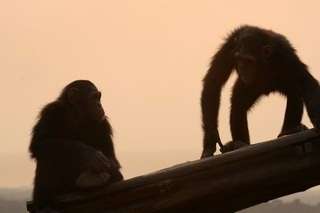
Solidarity or spite? - empathy with others, both in a positive and negative sense, appears to be a exclusive characteristic of humans. Image: Max Planck Institute for Evolutionary Anthropology

Humans have a strong desire to help each other, but is spite also part of the human condition?
In a study published in the Proceedings of the Royal Academy, Keith Jensen and colleagues from the Max Planck Institute for Evolutionary Anthropology in Leipzig, Germany looks at altruism and spite in our close cousin; the chimpanzee.

In Jensen’s study, chimpanzees from the Wolfgang Koehler Primate Research Centre in Leipzig were given a choice; by pulling on a rope they could either deliver food to another chimpanzee or they could deliver it to an empty room. In both cases, the chimpanzee pulling the rope did not receive any food itself. Contrary to initial expectations the chimpanzees behaved neither altruistic nor spiteful. According to the researchers, both characteristics therefore seem to be human-specific.

An altruistic chimpanzee would give food to its neighbour, despite the effort in pulling the food, and a spiteful chimpanzee would prevent its neighbour from having the food by delivering it to the empty room.

‘I predicted chimps would be spiteful. I thought if they knew they couldn’t have the food, they wouldn’t let anyone else have it.’ Jensen found that half the time, the chimpanzees did nothing. A quarter of the time they delivered food to their neighbour, then a quarter of the time to the empty room. This demonstrated neither altruism nor spite.

‘They didn’t seem to care about the other guy one way or the other. All that concerned them was getting the food and they were completely focused on that. Even when they knew they couldn’t have the food, they didn’t help the other chimp but they weren’t spiteful either.’

In contrast, humans are obviously altruistic. We give blood, we donate money to charity, and we volunteer to help strangers. This kind of altruism has never been demonstrated in any other animal except for humans and some believe it is one of the characteristics that makes us human. But Jensen says spite is just as important. As a form of punishment, spite can encourage cooperative behaviour by penalising cheaters.

‘Punishing others is usually costly to yourself, whether that’s the taxpayer or the lawmakers but punishment is still a natural part of modern society. We punish theft, murder and countless other crimes to keep the fabric of society together. Perhaps human society is where it is today because spite exists and there is a mechanism to punish cheaters.’

If altruism and spite are unique to humans and are not present in chimpanzees, then it is likely that these characteristics have arisen in the last 6 million years since humans and chimpanzees shared a common ancestor. Humans’ intense regard for each other, either positive or negative, may have made an important contribution to our ability to cooperate, our sense of fairness, and the morality that defines today’s society.

Source: Max Planck Institute

3.6 /5 (14 votes)  

Rank 3.6 /5 (14 votes)
Tags

Relevant PhysicsForums posts

More news stories

A frank discussion of the power law and linking correlation to causation

(PhysOrg.com) -- Michael Stumpf a mathematics professor at Imperial College in London, and Mason Porter a lecturer at Oxford have teamed together to write and publish a perspective piece in Science regarding the in ...

Other Sciences / Mathematics

created 23 hours ago | popularity 5 / 5 (5) | comments 8 | with audio podcast report

Employers feel no love for unscrupulous practice of 'service sweethearting'

A new study led by two Florida State University marketing professors finds that some frontline service employees who are rewarded for hikes in customer loyalty and satisfaction also may engage in "service ...

Other Sciences / Economics & Business

created 17 hours ago | popularity 4 / 5 (1) | comments 7

The question of life in the ancient world

There’s a general feeling that we don’t get the Greeks – ancient or modern. Many, including heads of state like Angela Merkel, visibly shake their head in exasperation, rightly or wrongly, at ...

Other Sciences / Archaeology & Fossils

created 23 hours ago | popularity 1.3 / 5 (3) | comments 4

Sonic Cradle lands spot in TED exhibition

A Simon Fraser University graduate student project that melds music, meditation and modern technology has landed a rare spot as an exhibit at TEDActive 2012 in Palm Springs, California this month.

Other Sciences / Other

created 19 hours ago | popularity not rated yet | comments 0

US workers are 'giving away the store,' costing firms billions

Nearly 70 percent of the nation's service employees give away free goods and services – from hamburgers to cable TV – costing companies billions of dollars a year, according to a groundbreaking study.

Other Sciences / Economics & Business

created Feb 09, 2012 | popularity 3.3 / 5 (3) | comments 10


Anonymous knocks CIA website offline (Update)

The website of the Central Intelligence Agency was inaccessible on Friday after the hacker group Anonymous claimed to have knocked it offline.

New error-correcting codes guarantee the fastest possible rate of data transmission

Error-correcting codes are one of the triumphs of the digital age. They’re a way of encoding information so that it can be transmitted across a communication channel — such as an optical fiber o ...

Small modular reactor design could be a 'SUPERSTAR'

(PhysOrg.com) -- Though most of today's nuclear reactors are cooled by water, we've long known that there are alternatives; in fact, the world's first nuclear-powered electricity in 1951 came from a reactor ...

New power source discovered

(PhysOrg.com) -- Researchers at the Massachusetts Institute of Technology (MIT) and RMIT University have made a breakthrough in energy storage and power generation.

The power of estrogen -- male snakes attract other males

A new study has shown that boosting the estrogen levels of male garter snakes causes them to secrete the same pheromones that females use to attract suitors, and turned the males into just about the sexiest ...

Advanced power-grid model finds low-cost, low-carbon future in West

(PhysOrg.com) -- The least expensive way for the Western U.S. to reduce greenhouse gas emissions enough to help prevent the worst consequences of global warming is to replace coal with renewable and other ...