'Cry for help' gene identified in plants
January 18, 2006
Maize plants defend themselves by attracting the enemies of their enemies

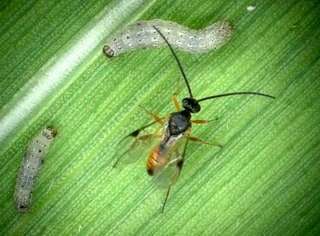
Maize plants defend themselves by attracting the enemies of their enemies: caterpillars feeding on the leaf of a corn plant are in turn attacked by a parasitic wasp. Image: University of Neuchâtel/T. Turlings

A genetic mechanism that enables corn plants to "cry for help" and attract beneficial insects has been clarified by scientists from the University of Neuchâtel, Switzerland and the Max Planck Institute for Chemical Ecology in Jena. Corn plants emit a cocktail of scents when they are attacked by certain pests, such as a caterpillar known as the Egyptian cotton leaf worm.

Parasitic wasps use these plant scents to localize the caterpillar and deposit their eggs on it, so that their offspring can feed on the caterpillar. Soon after, the caterpillar dies and the plant is relieved from its attacker. In the case of corn, only one gene, TPS10, has to be activated to attract the parasitic wasps. This gene carries information for a terpene synthase, an enzyme forming the sesquiterpene scent compounds that are released by the plant and attract wasps toward the damaged corn plant. Since this mechanism is based only on a single gene, it might be useful for the development of crop plants with a better resistance to pests (PNAS, Early Edition, January 16-20, 2006).

At least 15 species of plants are known to release scents after insect damage, thus attracting the enemies of their enemies. Scientists term this mechanism "indirect defence". A previous cooperation by the scientists in Neuchatel and Jena showed that indirect defence functions not only above ground, but also below the earth’s surface.

To understand the biochemistry behind this plant defence, biologists of the Max Planck institute studied corn plants, caterpillars of the species Spodoptera littoralis (Egyptian cotton leaf worm) and parasitic wasps of the species Cotesia marginiventris. Deciphering the complex mix of scents that the plants release after damage offered clues as to which classes of enzymes might be important for scent production.

The researchers isolated various genes encoding terpene synthases, the enzymes that produce these scents. One of these genes, TPS10, produced the exact bouquet of nine scent compounds that was released by the damaged corn plant. To demonstrate that TPS10 is indeed the important gene, the scientists introduced TPS10 into another plant, called Arabidopsis thaliana, which then released the same scents that have been observed in corn. To test whether these scents do attract the parasitic wasps, these plants were tested in an olfactometer, a device to study insect behaviour.

The researchers placed scent-producing as well as unmodified plants in the six arms of the olfactometer. When the predatory wasps were set free in the central cylinder of the olfactometer, they flew towards the scent-producing plants. The experiments led to an additional, surprising result: in order to react this way, the wasps needed a first exposure to both the corn scent and the caterpillar which led them to associate the two. Young, "naive" wasps without this experience could not distinguish between scent-producing plants and control plants, or failed to move at all.

Source: Max Planck Institute


Rank 4 /5 (8 votes)
Tags

Relevant PhysicsForums posts

More news stories

Employers feel no love for unscrupulous practice of 'service sweethearting'

A new study led by two Florida State University marketing professors finds that some frontline service employees who are rewarded for hikes in customer loyalty and satisfaction also may engage in "service ...

Other Sciences / Economics & Business

created 19 hours ago | popularity 4 / 5 (1) | comments 7

Sonic Cradle lands spot in TED exhibition

A Simon Fraser University graduate student project that melds music, meditation and modern technology has landed a rare spot as an exhibit at TEDActive 2012 in Palm Springs, California this month.

Other Sciences / Other

created 21 hours ago | popularity not rated yet | comments 0

A frank discussion of the power law and linking correlation to causation

(PhysOrg.com) -- Michael Stumpf a mathematics professor at Imperial College in London, and Mason Porter a lecturer at Oxford have teamed together to write and publish a perspective piece in Science regarding the in ...

Other Sciences / Mathematics

created Feb 10, 2012 | popularity 5 / 5 (5) | comments 8 | with audio podcast report

US workers are 'giving away the store,' costing firms billions

Nearly 70 percent of the nation's service employees give away free goods and services – from hamburgers to cable TV – costing companies billions of dollars a year, according to a groundbreaking study.

Other Sciences / Economics & Business

created Feb 09, 2012 | popularity 3.3 / 5 (3) | comments 10

New insights into how to correct false knowledge

The abundance of false information available on the Internet, in movies and on TV has created a big challenge for educators.

Other Sciences / Social Sciences

created Feb 07, 2012 | popularity 4.9 / 5 (7) | comments 9 | with audio podcast


GPS court ruling leaves US phone tracking unclear

A US Supreme Court decision requiring a warrant to place a GPS device on the car of a criminal suspect leaves unresolved the bigger issue of police tracking using mobile phones, legal experts say.

Netflix settlement trims 14 pct off 4Q earnings

(AP) -- Netflix pressed the rewind button on its fourth-quarter earnings after settling allegations that the video subscription service violated a consumer-privacy law.

Europe stakes billion-dollar bet on new rocket

A pencil-slim rocket is scheduled to lift into space from South America on Monday, carrying a billion-dollar bet that Europe can grab a juicy slice of the market to place satellites in low orbit.

Elbow position not a predictor of injury

Elbow position alone appeared to not affect injury rates and performance in college-level, male pitchers say researchers presenting at the American Orthopaedic Society for Sports Medicine's Specialty Day in San Francisco, ...

New data provides direction for ACL injured knee treatments

Primary Anterior Cruciate Ligament (ACL) reconstruction improves quality of life and sports functionality for athletes, according to research presented today at the American Orthopaedic Society for Sports Medicine's Specialty ...

Treatment for hip conditions should not rest solely on MRI scans

When it comes to treating people with hip pain, physicians should not replace clinical observation with the use of magnetic resonance images (MRI), according to research being presented today at the American Orthopaedic Society ...