June 1, 2007 feature
40% efficient solar cells to be used for solar electricity
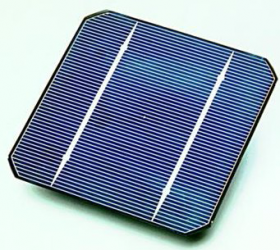
Scientists from Spectrolab, Inc., a subsidiary of Boeing, have recently published their research on the fabrication of solar cells that surpass the 40% efficiency milestone—the highest efficiency achieved for any photovoltaic device. Their results appear in a recent edition of Applied Physics Letters.
Most conventional solar cells used in today’s applications, such as for supplemental power for homes and buildings, are one-sun, single-junction silicon cells that use only the light intensity that the sun produces naturally, and have optimal efficiency for a relatively narrow range of photon energies.
The Spectrolab group experimented with concentrator multijunction solar cells that use high intensities of sunlight, the equivalent of 100s of suns, concentrated by lenses or mirrors. Significantly, the multijunction cells can also use the broad range of wavelengths in sunlight much more efficiently than single-junction cells.
"These results are particularly encouraging since they were achieved using a new class of metamorphic semiconductor materials, allowing much greater freedom in multijunction cell design for optimal conversion of the solar spectrum," Dr. Richard R. King, principal investigator of the high efficiency solar cell research and development effort, told PhysOrg.com. "The excellent performance of these materials hints at still higher efficiency in future solar cells."
In the design, multijunction cells divide the broad solar spectrum into three smaller sections by using three subcell band gaps. Each of the subcells can capture a different wavelength range of light, enabling each subcell to efficiently convert that light into electricity. With their conversion efficiency measured at 40.7%, the metamorphic multijunction concentrator cells surpass the theoretical limit of 37% of single-junction cells at 1000 suns, due to their multijunction structure.
While Spectrolab's primary business is supplying PV cells and panels to the aerospace industry (many of their solar cells are used on satellites currently in orbit), the company envisions that this breakthrough will also have applications in commercial terrestrial solar electricity generation.
The research that led to the discovery of the high efficiency concentrator solar cell was funded partly by the U.S. Department of Energy’s National Renewable Energy Laboratory, and will play a significant role in the government’s Solar America Initiative, which aims to make solar energy cost-competitive with conventional electricity generation by 2015. The company has said that these solar cells could help concentrator system manufacturers produce electricity at a cost that is competitive with electricity generated by conventional methods today.
The Spectrolab scientists also predict that with theoretical efficiencies of 58% in cells with more than three junctions using improved materials and designs, concentrator solar cells could achieve efficiencies of more than 45% or even 50% in the future.
Citation: King, R. R., Law, D. C., Edmondson, K. M., Fetzer, C. M., Kinsey, G. S., Yoon, H., Sherif, R. A., and Karam, N. H. “40% efficient metamorphic GaInP/GaInAs/Ge multijunction solar cells.” Applied Physics Letters 90, 183516 (2007).
Copyright 2007 PhysOrg.com.
All rights reserved. This material may not be published, broadcast, rewritten or redistributed in whole or part without the express written permission of PhysOrg.com.


