Releasing fish for the future
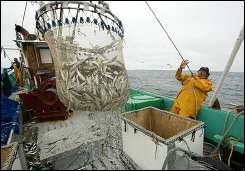
June 1, 2007 An Atlantic fisherman dumps his catch in the boat hold

NSW Department of Primary Industries (DPI) fisheries scientists are investigating ways to boost the survival rates of fish caught and then released by anglers.Some guidelines designed to improve fish survival were recently developed for released line-caught snapper, silver trevally, mulloway, sand whiting, yellowfin bream and dusky flathead.

The research, costing more than $1.5 million and funded by NSW DPI and the Recreational Fishing Trust (using money from licence fees), is developing protocols designed to maximise fish survival via subtle changes to management practices.

Owing to bag limits, legal sizes and non-consumptive angling, between 30 and 50% of the total recreational catch is released each year in Australia. This amounts to more than 47 million fish being caught and released annually.

New research is now seeking to maximise the post-release survival of other commonly-caught species including luderick, sand mullet, garfish, tailor, Australian bass, Murray cod and golden perch.

NSW DPI scientists Matt Broadhurst and Paul Butcher have shown that mortality rates can be significantly improved through changed practices.

Key recommendations from an initial two-year project are that fishers should

-- Cut the line on fish that swallow hooks
-- Remove hooks caught in the fish’s mouth
-- Minimise air exposure
-- Use landing nets without knotted mesh
-- Maintain water quality in on-boat holding tanks, and
-- Use the right rig for the fish species being targeting.

Dr Broadhurst said some of these actions were found to massively boost fish survival.

“Simply cutting the line rather than attempting to remove hooks swallowed by mulloway and yellowfin bream increased their survival from 12 percent to more than 85 percent.

“Up to 76 percent of the released line-cut, gut-hooked yellowfin bream then shed their hooks over an average of three weeks”, he said.


Source: New South Wales Department of Primary Industries


print this article email this article download pdf blog this article bookmark this article     Stumble it Digg this share on Facebook retweet share on Reddit add to delicious
Rate this story - 4.2 /5 (6 votes)


June 1, 2007 all stories

Comments: 0

4.2 /5 (6 votes)
  • Stumble this up

  • Digg this

  • share this

  • hide
  • Related Stories

  • Wolf release in Mexico sparks concern in US
    created Aug 13, 2009 | popularity not rated yet | comments 0
  • Record number of manatees counted in Florida
    created Jan 28, 2009 | popularity not rated yet | comments 0
  • World's rarest big cat gets a check-up
    created Oct 30, 2008 | popularity not rated yet | comments 0
  • Salmon smolt survival similar in Columbia and Fraser rivers
    created Oct 28, 2008 | popularity not rated yet | comments 0
  • 'Deadly dozen' reports diseases worsened by climate change
    created Oct 07, 2008 | popularity not rated yet | comments 0


  • hide
  • Relevant PhysicsForums posts

  • cycles
    created Nov 08, 2009
  • The Origin of the term 'fossil' fuels
    created Nov 05, 2009
  • co2
    created Nov 03, 2009
  • Early Earths Sulfidic Ocean Conditions
    created Oct 30, 2009
  • More from Physics Forums - Earth

Other News

Controversial new climate change results

Controversial new climate change results

Space & Earth / Environment

created 18 hours ago | popularity 4.5 / 5 (16) | comments 19

(PhysOrg.com) -- New data show that the balance between the airborne and the absorbed fraction of CO2 has stayed approximately constant since 1850, despite emissions of CO2 having risen from about 2 billion ...


Earth

Atomic Particles Help Solve Planetary Puzzle

Space & Earth / Earth Sciences

created 8 hours ago | popularity 4.6 / 5 (5) | comments 0

(PhysOrg.com) -- A University of Arkansas professor and his colleagues have shown that the Earth's mantle contains the same isotopic signatures from magnesium as meteorites do, suggesting that the planet formed ...


The Stars My Destination

The Stars My Destination

Space & Earth / Space Exploration

created 9 hours ago | popularity 5 / 5 (10) | comments 0

The Voyager spacecraft are now in the outermost layer of the heliosphere, traveling toward interstellar space - the first man-made spacecraft to travel such a vast distance from Earth.


Cave study links climate change to California droughts

Space & Earth / Earth Sciences

created 10 hours ago | popularity 3.7 / 5 (3) | comments 0

California experienced centuries-long droughts in the past 20,000 years that coincided with the thawing of ice caps in the Arctic, according to a new study by UC Davis doctoral student Jessica Oster and geology professor ...


Scientists prepare the Mini-Research Module 2 (MRM 2) "Poisk"

Rocket with new module for space station blasts off

Space & Earth / Space Exploration

created 12 hours ago | popularity 5 / 5 (1) | comments 0

A Soyuz rocket carrying a new Russian-made module for the International Space Station blasted off on Tuesday from the Baikonur space base in Kazakhstan, television pictures showed.