Astronomers Find Their Third Planet With Novel Telescope Network
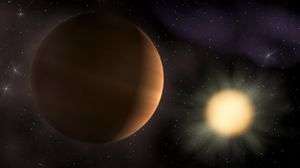
Astronomers using the Trans-atlantic Exoplanet Survey (TrES) network of small telescopes are announcing today their discovery of a planet twice the mass of Jupiter that passes in front of its star every 31 hours. The planet is in the constellation Hercules and has been named TrES-3 as the third planet found with the TrES network.
The new planet is the 15th transiting planet discovered so far-in other words, it is a planet that passes directly in front of its home star as seen from Earth. Three of these transiting planets have been found with the TrES global network of small telescopes utilizing mostly amateur-astronomy components and off-the-shelf four-inch camera lenses.
When a transiting planet passes directly between Earth and the star, the result is a slight reduction in the light in a manner similar to that caused by the moon's passing between the sun and Earth during a solar eclipse. According to Francis O'Donovan, a graduate student in astronomy at the California Institute of Technology, "When TrES-3 is in front of the star, it blocks off about 2.5 percent of the star's light, which is an effect we can observe with our TrES telescopes."
"TrES-3 is an unusual planet as it orbits its parent star in just 31 hours," says Georgi Mandushev, Lowell Observatory astronomer. "That is to say, the year on this planet lasts less than one and a third Earth days." This means it is very close to the star--much closer than Mercury is to the Sun--and so is heated by the intense starlight to about 1,500 degrees Kelvin. The planet is about 1,500 light-years from Earth.
To look for transits, the small telescopes are automated to take wide-field timed exposures of the clear skies on as many nights as possible. When an observing run is completed for a particular field--usually over an approximate two-month period--astronomers measure very precisely the light from every star in the field in order to detect the possible signature of a transiting planet.
In order to accurately measure the size and other properties of the planet, astronomers also made follow-up observations of the planet with one of the 10-meter Keck telescopes atop Mauna Kea, Hawaii; with the telescopes at Lowell Observatory and the Fred L. Whipple Observatory in Arizona; and with the Las Cumbres Observatory Global Telescope in Hawaii.
These observations were made by members of the TrES and the Hungarian Automated Telescope Network (HATNet) teams. Francis O'Donovan praised the teamwork between TrES and HATNet: "The search for extrasolar planets is an exciting and competitive field. I was happy to see that cooperation between separate teams led to a rapid confirmation of this planet."
Francis O'Donovan's paper about the discovery of this extrasolar planet, "TrES-3: A Nearby, Massive, Transiting Hot Jupiter in a 31-hour Orbit," has been accepted for publication by the Astrophysical Journal. The paper's other authors are Georgi Mandushev of the Lowell Observatory; Gaspar Bakos, David Latham, Alessandro Sozzetti, Robert Stefanik, David Charbonneau, and Guillermo Torres of the Harvard-Smithsonian Center for Astrophysics; Timothy Brown, Nairn Baliber, and Marton Hidas of the Las Cumbres Observatory Global Telescope; Geza Kovacs of the Konkoly Observatory in Hungary; Mark Everett and Gilbert Esquerdo of the Planetary Science Institute; Markus Rabus, Hans Deeg, and Juan Belamonte of the Instituto de Astrofisica de Canarias in Tenerife, Spain; and Lynne Hillenbrand of the California Institute of Technology.
Source: California Institute of Technology


