Researchers achieve atomic spectroscopy on a chip
June 1, 2007 Researchers achieve atomic spectroscopy on a chip

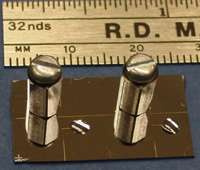
Atomic spectroscopy on a chip was achieved using this device, which features interconnected waveguides, rubidium vapor cells, and fiber-optical access. Photo courtesy of H. Schmidt

Researchers at the University of California, Santa Cruz, have performed atomic spectroscopy with integrated optics on a chip for the first time, guiding a beam of light through a rubidium vapor cell integrated into a semiconductor chip.

Atomic spectroscopy is a widely used technique with diverse applications. Based on the interactions of light and matter, spectroscopy is often used to identify substances by the wavelengths of light they absorb or emit. Conventional systems have many large components, whereas the compact, fully planar device developed at UCSC enables the study of atoms and molecules on a chip-based platform with integrated optics, said Holger Schmidt, associate professor of electrical engineering.

Schmidt's group and his collaborators at Brigham Young University described the first monolithically integrated, planar rubidium cell on a chip in a paper published in the June issue of Nature Photonics. The first author of the paper is Wenge Yang, a postdoctoral researcher in Schmidt's lab at UCSC's Baskin School of Engineering.

According to Schmidt, potential applications for this technology include frequency stabilization for lasers, gas detection sensors, and quantum information processing.

"To stabilize lasers, people use precision spectroscopy with bulk rubidium vapor cells. We could build a little integrated frequency stabilization chip that would do that more easily than a conventional frequency stabilization circuit," Schmidt said.

That project is already under way in Schmidt's lab. Other applications, such as quantum information processing, are more long-term goals, he said.

The key to the group's achievement is their development of hollow-core optical waveguides based on antiresonant reflecting optical waveguide (ARROW) principles. In previous publications, Schmidt and his collaborators have described other uses of ARROW waveguides integrated into chips using standard silicon fabrication technology (see http://press.ucsc.edu/text.asp?pid=578).

To perform atomic spectroscopy, the researchers incorporated rubidium reservoirs into a chip, connecting the reservoirs to hollow-core waveguides so that the optical beam path is filled with rubidium atoms. The resulting vapor cell is completely self-contained and has an active cell volume about 80 million times smaller than a conventional cell, Schmidt said.

"We used rubidium as a proof of principle, but this technique is applicable to any gaseous medium. So it has potentially far-reaching implications," Schmidt said.

In addition to its use in laser frequency stabilization, rubidium vapor is widely used in quantum optics experiments and has been used to slow the speed of light.

"Fundamental concepts in quantum information processing have been demonstrated in principle using bulk rubidium systems. To be practical you can't have big optical tables in all the places you would want to use it, but now we can make this technology more compact and portable," Schmidt said.

Source: University of California - Santa Cruz


print this article email this article download pdf blog this article bookmark this article     Stumble it Digg this share on Facebook retweet share on Reddit add to delicious
Rate this story - 4.5 /5 (10 votes)


June 1, 2007 all stories

Comments: 0

4.5 /5 (10 votes)
  • Stumble this up

  • Digg this

  • share this

  • hide
  • Related Stories

  • Researchers use semiconductors to set speed limit on light
    created Sep 28, 2004 | popularity not rated yet | comments 0
  • Quantum gas microscope offers glimpse of quirky ultracold atoms
    created Nov 04, 2009 | popularity not rated yet | comments 0
  • Physicists Turn to Radio Dial for Finer Atomic Matchmaking
    created Oct 20, 2009 | popularity not rated yet | comments 0
  • Physicists Demonstrate Three-Color Entanglement
    created Oct 07, 2009 | popularity not rated yet | comments 0
  • Pushing the cold frontier in an orderly fashion
    created Sep 28, 2009 | popularity not rated yet | comments 0


  • hide
  • Relevant PhysicsForums posts

Other News

Key scientist says politics behind stolen e-mails

Technology / Other

created 19 minutes ago | popularity not rated yet | comments 0

(AP) -- A leading climate change scientist said hackers breaking into a university's computer server and then posting documents online show the nasty politics of global warming.


Intel logo A

Intel wants a chip implant in your brain

Technology / Hi Tech

created 23 hours ago | popularity 4.2 / 5 (17) | comments 28

(PhysOrg.com) -- Computer chip maker Intel wants to implant a brain-sensing chip directly into the brains of its customers to allow them to operate computers and other devices without moving a muscle.


Just in time for Black Friday: students turn iPhone into barcode scanner

Just in time for Black Friday: students turn iPhone into barcode scanner

Technology / Software

created 11 hours ago | popularity 4.7 / 5 (3) | comments 0

(PhysOrg.com) -- Comparing prices over the Internet has become a common practice for consumers. Now, just in time for Black Friday, a group of Missouri University of Science and Technology students is putting ...


IBM Researchers Lower Language Barrier With Text Translator

Technology / Computer Sciences

created 13 hours ago | popularity 4.5 / 5 (4) | comments 0

IBM Researchers are helping to break the language barrier with the advent of technology dubbed "n.Fluent" -- smart software that translates text between English and 11 other languages. IBM employees use it to instantaneously ...


The KLM airplane which runs on biokerosene is seen at Schiphol airport, near Amsterdam

KLM flies world's first 'passenger flight on biofuel'

Technology / Energy

created 12 hours ago | popularity 5 / 5 (1) | comments 0

A Boeing 747, one of four engines powered by a 50-percent biokerosene mix, circled the Netherlands for an hour on Monday for what airline KLM called the world's first passenger flight using biofuel.