Agent slows aging in mice
Aspirin didn’t pan out. Neither did two other potential anti-aging agents. But a synthetic derivative of a pungent desert shrub is now a front- runner in ongoing animal experiments to find out if certain chemicals, known to inhibit inflammation, cancer and other destructive processes, can boost the odds of living longer.
Today at the annual meeting of the American Aging Association, University of Michigan scientist Richard A. Miller reports early results from a mouse study his lab and two others are conducting for the National Institute on Aging. The study, now in its fourth year, will test as many as two dozen possible anti-aging agents in animals in the next five years. The other centers are the University of Texas Health Science Center in San Antonio, Texas, and the Jackson Laboratory in Bar Harbor, Maine.
The scientists were surprised to find so quickly that one agent showed promise: NDGA, a compound derived from creosote bushes. These common North American desert shrubs have been traditionally used by Native Americans as healing remedies.
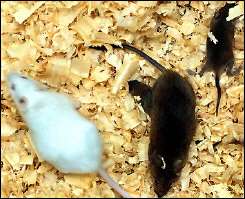
The preliminary results, to be published in August in the journal Aging Cell, show that male mice fed a normal diet and NDGA so far have survived in significantly greater numbers than mice on a normal diet. Scientists measured the difference at a point called median lifespan, when half the control mice had died of natural causes associated with aging.
“This is the first time to my knowledge when an agent has been shown to extend median life span in three laboratories,” says Miller, professor of pathology at the U-M Medical School and associate director of the U-M Geriatrics Center. Miller is also a research scientist at the Ann Arbor VA Medical Center.
No significant difference occurred in female mice. The scientists can’t explain why at this point. “We don’t know how NDGA is having its effect on survival in this first analysis,” Miller says.
“It may be that the female mice because of their hormonal status have other pathways to death and disability, or need higher or lower levels of NDGA to see an effect.”
The large, carefully controlled study at three sites, called the NIA Interventions Testing Program, is intended to provide some of the first reliable data on potential drugs to slow aging and its accompanying ills.
Miller says prior studies typically have been too small and their results hard to confirm in subsequent studies. “The National Institute on Aging decided to fund grants at three institutions to do studies of this sort in the right way,” he says.
In six to 10 months, once all the mice in the control group have died, the scientists will get answers to the really burning question: Will the mice fed NDGA, already well past middle age, live past the normal outer limit of old age" The longest that mice of this type usually live is around 1,000 to 1,100 days.
“If NDGA turns out to extend maximal lifespan by 20 or 30 percent, people would accept that as an important finding,” Miller says.
No one excited by these early results in mice is advised to bulk up on creosote bush leaves as a way to defy old age. If NDGA pushes the aging envelope in the final results of this study, other labs will likely try to repeat the results in animals. Much more research is needed before any possible human anti-aging drug could emerge, Miller says.
“Even if this agent turns out to be good for mice, it won’t be possible to tell without careful studies of humans whether NDGA is beneficial, useless, or harmful to people. Occasionally, something that is harmless in mice turns out to be highly toxic for people,” Miller cautions, adding that the Food and Drug Administration doesn’t evaluate the safety of such herbal remedies.
Source: University of Michigan Health System


