Nano-finding points to new computer technologies based on magnetic spin
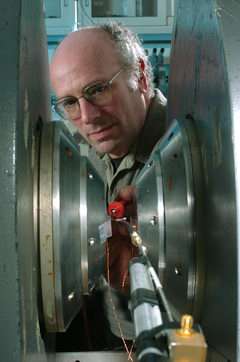
An unusual pool of scientific talent at the U.S. Department of Energy's Argonne National Laboratory, combined with new nanofabrication and nanocharacterization instruments, is helping to open a new frontier in electronics, to be made up of very small and very fast devices.
A new discovery by this group opens a path to new computer technologies and related devices, and could drive entire industries into the future, the researchers say.
The researchers learned that swirling spin structures called magnetic vortices, when trapped within lithographically patterned ferromagnetic structures, behave in novel ways. In a nickel-iron alloy, the two vortices swirl in opposite directions, one clockwise and the other counterclockwise. However, the researchers discovered that the magnetic polarity of the central core of the vortices, like the eye of a hurricane, controlled the time-evolution of the magnetic properties, not the swirling direction.
The material being studied is about one micron in size, and the area of the vortex core is about 10 nanometers in size. For comparison, the period at the end of this sentence is about 100 microns or 100,000 nanometers in diameter.
Group leader Sam Bader, an Argonne scientist for more than 30 years, explained that the work could lead to the next generation of electronic devices. “When the first computer hard disk was introduced 50 years ago, it required a rather large size to store each bit of digital information. On today's computer disks, the corresponding size is about one-50-millionth of that needed in the original disks. We are now moving well into the nanoscale range, and nanomagnetism is one of the real drivers of the nanotechnology field.”
The beauty of nanoscience, Bader said, is that researchers can take conventional materials, such as the nickel-iron alloy, reduce them to the nanoscale and create whole new properties. “Thinking far into the future, for example, we can envision circuits where the flow of spin, not the flow of electrical charge, will operate computers and other electronic devices while saving wasted heat energy that is generated in present-day devices.”
As with other materials at the nanoscale, Bader said, nanomagnets take on new properties, some of them unpredictable.
Understanding that unpredictability and underlying physics is important to researchers developing the new technology, said Argonne scientist Val Novosad. “With this very small array of spins, where each atom has a magnetic moment, the vortex core responds to stimuli by traveling in spiral trajectories.”
The researchers created the material in the form of an array of elliptical pancakes, each holding two vortex cores, stimulated the material with a magnetic pulse and watched the subsequent behavior.
“This first-ever reported experiment revealing unique dynamic behavior of two interacting magnetic vortices required a considerable assist from technology,” Novosad said.
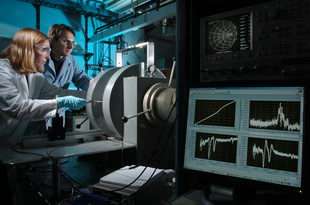
Argonne senior scientist Marcos Grimsditch provided the inspiration for the novel magnetic configuration of the samples, which were fabricated using a new electron beam lithography facility to be housed at Argonne 's Center for Nanoscale Materials, scheduled to open later this year. The tiny process could be monitored using a new instrument to measure spin resonance frequencies, developed by Argonne senior scientist Frank Fradin. And the interpretation of the experimental data was assisted by numerical modeling from Argonne post-doctoral student Kristen Buchanan, winner of a fellowship from Canada 's Natural Science and Engineering Research Council, and the analytical theory expertise of visiting theorist Konstantin Guslienko at Argonne's Theory Institute.
“Every step along the way was state of the art,” Bader said, “from the fabrication of the material to the measurement of the spin to the creation of software to illustrate the data through a movie.”
The research was reported in the new peer-reviewed journal, Nature Physics. The six Argonne researchers are co-authors of the article, along with Pierre Roy of Uppsala University in Sweden , a graduate student in residence at Argonne as part of his thesis research experience.
Source: Argonne National Laboratory


