Last update:
Condensed Matter news

Research demonstrates a new mechanism of order formation in quantum systems
Researchers Kazuaki Takasan and Kyogo Kawaguchi of the University of Tokyo with Kyosuke Adachi of RIKEN, Japan, have demonstrated that ferromagnetism, an ordered state of atoms, can be induced by increasing particle motility ...
Condensed Matter
1 hour ago
0
0

Scientists simulate magnetization reversal of Nd-Fe-B magnets using large-scale finite element models
NIMS has succeeded in simulating the magnetization reversal of Nd-Fe-B magnets using large-scale finite element models constructed based on tomographic data obtained by electron microscopy.
General Physics
1 hour ago
0
13

Quasi-2D spin-Peierls transition through interstitial anionic electrons in K(NH₃)₂
In a paper published in Science Bulletin, a Chinese team of scientists predicts a novel electride K(NH3)2, with interstitial electrons distributed at cages formed by six ammonia molecules and forming a quasi-2D triangular ...
Condensed Matter
19 hours ago
0
1

A shade closer to more efficient organic photovoltaics
Transparent solar cells will transform the look of infrastructure by enabling many more surfaces to become solar panels. Now, materials called non-fullerene acceptors that can intrinsically generate charges when exposed to ...
Condensed Matter
Apr 24, 2024
0
29

A novel universal light-based technique to control valley polarization in bulk materials
Electrons inside solid materials can only take certain values of energy. The allowed energy ranges are called "bands," and the space between them, the forbidden energies, is known as "band gaps." Both of them together constitute ...
Condensed Matter
Apr 24, 2024
0
1
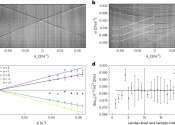
Making light 'feel' a magnetic field like an electron would
Unlike electrons, particles of light are uncharged, so they do not respond to magnetic fields. Despite this, researchers have now experimentally made light effectively "feel" a magnetic field within a complicated structure ...
Condensed Matter
Apr 24, 2024
0
46

Spintronics research shows material's magnetic properties can predict how a spin current changes with temperature
Spintronics is a field garnering immense attention for its range of potential advantages for conventional electronics. These include reducing power consumption, high-speed operation, non-volatility, and the potential for ...
Condensed Matter
Apr 23, 2024
0
124

The big quantum chill: Scientists modify common lab refrigerator to cool faster with less energy
By modifying a refrigerator commonly used in both research and industry, researchers at the National Institute of Standards and Technology (NIST) have drastically reduced the time and energy required to cool materials to ...
Condensed Matter
Apr 23, 2024
0
62

Manipulating the geometry of the 'electron universe' in magnets
Researchers at Tohoku University and the Japan Atomic Energy Agency have developed fundamental experiments and theories to manipulate the geometry of the "electron universe," which describes the structure of electronic quantum ...
Condensed Matter
Apr 23, 2024
0
78

Study shines light on properties and promise of hexagonal boron nitride, used in electronic and photonics technologies
Single-photon emitters (SPEs) are akin to microscopic lightbulbs that emit only one photon (a quantum of light) at a time. These tiny structures hold immense importance for the development of quantum technology, particularly ...
Condensed Matter
Apr 23, 2024
0
125
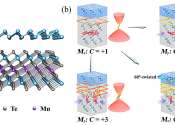
Tunable quantum anomalous Hall effects in van der Waals heterostructures
The quantum anomalous Hall effect (QAHE) has unique advantages in topotronic applications, but realizing the QAHE with tunable magnetic and topological properties for building functional devices is still a key scientific ...
Condensed Matter
Apr 23, 2024
0
14
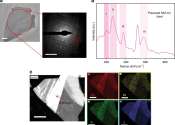
New 2D material manipulates light with remarkable precision and minimal loss
Responding to the increasing demand for efficient, tunable optical materials capable of precise light modulation to create greater bandwidth in communication networks and advanced optical systems, a team of researchers at ...
Condensed Matter
Apr 22, 2024
0
86
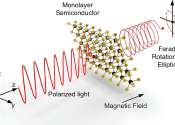
Study shows ultra-thin two-dimensional materials can rotate the polarization of visible light
It has been known for centuries that light exhibits wave-like behavior in certain situations. Some materials are able to rotate the polarization, i.e. the direction of oscillation, of the light wave when the light passes ...
Condensed Matter
Apr 22, 2024
1
134
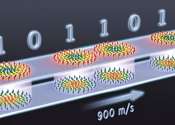
Skyrmions move at record speeds: A step towards the computing of the future
An international research team led by scientists from the CNRS has discovered that the magnetic nanobubbles known as skyrmions can be moved by electrical currents, attaining record speeds up to 900 m/s.
Condensed Matter
Apr 18, 2024
0
1102

Scientists experimentally observe current-driven antiskyrmion sliding
Prof. Zhang Ying's group from the Institute of Physics of the Chinese Academy of Sciences (CAS), in collaboration with domestic universities and the Los Alamos National Laboratory in the United States, has experimentally ...
Condensed Matter
Apr 18, 2024
0
67

A new spin on materials analysis: Benefits of probing electron spin states at much higher resolution and efficiency
Electron spin states can now be probed at much higher resolution and more efficiently, opening new opportunities in materials analysis and data processing technologies.
Condensed Matter
Apr 17, 2024
0
36

Dual-beamline photoelectron momentum microscopy upgrade advances valence orbital analysis
The world's first dual-beamline photoelectron momentum microscope has been developed at the UVSOR Synchrotron Facility, Japan. This innovative experimental station brings breakthroughs in studying the behavior of electrons ...
Condensed Matter
Apr 17, 2024
0
44
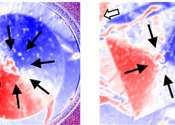
Spintronics: A new path to room temperature swirling spin textures
In some materials, spins form complex magnetic structures within the nanometer and micrometer scale in which the magnetization direction twists and curls along specific directions. Examples of such structures are magnetic ...
Condensed Matter
Apr 17, 2024
0
32
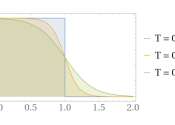
Beyond equilibrium: Scientists investigate Floquet Fermi liquids
Researchers from Germany and Singapore have studied a non-equilibrium state of Fermi liquids called the Floquet Fermi liquid (FFL), which is formed when Fermi liquids are subjected to a periodic driving force and kept in ...

Magnetism boosts hydrogen production in model catalysts
Researchers at the University of Twente have shown how to improve the efficiency of hydrogen production in an experimental setup. They showed that the magnetic order of the molecules plays a critical role.
Condensed Matter
Apr 16, 2024
0
20
More news


A universal path for converting light into current in solids


Physicists discover a novel quantum state in an elemental solid


Simulating magnetization in a Heisenberg quantum spin chain


Study unveils a new family of quantum anomalous Hall insulators


Team creates cooperative exciton-polariton condensate

Other news


Large Hadron Collider experiment zeroes in on magnetic monopoles

Study details a common bacterial defense against viral infection

Unveiling a new quantum frontier: Frequency-domain entanglement


Scientists capture X-rays from upward positive lightning


Experiment reveals strategic thinking in mice

Energy trades could help resolve Nile conflict

New multi-task deep learning framework integrates large-scale single-cell proteomics and transcriptomics data

How to clean up New Delhi's smoggy air


Gigantic Jurassic raptor footprints unearthed in China


Genetic hope in fight against devastating wheat disease


New topological metamaterial amplifies sound waves exponentially

A new type of cooling for quantum simulators

Electron-bending effect could boost computer memory

Physicists demonstrate parity anomaly in a topological insulator

Breaking the ice: Molecular insights into saltwater droplet freezing

Thiol-ene click reaction offers a novel approach to fabricate elastic ferroelectrics


Managing meandering waterways in a changing world


