Superconductivity news

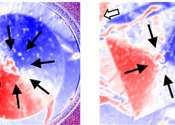
Pinning Down Superconductivity to a Single Layer

Pinning Down Superconductivity to a Single Layer

Physics / Superconductivity

created Oct 29, 2009 | popularity 4.9 / 5 (16) | comments 28

(PhysOrg.com) -- Using precision techniques for making superconducting thin films layer-by-layer, physicists at the U.S. Department of Energy's Brookhaven National Laboratory have identified a single layer ...


Magnet Lab to Investigate Promising Superconductor

Physics / Superconductivity

created Oct 13, 2009 | popularity 3.5 / 5 (2) | comments 0

(PhysOrg.com) -- The Applied Superconductivity Center at the National High Magnetic Field Laboratory has received $1.2 million in funding from the U.S. Department of Energy to understand and enhance a new form of superconducting ...


For Future Superconductors, a Little Bit of Lithium May Do Hydrogen a Lot of Good

For Future Superconductors, a Little Bit of Lithium May Do Hydrogen a Lot of Good

Physics / Superconductivity

created Oct 05, 2009 | popularity 4.3 / 5 (12) | comments 5

(PhysOrg.com) -- Scientists have a long and unsuccessful history of attempting to convert hydrogen to a metal by squeezing it under incredibly high and steady pressures.


Rice awarded $5M for light-based crystal simulator

Rice researchers to build light-based crystal simulator

Physics / Superconductivity

created Sep 23, 2009 | popularity 4.8 / 5 (4) | comments 0

A Rice University-led team of physicists at seven U.S. universities has won $5 million from the Department of Defense to build a simulator capable of tackling high-temperature superconductivity, one of the ...


Scientists Detect 'Fingerprint' of High-Temp Superconductivity Above Transition Temperature

Scientists Detect 'Fingerprint' of High-Temp Superconductivity Above Transition Temperature

Physics / Superconductivity

created Aug 27, 2009 | popularity 4.6 / 5 (12) | comments 8

(PhysOrg.com) -- A team of U.S. and Japanese scientists has shown for the first time that the spectroscopic "fingerprint" of high-temperature superconductivity remains intact well above the super chilly temperatures ...


Magnetic Measurements Question Assumptions About High-Tc Superconductors

Magnetic Measurements Question Assumptions About High-Tc Superconductors

Physics / Superconductivity

created Aug 03, 2009 | popularity 4.7 / 5 (7) | comments 1

(PhysOrg.com) -- Conquering one of the biggest challenges in the study of high-temperature (high-Tc) superconductors, scientists at the U.S. Department of Energy’s Brookhaven National Laboratory have grown ...


New insights, and a new angle, on high-temperature superconductivity

New insights, and a new angle, on high-temperature superconductivity

Physics / Superconductivity

created Jun 29, 2009 | popularity 4.9 / 5 (15) | comments 6

(PhysOrg.com) -- A Princeton-led research team has revealed surprising information about how electron behavior influences the conduction of electricity in a class of high-temperature superconductors. An increased ...


NIST discovers how strain at grain boundaries suppresses high-temperature superconductivity

Researchers discovers how strain at grain boundaries suppresses high-temperature superconductivity

Physics / Superconductivity

created Jun 17, 2009 | popularity 5 / 5 (4) | comments 0

Researchers at the National Institute of Standards and Technology (NIST) have discovered that a reduction in mechanical strain at the boundaries of crystal grains can significantly improve the performance ...


Thinnest superconducting metal created

Thinnest superconducting metal created

Physics / Superconductivity

created Jun 08, 2009 | popularity 4.3 / 5 (7) | comments 2

A superconducting sheet of lead only two atoms thick, the thinnest superconducting metal layer ever created, has been developed by physicists at The University of Texas at Austin.


New material could help cut future energy losses

Physics / Superconductivity

created Mar 19, 2009 | popularity 4 / 5 (4) | comments 2

Scientists at the University of Liverpool and Durham University have developed a new material to further understanding of how superconductors could be used to transmit electricity to built-up areas and reduce global energy ...


Magnetism Governs Properties of Iron-Based Superconductors

Magnetism Governs Properties of Iron-Based Superconductors

Physics / Superconductivity

created Mar 18, 2009 | popularity 3.5 / 5 (6) | comments 0

(PhysOrg.com) -- Though a year has passed since the discovery of a new family of high-temperature superconductors, a viable explanation for the iron-based materials’ unusual talent remains elusive. But a team ...


Study Yields Surprising New Insight into High-Temp Superconductors

Physics / Superconductivity

created Mar 17, 2009 | popularity 4.8 / 5 (16) | comments 135

(PhysOrg.com) -- Recently, an international group of researchers discovered that the underlying mechanism producing high-temperature superconductivity in a widely studied class of copper-oxygen-based superconductors may be ...


An iron-based superconductor under pressure

Putting the Pressure on Iron-Based Superconductors

Physics / Superconductivity

created Mar 05, 2009 | popularity 4.8 / 5 (9) | comments 3

(PhysOrg.com) -- Traditionally, magnetism and superconductivity don't mix. For more than 20 years, the only known superconductors that worked at so-called "high" temperatures (above 30 K, or about -406 degrees ...


Superconductivity: the new high critical temperature superconductors

Superconductivity: the new high critical temperature superconductors

Physics / Superconductivity

created Feb 24, 2009 | popularity 4.3 / 5 (8) | comments 0

(PhysOrg.com) -- The paper published in the Journal of the American Chemical Society (JACS) by a team led by professor Francesc Illas of the University of Barcelona's Department of Physical Chemistry and di ...


Secrets behind high temperature superconductors revealed

Physics / Superconductivity

created Feb 22, 2009 | popularity 3.7 / 5 (23) | comments 29

(PhysOrg.com) -- Scientists from Queen Mary, University of London and the University of Fribourg (Switzerland) have found evidence that magnetism is involved in the mechanism behind high temperature superconductivity.