Animal
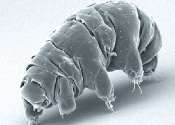
hideAnimals are a major group of mostly multicellular, eukaryotic organisms of the kingdom Animalia or Metazoa. Their body plan eventually becomes fixed as they develop, although some undergo a process of metamorphosis later on in their life. Most animals are motile, meaning they can move spontaneously and independently. Most animals are also heterotrophs, meaning they must ingest other organisms for sustenance.
Most known animal phyla appeared in the fossil record as marine species during the Cambrian explosion, about 542 million years ago.
For more information about Animal, read the full article at
Wikipedia.
This text uses material from Wikipedia and is available under the GNU Free Documentation License.
News tagged with animals
Extinct goat was cold-blooded
Nov 18, 2009 |
4.9 / 5 (29) |
10
(PhysOrg.com) -- An extinct goat that lived on a barren Mediterranean island survived for millions of years by reducing in size and by becoming cold-blooded, which has never before been discovered in mammals.
Bigger not necessarily better, when it comes to brains
Nov 17, 2009 |
4.4 / 5 (15) |
10
(PhysOrg.com) -- Tiny insects could be as intelligent as much bigger animals, despite only having a brain the size of a pinhead, say scientists at Queen Mary, University of London.
Penguins and sea lions help produce new atlas
Nov 16, 2009 |
not rated yet |
0
Recording hundreds of thousands of individual uplinks from satellite transmitters fitted on penguins, albatrosses, sea lions, and other marine animals, the Wildlife Conservation Society (WCS) and BirdLife ...
Warm-blooded dinosaurs worked up a sweat
Nov 11, 2009 |
5 / 5 (5) |
1
(PhysOrg.com) -- Were dinosaurs endothermic (warm-blooded) like present-day mammals and birds or ectothermic (cold-blooded) like present-day lizards? The implications of this simple-sounding question go beyond ...
Can biodiversity persist in the face of climate change?
Nov 06, 2009 |
3 / 5 (8) |
2
(PhysOrg.com) -- Predictions made over the last decade about the impacts of climate change on biodiversity may be exaggerated, according to a paper published in the journal Science.
Over 17,000 species threatened by extinction
Nov 02, 2009 |
not rated yet |
0
(AP) -- A rare Panamanian tree frog, a rodent from Madagascar and two lizards found only in the Philippines are among over 17,000 species threatened with extinction, a leading environmental group said Tuesday.
New research shows how mobile DNA survives -- and thrives -- in plants, animals
Oct 21, 2009 |
not rated yet |
0
(PhysOrg.com) -- Bits of movable DNA called transposable elements or TEs fill up the genomes of plants and animals, but it has remained unclear how a genome can survive a rapid burst of hundreds, even thousands of new TE ...
Traces of pharmaceuticals found in central Indiana waterways
Oct 20, 2009 |
5 / 5 (1) |
0
(PhysOrg.com) -- Pharmaceuticals have been found in freshwater ecosystems in rural areas of central Indiana, says a new study from Ball State University.
Pigs learn to understand mirrors
Oct 09, 2009 |
4.2 / 5 (9) |
2
(PhysOrg.com) -- A study of domesticated pigs has found that with just a little experimentation they can find food based only on a reflection in a mirror.
Seven new luminescent mushroom species discovered
Oct 05, 2009 |
4.7 / 5 (3) |
0
Seven new glow-in-the-dark mushroom species have been discovered, increasing the number of known luminescent fungi species from 64 to 71. Reported today in the journal Mycologia, the new finds include two ne ...
Lone llama rescued after month on Pikes Peak
Oct 03, 2009 |
2 / 5 (1) |
3
(AP) -- A lone llama wandering near the summit of Pikes Peak for a month has been captured and is heading to a new home.
Research team finds first evolutionary branching for bilateral animals
Sep 23, 2009 |
3.8 / 5 (5) |
0
When it comes to understanding a critical junction in animal evolution, some short, simple flatworms have been a real thorn in scientists' sides. Specialists have jousted over the proper taxonomic placement ...
Scientists identify 'DNA barcodes' to help track illegal trading of wildlife products
Sep 15, 2009 |
not rated yet |
0
(PhysOrg.com) -- Researchers from several institutions including the University of Colorado at Boulder have sequenced DNA "barcodes" for as many as 25 hunted wildlife species, providing information that can be used to better ...
Barcoding endangered sea turtles
Sep 14, 2009 |
not rated yet |
0
Conservation geneticists who study sea turtles have a new tool to help track this highly migratory and endangered group of marine animals: DNA barcodes. DNA barcodes are short genetic sequences that efficiently ...
Evolution coup: Study reveals how plants protect their genes
Sep 10, 2009 |
5 / 5 (3) |
0
Unlike animals and humans, plants can't run and hide when exposed to stressful environmental conditions. So how do plants survive? A new Université de Montréal study, published in the journal Proceedings of ...