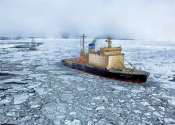
Arctic Ocean
hideThe Arctic Ocean, located in the Northern Hemisphere and mostly in the Arctic north polar region, is the smallest, and shallowest of the world's five major oceanic divisions. The International Hydrographic Organization (IHO) recognizes it as an ocean, although some oceanographers call it the Arctic Mediterranean Sea or simply the Arctic Sea, classifying it as one of the mediterranean seas of the Atlantic Ocean. Alternatively, the Arctic Ocean can be seen as the northernmost lobe of the all-encompassing World Ocean.
Almost completely surrounded by Eurasia and North America, the Arctic Ocean is partly covered by sea ice throughout the year (and almost completely in winter). The Arctic Ocean's temperature and salinity vary seasonally as the ice cover melts and freezes; its salinity is the lowest on average of the five major oceans, due to low evaporation, heavy freshwater inflow from rivers and streams, and limited connection and outflow to surrounding oceanic waters with higher salinities. The summer shrinking of the ice has been quoted at 50%. The National Snow and Ice Data Center (NSIDC) use satellite data to provide a daily record of Arctic sea ice cover and the rate of melting compared to an average period and specific past years.
For more information about Arctic Ocean, read the full article at
Wikipedia.
This text uses material from Wikipedia and is available under the GNU Free Documentation License.
News tagged with arctic ocean
Arctic exploration finds large underwater mountain
Space & Earth / Earth Sciences
Sep 10, 2009 |
3.6 / 5 (5) |
0
(AP) -- Joint U.S.-Canada exploration of the Arctic sea floor discovered an unusual underwater mountain and evidence that could boost the two countries' claims that their boundaries extend farther north. For the past two ...
Mystery mechanism drove global warming 55 million years ago
Space & Earth / Earth Sciences
Jul 13, 2009 |
4.3 / 5 (25) |
24
A runaway spurt of global warming 55 million years ago turned Earth into a hothouse but how this happened remains worryingly unclear, scientists said on Monday.
Arctic climate under greenhouse conditions in the Late Cretaceous
Space & Earth / Earth Sciences
Jul 09, 2009 |
3.5 / 5 (10) |
1
New evidence for ice-free summers with intermittent winter sea ice in the Arctic Ocean during the Late Cretaceous - a period of greenhouse conditions - gives a glimpse of how the Arctic is likely to respond ...
New NASA Satellite Survey Reveals Dramatic Arctic Sea Ice Thinning
Space & Earth / Earth Sciences
Jul 07, 2009 |
4.7 / 5 (65) |
6
(PhysOrg.com) -- Arctic sea ice thinned dramatically between the winters of 2004 and 2008, with thin seasonal ice replacing thick older ice as the dominant type for the first time on record. The new results, ...
Unstated assumptions color Arctic sovereignty claims
Space & Earth / Earth Sciences
May 28, 2009 |
4 / 5 (2) |
0
Settling the growing debate over ownership of Arctic Ocean resources is complicated by the fact that the various countries involved have different understandings of the geography of the place.
Scientists issue warning on future of central Arctic
Apr 17, 2009 |
4.2 / 5 (35) |
12
(PhysOrg.com) -- Scientists have warned that world leaders are in a race against time to make key decisions about the future of international co-operation in the Arctic.
Linking Climate Change in Siberia and Britain
Space & Earth / Earth Sciences
Mar 23, 2009 |
3.3 / 5 (14) |
1
(PhysOrg.com) -- Scientists have for first time demonstrated a critical link between the Siberian climate and the circulation of the major current system which gives us our mild winters here in the UK. This new understanding ...
British team trek to North Pole to measure sea ice
Space & Earth / Earth Sciences
Mar 01, 2009 |
4.7 / 5 (36) |
3
Three British explorers have set out on a 90-day skiing expedition to the North Pole, measuring sea ice thickness the whole way to find out exactly how fast it is disappearing, according to the Catlin Arctic ...
Ancient turtle migrated from Asia to America over a tropical Arctic
Other Sciences / Archaeology & Fossils
Feb 01, 2009 |
4.7 / 5 (9) |
0
In Arctic Canada, a team of geologists from the University of Rochester has discovered a surprise fossil: a tropical, freshwater, Asian turtle. The find strongly suggests that animals migrated from Asia to ...
Less ice in the Arctic Ocean 6000-7000 years ago
Space & Earth / Earth Sciences
Oct 20, 2008 |
4.7 / 5 (46) |
15
Recent mapping of a number of raised beach ridges on the north coast of Greenland suggests that the ice cover in the Arctic Ocean was greatly reduced some 6000-7000 years ago. The Arctic Ocean may have been periodically ice ...
Research around the North Pole
Space & Earth / Earth Sciences
Oct 20, 2008 |
3.8 / 5 (5) |
2
The German research vessel Polarstern has returned today to Bremerhaven from the Arctic Sea. It has cruised as the first research vessel ever both the Northeast and the Northwest Passages and thereby circled ...
Arctic ice on the verge of another all-time low
Space & Earth / Earth Sciences
Aug 28, 2008 |
3.6 / 5 (54) |
123
Following last summer's record minimum ice cover in the Arctic, current observations from ESA's Envisat satellite suggest that the extent of polar sea-ice may again shrink to a level very close to that of ...