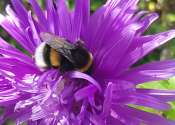
Bee

hide

Andrenidae Apidae Colletidae Dasypodaidae Halictidae Megachilidae Meganomiidae Melittidae Stenotritidae

Apiformes

Bees are flying insects closely related to wasps and ants, and are known for their roles of producing honey and beeswax and pollination. Bees are a monophyletic lineage within the superfamily Apoidea, presently classified by the unranked taxon name Anthophila. There are nearly 20,000 known species of bees in nine recognized families, though many are undescribed and the actual number is probably higher. They are found on every continent except Antarctica, in every habitat on the planet that contains insect-pollinated flowering plants.

For more information about Bee, read the full article at Wikipedia.
This text uses material from Wikipedia and is available under the GNU Free Documentation License.


News tagged with bees

results timeline


Angraecum sesquipedale ('Comet Orchid')

The evolution of orchids

Biology / Plants & Animals

created Nov 19, 2009 | popularity 4.8 / 5 (8) | comments 1

(PhysOrg.com) -- Charles Darwin and many other scientists have long been puzzled by the evolution of orchids, the largest and most diverse family of flowering plants on Earth. Now genetic sequencing is giving ...


Study finds bees can learn differences in food's temperature

Study finds bees can learn differences in food's temperature

Biology / Plants & Animals

created Nov 17, 2009 | popularity 1 / 5 (1) | comments 0

Biologists at UC San Diego have discovered that honeybees can discriminate between food at different temperatures, an ability that may assist bees in locating the warm, sugar-rich nectar or high-protein pollen ...


Rasberry crazy ant

Rapacious Rasberry ants march north

Biology / Plants & Animals

created Nov 13, 2009 | popularity 4.4 / 5 (10) | comments 10

Poor Texas. First it was killer bees, then fire ants. Now, it's the Rasberry ants.


Scientists examine how common pesticide mixes may affect bee die-offs

Biology / Plants & Animals

created Oct 29, 2009 | popularity not rated yet | comments 0

(PhysOrg.com) -- Since reports of widespread bee die-offs began to surface in October 2006, researchers have investigated possible reasons ranging from hive-infecting mites to cell phone-tower radiation. They have yet to ...


bee

Penn State researchers promote pollinator-friendly native gardens

Biology / Plants & Animals

created Oct 19, 2009 | popularity 5 / 5 (1) | comments 0

(PhysOrg.com) -- Across the country, pollinators such as honeybees and hummingbirds are declining due to habitat loss, diseases such as Colony Collapse Disorder (CCD), pests and excessive pesticide use. Penn ...


Killer bees may increase food supplies for native bees

Killer bees may increase food supplies for native bees

Biology / Plants & Animals

created Oct 01, 2009 | popularity not rated yet | comments 0

Aggressive African bees were accidentally released in Brazil in 1957. As "killer bees" spread northward, David Roubik, staff scientist at the Smithsonian Tropical Research Institute, began a 17-year study ...


Bees Throw Out Mites

Bees Throw Out Mites

Biology / Plants & Animals

created Sep 11, 2009 | popularity 4.9 / 5 (9) | comments 3

Honey bees are now fighting back aggressively against Varroa mites, thanks to Agricultural Research Service (ARS) efforts to develop bees with a genetic trait that allows them to more easily find the mites ...


New research discovers worker bees in 'reproductive class war' with queen

Biology / Plants & Animals

created Sep 09, 2009 | popularity 5 / 5 (1) | comments 1

Bee colonies are well known for high levels of cooperation, but new research published in Molecular Ecology demonstrates a conflict for reproduction between worker bees and their Queens, leading some workers to selfishly exploi ...


Bumblebees dive in to fill a void

Biology / Ecology

created Sep 02, 2009 | popularity 4 / 5 (1) | comments 0

Native pollinators such as these fat, fuzzy bumblebees, once an overlooked sideshow in the insect world, are gaining widespread appreciation among everyone from backyard gardeners to big-time farmers. That's because European ...


Leaving mobile phones near to a bee hive was found to have a catastrophic effect

Mobile phone towers a threat to honey bees: study

Biology / Plants & Animals

created Aug 31, 2009 | popularity 4.1 / 5 (10) | comments 9

The electromagnetic waves emitted by mobile phone towers and cellphones can pose a threat to honey bees, a study published in India has concluded.


Urban beekeeping generates buzz

Biology / Plants & Animals

created Aug 19, 2009 | popularity 5 / 5 (3) | comments 0

Walking up to the roof of the Fairmont Hotel in Washington, D.C., is not a jaw-dropping experience. Exit the door and you are confronted with a sea of roof tiles and empty space -- there is nothing about this rooftop that ...


Honeybee

Study finds higher pathogen loads in collapsed honeybee colonies

Biology / Plants & Animals

created Aug 13, 2009 | popularity 5 / 5 (2) | comments 0

Honeybees in colonies affected by colony collapse disorder (CCD) have higher levels of pathogens and are co-infected with a greater number of pathogens than their non-CCD counterparts, but no individual pathogen ...


The number of honeybees in the UK has dropped by up to 15 percent in the past two years

UK conservation agency launches plastic beehive

Biology / Plants & Animals

created Aug 05, 2009 | popularity 4 / 5 (4) | comments 5

A new plastic beehive was launched in Britain on Wednesday to encourage people to keep bees in their gardens or on rooftoops to help boost declining honeybee populations.


Calcium -- the secret to honeybees' memory

Biology / Cell & Microbiology

created Jun 16, 2009 | popularity not rated yet | comments 0

Long-term memory formation in honeybees is instigated by a calcium ion cascade. Researchers writing in the open access journal BMC Biology have shown that calcium acts as a switch between short- and long-term storage of lea ...


Bee

Trading energy for safety, bees extend legs to stay stable in wind

Biology / Plants & Animals

created Jun 02, 2009 | popularity 5 / 5 (3) | comments 0

New research shows some bees brace themselves against wind and turbulence by extending their sturdy hind legs while flying. But this approach comes at a steep cost, increasing aerodynamic drag and the power ...