Frontpage » Tag » clouds

News tagged with clouds

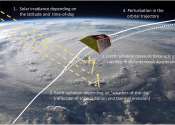
Probing a link from Sahara dust to climate change

Qilong Min, Ph.D., Senior Research Associate and Professor with the Atmospheric Sciences Research Center (ASRC) at the University at Albany is developing innovative ways to measure how dust in the Sahara Desert ...

Space & Earth / Earth Sciences

created 14 hours ago | popularity not rated yet | comments 0

NASA's TRMM satellite sees Cyclone Jasmine in 3-D

Data from NASA's TRMM satellite was used to create a 3-Dimensional look at Cyclone Jasmine, currently moving through the South Pacific Ocean.

Space & Earth / Earth Sciences

created Feb 09, 2012 | popularity not rated yet | comments 0

Low-cost instrument developed by students could aid weather research

On a recent blustery afternoon, scientists gathered on a rooftop at the Georgia Tech Research Institute (GTRI) to observe two atmospheric electric field-mill devices monitor the buildup of electrical charge ...

Technology / Engineering

created Feb 08, 2012 | popularity 4.5 / 5 (2) | comments 0

VLT takes most detailed infrared image of the Carina Nebula

(PhysOrg.com) -- ESO's Very Large Telescope has delivered the most detailed infrared image of the Carina Nebula stellar nursery taken so far. Many previously hidden features, scattered across a spectacular ...

Space & Earth / Astronomy

created Feb 08, 2012 | popularity 5 / 5 (6) | comments 3 | with audio podcast

NASA's Aqua satellite sees small new tropical storm near Tonga

Tropical Storm 11P has formed in the South Pacific Ocean, and NASA's Aqua satellite captured an infrared image of its cloud temperatures, revealing power in the cyclone.

Space & Earth / Earth Sciences

created Feb 06, 2012 | popularity not rated yet | comments 0

NASA's Juno spacecraft refines its path to Jupiter

(PhysOrg.com) -- NASA's solar-powered Juno spacecraft successfully refined its flight path Wednesday with the mission's first trajectory correction maneuver. The maneuver took place on Feb. 1. It is the first ...

Space & Earth / Space Exploration

created Feb 03, 2012 | popularity 3 / 5 (1) | comments 0 | with audio podcast

Want to understand the fluid dynamics of the oceans and atmosphere? UCLA's got the video

(PhysOrg.com) -- Oceans and clouds, even the atmosphere itself, are in constant motion and can undergo dramatic fluctuations, like hurricanes, that lead to severe consequences. If you've ever ...

Physics / General Physics

created Feb 02, 2012 | popularity 5 / 5 (1) | comments 2

A pocket of star formation

(PhysOrg.com) -- This new view shows a stellar nursery called NGC 3324. It was taken using the Wide Field Imager on the MPG/ESO 2.2-metre telescope at the La Silla Observatory in Chile. The intense ultraviolet ...

Space & Earth / Astronomy

created Feb 01, 2012 | popularity not rated yet | comments 0 | with audio podcast

NASA sees strong thunderstorms still surround Cyclone Iggy's center

NASA's Aqua satellite passed over Tropical Cyclone Iggy on January 31 and the AIRS infrared instrument aboard showed that there is a large area of strong thunderstorms still surrounding Iggy's center of circulation.

Space & Earth / Earth Sciences

created Jan 31, 2012 | popularity not rated yet | comments 0

Cloud streets off of the Aleutian Islands

(PhysOrg.com) -- Strong winds polished the snow of southwestern Alaska and stretched marine stratocumulus clouds into long, parallel streets in early January, 2012. After crossing Bristol Bay, the winds scraped ...

Space & Earth / Earth Sciences

created Jan 30, 2012 | popularity 5 / 5 (1) | comments 0

Hot molecule explains cold chemistry

(PhysOrg.com) -- Surprisingly, hydrogen cyanide and its far more energetic isomer, hydrogen isocyanide, are present in almost equal amounts in cold interstellar gas clouds. Scientists from the Max Planck Institute ...

Space & Earth / Astronomy

created Jan 30, 2012 | popularity not rated yet | comments 1 | with audio podcast

NASA sees a weakening Cyclone Funso's 'closed eye'

Powerful Cyclone Funso's eye has been clear in NASA satellite imagery over the last several days until NASA's Aqua satellite noticed it had "closed" and become filled with high clouds on January 27.

Space & Earth / Earth Sciences

created Jan 28, 2012 | popularity not rated yet | comments 0

NASA eyes cyclone Iggy's threat to western Australia

NASA satellites are providing valuable data to forecasters as Tropical Cyclone Iggy nears Western Australia. NASA's Aqua satellite provided visible and infrared data on Iggy, observing colder cloud tops and ...

Space & Earth / Earth Sciences

created Jan 28, 2012 | popularity not rated yet | comments 0

NASA infrared satellite instrument sees tropical storm Iggy growing in strength

The AIRS infrared instrument that flies on NASA's Aqua satellite has been providing forecasters with the cloud top temperatures in the Southern Indian Ocean's ninth tropical cyclone, which has officially been ...

Space & Earth / Earth Sciences

created Jan 26, 2012 | popularity not rated yet | comments 1

The proof is in the clouds

For most people, clouds are just an indication of whether it's a "good" or "bad" day. A team of scientists from Pacific Northwest National Laboratory found that certain clouds hold the key to climate behavior ...

Space & Earth / Earth Sciences

created Jan 26, 2012 | popularity not rated yet | comments 0

Cloud

A cloud is a visible mass of droplets or frozen crystals suspended in the atmosphere above the surface of the Earth or another planetary body. A cloud is also a visible mass attracted by gravity, such as masses of material in space called interstellar clouds and nebulae. Clouds are studied in the nephology or cloud physics branch of meteorology.

On Earth the condensing substance is typically water vapor, which forms small droplets or ice crystals, typically 0.01 mm in diameter. When surrounded by billions of other droplets or crystals they become visible as clouds. Dense deep clouds exhibit a high reflectance (70% to 95%) throughout the visible range of wavelengths. They thus appear white, at least from the top. Cloud droplets tend to scatter light efficiently, so that the intensity of the solar radiation decreases with depth into the gases, hence the gray or even sometimes dark appearance at the base. Thin clouds may appear to have acquired the color of their environment or background and clouds illuminated by non-white light, such as during sunrise or sunset, may appear colored accordingly. In the near-infrared range, clouds look darker because the water that constitutes the cloud droplets strongly absorbs solar radiation at those wavelengths.

For more information about Cloud, read the full article at Wikipedia.
This text uses material from Wikipedia and is available under the GNU Free Documentation License.