Coffee
hideCoffee is a brewed beverage prepared from roasted seeds, commonly called coffee beans, of the coffee plant. Due to its caffeine content, coffee can have a stimulating effect in humans. Today, coffee is one of the most popular beverages worldwide.
It is supposed that the Ethiopians, the ancestors of today's Galla tribe, were the first to have discovered and recognized the energizing effect of the coffee bean plant. However, no direct evidence has ever been found revealing exactly where in Africa coffee grew or who among the natives might have used it as a stimulant or even known about it there earlier than the seventeenth century. The earliest credible evidence of either coffee drinking or knowledge of the coffee tree appears in the middle of the fifteenth century, in the Sufi monasteries of the Yemen in southern Arabia. From Yemen, coffee spread to Egypt and Ethiopia, and by the 15th century, had reached Armenia, Persia, Turkey, and northern Africa. From the Muslim world, coffee spread to Italy, then to the rest of Europe, to Indonesia, and to the Americas.
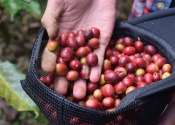
Coffee berries, which contain the coffee bean, are produced by several species of small evergreen bush of the genus Coffea. The two most commonly grown species are Coffea canephora (also known as Coffea robusta) and Coffea arabica; less popular species are Liberica, Excelsa, Stenophylla, Mauritiana, Racemosa. These are cultivated primarily in Latin America, Southeast Asia, and Africa. Once ripe, coffee berries are picked, processed, and dried. The seeds are then roasted, undergoing several physical and chemical changes. They are roasted to varying degrees, depending on the desired flavor. They are then ground and brewed to create coffee. Coffee can be prepared and presented in a variety of ways.
Coffee has played an important role in many societies throughout history. In Africa and Yemen, it was used in religious ceremonies. As a result, the Ethiopian Church banned its secular consumption until the reign of Emperor Menelik II of Ethiopia. It was banned in Ottoman Turkey in the 17th century for political reasons, and was associated with rebellious political activities in Europe.
Coffee is an important export commodity. In 2004, coffee was the top agricultural export for 12 countries, and in 2005, it was the world's seventh-largest legal agricultural export by value.
Some controversy is associated with coffee cultivation and its impact on the environment. Many studies have examined the relationship between coffee consumption and certain medical conditions; whether the overall effects of coffee are positive or negative is still disputed.
For more information about Coffee, read the full article at
Wikipedia.
This text uses material from Wikipedia and is available under the GNU Free Documentation License.
News tagged with coffee
Drinking coffee slows progression of liver disease in chronic hepatitis C sufferers
Oct 20, 2009 |
5 / 5 (3) |
0
Patients with chronic hepatitis C and advanced liver disease who drink three or more cups of coffee per day have a 53% lower risk of liver disease progression than non-coffee drinkers according to a new study led by Neal ...
Forget dieting over the holidays
Oct 16, 2009 |
not rated yet |
0
(PhysOrg.com) -- Changing your focus from dieting to living healthy during the holidays boosts the chances of maintaining your perfect weight.
Is free Wi-Fi a good deal for coffee shops?
Sep 30, 2009 |
3.5 / 5 (2) |
0
Free Wi-Fi has turned coffee shops into de facto work spaces. That's good for a region full of digital nomads armed with laptops who want to escape the isolation of working alone. But it's been a mixed blessing for coffee ...
High caffeine intake can lead to arrhythmias
Aug 31, 2009 |
4 / 5 (1) |
1
Coffee is routinely consumed in countries within the Mediterranean basin. Coffee, an infusion of ground, roasted coffee beans, is the most widely consumed behaviourally active substance in the world. It contains ...
Scientists Make Temperature-Regulating Coffee Mug
Aug 25, 2009 |
4.8 / 5 (8) |
17
(PhysOrg.com) -- A well-insulated mug may keep your coffee somewhat warm, but now scientists have designed a high-tech mug that can keep drinks hot or cold at the perfect temperature for up to half an hour. ...
Malaysian authorities seize 'Viagra coffee' : report
Jul 05, 2009 |
3 / 5 (1) |
1
Malaysia's health authorities have seized over 20,000 dollars worth of coffee mixed with sildenafil, the main ingredient in erectile dysfunction drug Viagra, a report said Sunday.
A breath mint made from... coffee?
Jun 24, 2009 |
4.3 / 5 (3) |
0
We all know why Starbucks puts boxes of breath mints close to the cash register. Your morning latte can create a startling aroma in your mouth, strong enough to startle your co-workers too.
Will Twitter boost users' taste for coffee brand?
May 20, 2009 |
not rated yet |
0
The 150-year-old coffee brand has tapped into new technology to market itself.
Consumers respond to lower calorie beverage options
Apr 20, 2009 |
not rated yet |
0
At Experimental Biology 2009, Dr. Maureen Storey, senior vice president of science policy for the American Beverage Association, today briefed colleagues on her new analysis indicating that consumers of all ages are drinking ...
Physicists see the cosmos in a coffee cup
Apr 14, 2009 |
4.6 / 5 (22) |
4
(PhysOrg.com) -- A Duke University professor and his graduate student have discovered a universal principle that unites the curious interplay of light and shadow on the surface of your morning coffee with ...
Studies suggest drinking coffee or tea may reduce the risk of stroke
Mar 22, 2009 |
3.8 / 5 (8) |
1
The role coffee and tea play in a person's risk of having a stroke got a little clearer recently as two large observational studies found that the beverages may actually provide a modest amount of protection.
Are You Getting Enough Sleep? Why Women Struggle with Sleep Problems
Mar 18, 2009 |
3 / 5 (1) |
2
Good sleep equals good health, says Raul Noriega, manager of the Comprehensive Epilepsy and Sleep Disorders Center at Baylor Regional Medical Center at Grapevine. Yet more than half of women report problems with insomnia. ...
A steep(ing) learning curve on tea
Feb 23, 2009 |
3.5 / 5 (10) |
2
It's true that, unlike the rest of the world, Americans more often drink our tea instant and iced. But a revolution is brewing. We're warming up to the beneficial qualities of tea, the second most popular drink on the planet ...
Get smart about science: Sorting through the studies about caffeine and other choices
Feb 20, 2009 |
4.3 / 5 (7) |
0
Coffee, elixir of the gods. Studies say drinking it can lower your risk of developing type 2 diabetes, Parkinson's disease, Alzheimer's disease and mouth cancer. It can prevent cavities. It can make you happier. It can kill ...
Coffee cultivation good for diversity in agrarian settlements but not in forests
Biology /
Feb 19, 2009 |
2 / 5 (1) |
0
Coffee shrubs, both in themselves and because they are most often cultivated in the shade of large trees, can have a positive impact on plant and animal diversity in those parts of the landscape that are deforested and dominated ...