Comet

hide

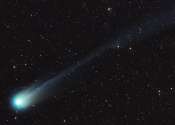
A comet is a Small Solar System Body that orbits the Sun. When close enough to the Sun, a comet exhibits a visible coma (fuzzy "atmosphere"), and sometimes a tail, both because of the effects of solar radiation upon the comet's nucleus. Comet nuclei are themselves loose collections of ice, dust and small rocky particles, ranging from a few kilometers to tens of kilometers across.

For more information about Comet, read the full article at Wikipedia.
This text uses material from Wikipedia and is available under the GNU Free Documentation License.


News tagged with comet

results timeline


Rosetta

Rosetta bound for outer Solar System after final Earth swingby (w/ Video)

Space & Earth / Space Exploration

created Nov 13, 2009 | popularity 4.9 / 5 (7) | comments 1

(PhysOrg.com) -- This morning, mission controllers confirmed that ESA’s comet chaser Rosetta had swung by Earth at 8:45 CET as planned, skimming past our planet to pick up a gravitational boost for an epic ...


First view of Earth as Rosetta approaches home

First view of Earth as Rosetta approaches home

Space & Earth / Space Exploration

created Nov 12, 2009 | popularity 4.5 / 5 (6) | comments 0

(PhysOrg.com) -- This spectacular image of our home planet was captured by the OSIRIS instrument on ESA's Rosetta comet chaser earlier today as the spacecraft approached Earth for the third and final swingby. ...


Rosetta

Rosetta spacecraft may help unravel cosmic mystery (w/ Video)

Space & Earth / Space Exploration

created Nov 12, 2009 | popularity 5 / 5 (3) | comments 4

When Europe's comet chaser Rosetta swings by Earth tomorrow for a critical gravity assist, tracking data will be collected to precisely measure the satellite's change in orbital energy. The results could help ...


Rosetta approach on schedule

Rosetta approach on schedule

Space & Earth / Space Exploration

created Nov 06, 2009 | popularity 5 / 5 (1) | comments 0

(PhysOrg.com) -- After the trajectory correction manoeuvre on 22 October, Rosetta has lined up on a near-perfect Earth approach path. The manoeuvre was so precise that mission controllers decided not to use ...


Unsettled Youth: Spitzer Observes a Chaotic Planetary System

Unsettled Youth: Spitzer Observes a Chaotic Planetary System

Space & Earth / Astronomy

created Nov 04, 2009 | popularity 4.1 / 5 (7) | comments 0

(PhysOrg.com) -- Before our planets found their way to the stable orbits they circle in today, they wiggled and jostled about like unsettled children. Now, NASA's Spitzer Space Telescope has found a young ...


Follow Rosetta's final Earth boost

Rosetta's final Earth boost

Space & Earth / Space Exploration

created Nov 04, 2009 | popularity not rated yet | comments 0

ESA's comet chaser Rosetta will swing by Earth for the last time on 13 November to pick up energy and begin the final leg of its 10-year journey to comet 67P/Churyumov-Gerasimenko. ESA's European Space Operations ...


Artist concept of Stardust.

'Ultra-primitive' particles found in comet dust

Space & Earth / Space Exploration

created Nov 02, 2009 | popularity 5 / 5 (8) | comments 2

Dust samples collected by high-flying aircraft in the upper atmosphere have yielded an unexpectedly rich trove of relicts from the ancient cosmos, report scientists from the Carnegie Institution. The stratospheric ...


Channels from Hale Crater

Channels from Mars Hale Crater

Space & Earth / Space Exploration

created Oct 28, 2009 | popularity 4.3 / 5 (7) | comments 1

(PhysOrg.com) -- This image from NASA's Mars Reconnaissance Orbiter shows channels to the southeast of Hale crater on southern Mars. Taken by the orbiter's High Resolution Imaging Science Experiment (HiRISE) ...


A long night falls over Saturn's rings

A long night falls over Saturn's rings

Space & Earth / Space Exploration

created Oct 24, 2009 | popularity 4.8 / 5 (6) | comments 4

As Saturn's rings orbit the planet, a section is typically in the planet's shadow, experiencing a brief night lasting from 6 to 14 hours. However, once approximately every 15 years, night falls over the entire ...


Orionids Meteor Shower Lights Up the Sky

Orionids Meteor Shower Lights Up the Sky

Space & Earth / Space Exploration

created Oct 21, 2009 | popularity 4 / 5 (4) | comments 0

Earth is currently passing through a stream of debris from Halley's Comet, lighting up the night sky with the "fireworks" of the annual Orionids meteor shower.


Last visit home for ESA's comet chaser Rosetta

Last visit home for ESA's comet chaser Rosetta

Space & Earth / Space Exploration

created Oct 20, 2009 | popularity 5 / 5 (6) | comments 0

ESA's Rosetta comet chaser will swing by Earth on 13 November to pick up orbital energy and begin the final leg of its 10-year journey to the outer Solar System. Several observations of the Earth-Moon system ...


Galileo's Jupiter Journey Began Two Decades Ago

Galileo's Jupiter Journey Began Two Decades Ago

Space & Earth / Space Exploration

created Oct 19, 2009 | popularity 4.8 / 5 (5) | comments 0

(PhysOrg.com) -- NASA's Galileo spacecraft began what would become a 14-year odyssey of exploration 20 years ago this Sunday, Oct. 18. Galileo was humanity's first emissary to orbit a planet in the outer solar ...


meteor shower

Orionid meteor shower peaks Wednesday

Space & Earth / Space Exploration

created Oct 19, 2009 | popularity 5 / 5 (1) | comments 0

(PhysOrg.com) -- The annual Orionid meteor shower will peak in the hours before dawn on Oct. 21, according to the editors of StarDate magazine, who said the shower could produce up to 20 meteors per hour.


Geologists point to outer space as source of the Earth's mineral riches

Space & Earth / Earth Sciences

created Oct 18, 2009 | popularity 4.1 / 5 (11) | comments 5

According to a new study by geologists at the University of Toronto and the University of Maryland, the wealth of some minerals that lie in the rock beneath the Earth's surface may be extraterrestrial in origin.


Twin Keck telescopes probe dual dust disks

Twin Keck telescopes probe dual dust disks

Space & Earth / Astronomy

created Sep 24, 2009 | popularity 4.7 / 5 (6) | comments 1

Astronomers using the twin 10-meter telescopes at the W. M. Keck Observatory in Hawaii have explored one of the most compact dust disks ever resolved around another star. If placed in our own solar system, ...


more news »