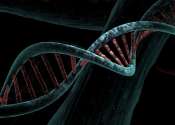
DNA
hideDeoxyribonucleic acid (DNA) is a nucleic acid that contains the genetic instructions used in the development and functioning of all known living organisms and some viruses. The main role of DNA molecules is the long-term storage of information. DNA is often compared to a set of blueprints or a recipe, or a code, since it contains the instructions needed to construct other components of cells, such as proteins and RNA molecules. The DNA segments that carry this genetic information are called genes, but other DNA sequences have structural purposes, or are involved in regulating the use of this genetic information.
Chemically, DNA consists of two long polymers of simple units called nucleotides, with backbones made of sugars and phosphate groups joined by ester bonds. These two strands run in opposite directions to each other and are therefore anti-parallel. Attached to each sugar is one of four types of molecules called bases. It is the sequence of these four bases along the backbone that encodes information. This information is read using the genetic code, which specifies the sequence of the amino acids within proteins. The code is read by copying stretches of DNA into the related nucleic acid RNA, in a process called transcription.
Within cells, DNA is organized into X-shaped structures called chromosomes. These chromosomes are duplicated before cells divide, in a process called DNA replication. Eukaryotic organisms (animals, plants, fungi, and protists) store most of their DNA inside the cell nucleus and some of their DNA in the mitochondria (animals and plants) and chloroplasts (plants only). Prokaryotes (bacteria and archaea) however, store their DNA in the cell's cytoplasm. Within the chromosomes, chromatin proteins such as histones compact and organize DNA. These compact structures guide the interactions between DNA and other proteins, helping control which parts of the DNA are transcribed.
For more information about DNA, read the full article at
Wikipedia.
This text uses material from Wikipedia and is available under the GNU Free Documentation License.
News tagged with dna strand
IBM Research Aims to Build Nanoscale DNA Sequencer (w/ Video)
Nanotechnology / Bio & Medicine
Oct 06, 2009 |
4.2 / 5 (11) |
4
(PhysOrg.com) -- In an effort to build a nanoscale DNA sequencer, IBM scientists are drilling nano-sized holes in computer-like chips and passing DNA strands through them in order to read the information contained ...
Rapid DNA Detection Quickly Diagnoses Infections
Nanotechnology / Bio & Medicine
Oct 05, 2009 |
4.8 / 5 (4) |
0
(PhysOrg.com) -- A new portable device can detect bacteria and help prevent the spread of infectious diseases. This new tool takes from 15 minutes to 2 hours to diagnose a patient for infectious diseases and ...
Putting the squeeze on sperm DNA
Sep 30, 2009 |
4.8 / 5 (4) |
0
(PhysOrg.com) -- In the quest for speed, olympic swimmers shave themselves or squeeze into high-tech super-suits. In the body, sperm are the only cells that swim and, as speed is crucial to fertility, have ...
DNA origami
Nanotechnology / Bio & Medicine
Sep 16, 2009 |
3.8 / 5 (5) |
0
Researchers from Brigham Young University found how to shape customized segments of DNA into tiny letters that spell "BYU." This new method of DNA origami will appear in the aptly titled journal Nano Letters.
Scientists Build Nanostructures out of Single DNA Strands
Nanotechnology / Bio & Medicine
(PhysOrg.com) -- With its unique double-helical structure, DNA has the ability to be used as a programmable building material to construct designer nanoscale architectures. Complex DNA architectures could ...
New reagents for genomic engineering of mouse models to understand human disease
Aug 19, 2009 |
5 / 5 (1) |
0
A new study published in Disease Models and Mechanisms, reports new tools for generating specifically targeted genetic mutations in bacteria, mammalian cells and mice. The new recombinase, Dre, is similar to its predecessor, Cre, b ...
Raising the alarm when DNA goes bad (w/ Video)
Aug 13, 2009 |
2 / 5 (1) |
1
Scientists have known for a long time that when DNA is damaged, a key enzyme sets off a cellular "alarm bell" to alert the cell to start the repair process, but until recently little was known about how the cell detects and ...
Nanoscale origami from DNA
Nanotechnology / Bio & Medicine
Aug 06, 2009 |
5 / 5 (8) |
2
Scientists at the Technische Universitaet Muenchen (TUM) and Harvard University have thrown the lid off a new toolbox for building nanoscale structures out of DNA, with complex twisting and curving shapes. ...
Scientists track impact of DNA damage in the developing brain
Medicine & Health / Neuroscience
Jul 27, 2009 |
5 / 5 (1) |
0
Switching off a key DNA repair system in the developing nervous system is linked to smaller brain size as well as problems in brain structures vital to movement, memory and emotion, according to new research led by St. Jude ...
DNA molecules can detect pathogens, deliver drugs
Nanotechnology / Bio & Medicine
May 20, 2009 |
5 / 5 (1) |
1
(PhysOrg.com) -- First, Cornell researchers created DNA "bar codes" -- strands of the genetic material that quickly identify the presence of different molecules by fluorescing. Now, they have created new DNA ...
Researchers create novel nanotechnique to sequence human genome
Nanotechnology / Bio & Medicine
Apr 15, 2009 |
5 / 5 (3) |
2
Since the human genome was sequenced six years ago, the cost of producing a high-quality genome sequence has dropped precipitously. More recently, the National Institutes of Health called for cutting the cost ...
Show me your DNA and I'll tell you your eye color
Mar 09, 2009 |
not rated yet |
0
More and more information is being gathered about how human genes influence medically relevant traits, such as the propensity to develop a certain disease. The ultimate goal is to predict whether or not a given trait will ...