Dog
hideThe dog (Canis lupus familiaris, pronounced /ˈkeɪ.nis ˈluːpəs fʌˈmɪliɛəris/) is a domesticated subspecies of the Gray Wolf, a member of the Canidae family of the order Carnivora. The term is used for both feral and pet varieties. The domestic dog has been one of the most widely kept working and companion animals in human history. Amongst canine enthusiasts, the word "dog" may also mean the male of a canine species, as opposed to the word "bitch."
The dog quickly became ubiquitous across culture in all parts of the world, and was extremely valuable to early human settlements. For instance, it is believed that the successful emigration across the Bering Strait might not have been possible without sled dogs. Dogs perform many roles for people, such as hunting, herding, protection, and, more recently, assisting handicapped individuals. Currently, there are estimated to be 400 million dogs in the world.
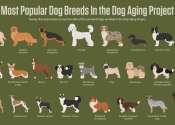
Over the 15,000 year span that the dog had been domesticated, it diverged into only a handful of landraces, groups of similar animals whose morphology and behavior have been shaped by environmental factors and functional roles. As the modern understanding of genetics developed, humans began to intentionally breed dogs for a wide range of specific traits. Through this process, the dog has developed into hundreds of varied breeds, and shows more behavioral and morphological variation than any other land mammal. For example, height measured to the withers ranges from a few inches in the Chihuahua to a few feet in the Irish Wolfhound; color varies from white through grays (usually called "blue'") to black, and browns from light (tan) to dark ("red" or "chocolate") in a wide variation of patterns; coats can be short or long, coarse-haired to wool-like, straight, curly, or smooth. It is common for most breeds to shed this coat, but non-shedding breeds are also popular.
For more information about Dog, read the full article at
Wikipedia.
This text uses material from Wikipedia and is available under the GNU Free Documentation License.
News tagged with dogs
Recovering with 4-legged friends requires less pain medication
Nov 16, 2009 |
not rated yet |
0
Adults who use pet therapy while recovering from total joint-replacement surgery require 50 percent less pain medication than those who do not. These findings were presented at the 18th Annual Conference of the International ...
Study says dogs have larger carbon footprint than SUV
Nov 04, 2009 |
2.3 / 5 (10) |
5
Thanks for killing the planet, dog owners. Well, that's a rough paraphrase of a New Zealand study that claims a medium-size dog leaves a larger ecological footprint than an SUV.
New clues to the Falklands wolf mystery
Nov 02, 2009 |
4.7 / 5 (3) |
0
Ever since the Falklands wolf was described by Darwin himself, the origin of this now-extinct canid found only on the Falkland Islands far off the east coast of Argentina has remained a mystery. Now, researchers ...
In combat zone, gastroenterologists put skills to test
Oct 26, 2009 |
not rated yet |
0
Most of today's gastroenterologists practice in relatively calm environments with patients of the same species. But for Dr. Leon Kundrotas and his colleagues working in Joint Base Balad, Iraq, the need to diagnose and treat ...
Microchips result in higher rate of return of shelter animals to owners
Oct 13, 2009 |
not rated yet |
0
Animals shelter officials housing lost pets that had been implanted with a microchip were able to find the owners in almost three out of four cases in a recently published national study.
Studying cancer in pet dogs to find new treatments for human patients
Oct 13, 2009 |
5 / 5 (1) |
0
A team of scientists at the National Cancer Institute (NCI) in Bethesda, USA, says that studying pet dogs with cancer could yield valuable information on how to diagnose and treat human cancers. In this week's PLoS Medicine, the te ...
Owners should count calories for obese pets, consider several factors for good health
Oct 08, 2009 |
1 / 5 (1) |
1
You might watch your daily calorie intake or glance over nutritional information on food packages, but do you do the same for your pet?
A new take on why social cues confuse babies and dogs in a classic hiding game
Medicine & Health / Psychology & Psychiatry
Sep 24, 2009 |
4.7 / 5 (3) |
3
A study by developmental scientists at the University of Iowa and Indiana University challenges the conclusions of two recent studies on how babies and dogs respond to certain social cues. The new findings, published in this ...
Vet says owners should exercise with their dogs based on specific needs to prevent obesity
Sep 08, 2009 |
not rated yet |
0
People and their dogs both need physical activity to fight obesity, and there are many exercises that owner and pet can do together that can improve their health and their relationship, according to a Kansas State University ...
Pups from 1st cloned dog to be distributed to public
Sep 03, 2009 |
not rated yet |
3
Puppies born from the world's first cloned dog will be offered to good homes later this year, South Korean researchers said on Thursday.
Cradle and birthday of dog identified
Sep 01, 2009 |
4.3 / 5 (3) |
0
Previous studies in the field have indicated that East Asia is where the wolf was tamed and became the dog. It was not possible to be more precise than that. But now researchers at the Royal Institute of Technology ...
SKorean cloning expert to re-create dogs for province
Aug 31, 2009 |
not rated yet |
0
South Korean scientist Hwang Woo-Suk plans to present two cloned dogs to one of the country's provinces to help it nurture a bio-technology industry, his research centre said Monday.
Why Obama's Dog Has Curly Hair? Study Finds 3 Dog Coat Genes
Aug 27, 2009 |
1 / 5 (2) |
0
(PhysOrg.com) -- University of Utah researchers used data from Portuguese water dogs - the breed of President Barack Obama's dog Bo - to help find a gene that gives some dogs curly hair and others long, wavy ...
Schools fight families over autism service dogs
Aug 21, 2009 |
5 / 5 (3) |
2
(AP) -- Like seeing-eye dogs for the blind, trained dogs are now being used to help autistic children deal with their disabilities. But some schools want to keep the animals out, and families are fighting ...
New insights into the 'smell of death' could help recover bodies in disasters and solve crimes
Chemistry / Analytical Chemistry
Aug 17, 2009 |
4.7 / 5 (3) |
1
In an advance toward the first portable device for detecting human bodies buried in disasters and at crime scenes, scientists today report early results from a project to establish the chemical fingerprint ...


