New research suggests that our universe has no dark matter
The current theoretical model for the composition of the universe is that it's made of normal matter, dark energy and dark matter. A new University of Ottawa study challenges this.
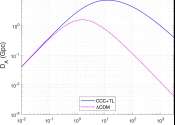
The current theoretical model for the composition of the universe is that it's made of normal matter, dark energy and dark matter. A new University of Ottawa study challenges this.
Astronomy
Mar 15, 2024
17
3641

A new study by researchers at Lanzhou University and Hubei University proposes a quantum battery (QB) charging scheme based on a rectangular hollow metal waveguide. This approach allows them to overcome environment-induced ...

Dark matter comprises more than 80% of all matter in the cosmos but is invisible to conventional observation, because it seemingly does not interact with light or electromagnetic fields. Now Dr. Sukanya Chakrabarti, the Pei-Ling ...
Astronomy
Feb 26, 2024
0
162

Within the next 15 years, NASA, China, and SpaceX plan to send the first crewed missions to Mars. In all three cases, these missions are meant to culminate in the creation of surface habitats that will allow for many returns ...
Space Exploration
Jan 31, 2024
0
48

Light, as an electromagnetic field, has two essential components: amplitude and phase. However, optical detectors, usually relying on photon-to-electron conversion (such as charge-coupled device sensors and the human eye), ...
Optics & Photonics
Jan 3, 2024
0
28

Physicists at the University of Duisburg-Essen and their cooperating partners have discovered that tiny graphene sheets can become electromagnets under infrared radiation. The study is published in the journal Nature Communications.
Nanophysics
Dec 4, 2023
1
64

Ever since the discovery of the Higgs boson in 2012, physicists have wanted to build new particle colliders to better understand the properties of that elusive particle and probe elementary particle physics at ever-higher ...
General Physics
Nov 3, 2023
8
547

Researchers in Germany and the U.S. have produced the first theoretical demonstration that the magnetic state of an atomically thin material, α-RuCl3, can be controlled solely by placing it into an optical cavity. Crucially, ...
Condensed Matter
Nov 3, 2023
1
950

Exquisite, never-before-seen details help unravel the supernova remnant's puzzling history.
Astronomy
Oct 30, 2023
0
254

For the first time ever, a NASA probe is journeying to an object composed not of rock, ice, or gas, but metal: the asteroid Psyche.
Planetary Sciences
Oct 12, 2023
0
57
The electromagnetic field is a physical field produced by electrically charged objects. It affects the behavior of charged objects in the vicinity of the field.
The electromagnetic field extends indefinitely throughout space and describes the electromagnetic interaction. It is one of the four fundamental forces of nature (the others are gravitation, the weak interaction, and the strong interaction). The field propagates by electromagnetic radiation; in order of increasing energy (decreasing wavelength) electromagnetic radiation comprises: radio waves, microwaves, infrared, visible light, ultraviolet, X-rays, and gamma rays.
The field can be viewed as the combination of an electric field and a magnetic field. The electric field is produced by stationary charges, and the magnetic field by moving charges (currents); these two are often described as the sources of the field. The way in which charges and currents interact with the electromagnetic field is described by Maxwell's equations and the Lorentz force law.
From a classical perspective, the electromagnetic field can be regarded as a smooth, continuous field, propagated in a wavelike manner; whereas, from a quantum mechanical perspective, the field is seen as quantised, being composed of individual particles.
This text uses material from Wikipedia, licensed under CC BY-SA
