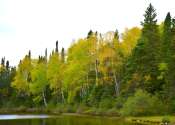
Forest

hide

A forest is an area with a high density of trees. There are many definitions of a forest, based on the various criteria. These plant communities presently cover approximately 9.4% of the Earth's surface (or 30% of total land area) in many different regions and function as habitats for organisms, hydrologic flow modulators, and soil conservers, constituting one of the most important aspects of the Earth's biosphere. Although a forest is classified primarily by trees a forest ecosystem is defined intrinsically with additional species such as fungi. A woodland, with more open space between trees, is ecologically distinct from a forest.

For more information about Forest, read the full article at Wikipedia.
This text uses material from Wikipedia and is available under the GNU Free Documentation License.


News tagged with forest

results timeline


Like humans, ants use bacteria to make their gardens grow

Like humans, ants use bacteria to make their gardens grow

Biology / Plants & Animals

created Nov 19, 2009 | popularity 5 / 5 (2) | comments 1

(PhysOrg.com) -- Leaf-cutter ants, which cultivate fungus for food, have many remarkable qualities.


New research provides insights into potential ecological costs and cobenefits of REDD

Space & Earth / Environment

created Nov 16, 2009 | popularity not rated yet | comments 0

A new paper just published in Global Change Biology examines the potential of a REDD (Reducing Emissions from Deforestation and Forest Degradation) mechanism to provoke ecological damage and/or promote ecological cobenefits. Such a ...


Cautious conservation: How to ensure that slowing global warming will protect biodiversity

Biology / Ecology

created Nov 16, 2009 | popularity not rated yet | comments 0

While it is clear that massive destruction of tropical rainforests poses a serious threat to the incredibly rich biodiversity found on Earth, other hazards are not so explicit. An international group of prominent scientists ...


Reducing greenhouse gases may not be enough to slow climate change

Space & Earth / Environment

created Nov 11, 2009 | popularity 3.3 / 5 (11) | comments 6

Georgia Tech City and Regional Planning Professor Brian Stone publishes a paper in the December edition of Environmental Science and Technology that suggests policymakers need to address the influence of global deforestation ...


Central Africa's tropical Congo Basin was arid, treeless in Late Jurassic

Space & Earth / Earth Sciences

created Nov 10, 2009 | popularity 4.3 / 5 (3) | comments 0

The Congo Basin -- with its massive, lush tropical rain forest -- was far different 150 million to 200 million years ago. At that time Africa and South America were part of the single continent Gondwana. The Congo Basin was ...


California's Ancient Kelp Forest

Biology / Ecology

created Nov 10, 2009 | popularity 4.8 / 5 (4) | comments 0

(PhysOrg.com) -- The kelp forests off southern California are considered to be some of the most diverse and productive ecosystems on the planet, yet a new study indicates that today's kelp beds are less extensive and lush ...


Researcher finds forest birds ‘commuting’ to attract mates

Researcher finds forest birds 'commuting' to attract mates

Biology / Ecology

created Nov 06, 2009 | popularity not rated yet | comments 0

(PhysOrg.com) -- An ecologist at the University of Rhode Island studying habitat use by a forest-dwelling game bird found that the birds unexpectedly exhibited what he described as "the bar scene phenomenon" ...


Researchers hail innovative plan to save rainforest, reduce greenhouse gas emissions

Space & Earth / Environment

created Nov 05, 2009 | popularity 2.3 / 5 (3) | comments 1

An innovative proposal by the Ecuadorian government to protect an untouched, oil rich region of Amazon rainforest is a precedent-setting and potentially economically viable approach, says a team of environmental researchers ...


Coral reefs inspire rare consensus -- just save them

Coral reefs inspire rare consensus -- just save them

Space & Earth / Environment

created Nov 05, 2009 | popularity 1 / 5 (1) | comments 0

One of the first set of studies to examine what tourists and recreation enthusiasts actually think about coral reef ecosystems suggests they are a rare exception to controversies over human use versus environmental ...


Timber harvest impacts amphibians differently during life stages

Timber harvest impacts amphibians differently during life stages

Biology / Ecology

created Nov 03, 2009 | popularity 2.5 / 5 (2) | comments 0

Frogs are croaking in clear-cut forests, but not exactly in their traditional manner. University of Missouri researchers found that removing all of the trees from a section of the forest had a negative effect ...


Wolves, moose and biodiversity: An unexpected connection

Wolves, moose and biodiversity: An unexpected connection

Biology / Ecology

created Nov 02, 2009 | popularity 4.9 / 5 (7) | comments 4

Moose eat plants; wolves kill moose. What difference does this classic predator-prey interaction make to biodiversity?


ARS Scientists Cryopreserve Pest-Imperiled Ash Trees

Scientists Cryopreserve Pest-Imperiled Ash Trees

Biology / Ecology

created Oct 28, 2009 | popularity 4.3 / 5 (4) | comments 0

(PhysOrg.com) -- Using cryopreservation methods, Agricultural Research Service (ARS) scientists have devised a procedure for storing frozen budwood from ash trees (Fraxinus) and thawing the delicate buds for ...


Sensing disasters from space

Sensing disasters from space

Space & Earth / Earth Sciences

created Oct 22, 2009 | popularity 5 / 5 (3) | comments 0

One small step for mankind is now a leap for averting natural and man-made disasters on earth.


Carbon-offsetting and conservation can both be winners in rainforest

Space & Earth / Environment

created Oct 20, 2009 | popularity 2 / 5 (1) | comments 0

Logged rainforests can support as much plant, animal and insect life as virgin forest within 15 years if properly managed, research at the University of Leeds has found.


Global warming may spur increased growth in Pacific Northwest forests

Biology / Ecology

created Oct 19, 2009 | popularity 1 / 5 (3) | comments 0

Global warming in the next century could cause a significant increase in the productivity of high-elevation forests of the Pacific Northwest, a new study suggests. However, forests at lower elevations - which in recent years ...